
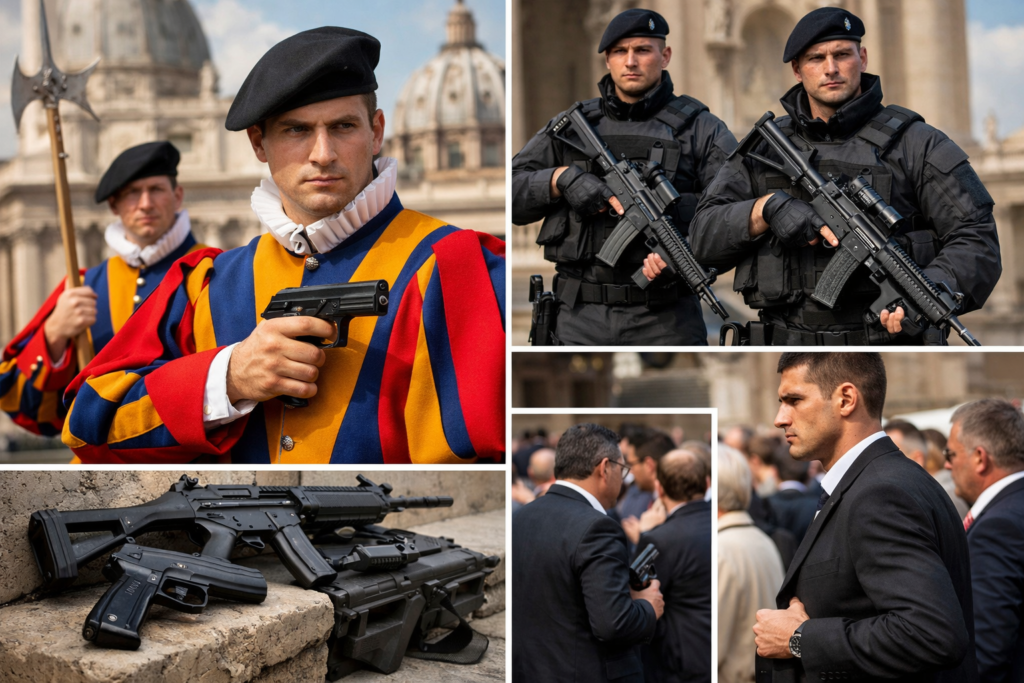
Image Credentials: Image Title: More Than a Costume: The Modern Combat Readiness of the Pontifical Swiss Guard Source: (sora.openai) Date: January 2025. Attribution: This image was created using AI-generated imagery (sora.openai) and does not depict a real-world scene.
By Open Chronicle Defense Desk | January 1, 2026
To the casual tourist standing in St. Peter’s Square, the Pontifical Swiss Guard appears to be a living relic of the Renaissance. Clad in vibrant, striped uniforms and carrying 16th-century halberds, they seem more like museum pieces than a military force. However, behind the “Michelangelo-style” aesthetic lies a highly trained, modern security unit capable of neutralizing contemporary threats with surgical precision.
The Uniform: A 20th-Century Recreation
Contrary to popular myth, the iconic “Tricolor” uniform (blue, red, and yellow) was not designed by Michelangelo. It is a 20th-century creation of Jules Repond, the Guard’s commanding officer from 1910 to 1921.
-
The Inspiration: Repond spent years studying 16th-century frescoes and depictions of the Guard during the Sack of Rome. In the 1920s, he introduced the current design, replacing the less-distinctive uniforms of the late 19th century.
-
Ceremonial Utility: While the uniform is synonymous with the Vatican’s identity, it is strictly ceremonial. For active tactical duties and night patrols, guardsmen wear a functional “service blue” uniform or plain clothes.
Behind the Halberd: Modern Weaponry
The halberd and the rapier are the Guard’s most visible tools, but they are not their primary weapons. In an era of asymmetric warfare and global terrorism, the Vatican’s defense relies on top-tier firearms.
-
Primary Armament: For daily security, guards are equipped with the SIG Sauer P226 semi-automatic pistol.
-
Tactical Gear: In the event of an elevated threat, the Guard has access to Heckler & Koch MP5 submachine guns and SIG SG 550 assault rifles, standard issue for many elite special forces worldwide.
-
Invisible Protection: While the colorful guards at the gates attract the cameras, plain-clothed guardsmen equipped with concealed firearms and earpieces are constantly monitoring the crowd and the Pope’s immediate vicinity.
Elite Training: From Tessin to the Vatican
The path to becoming a Swiss Guard involves rigorous training that bridges the gap between traditional soldiering and high-stakes police work.
-
Swiss Military Roots: Every guardsman must have completed basic training with the Swiss Armed Forces.
-
Specialized Combat: The Guard undergoes intensive tactical training with the Tessin (Ticino) police in Switzerland. This training occurs at the Isone barracks, the same facility where Swiss Army Grenadiers (Switzerland’s elite special forces) are forged.
-
Curriculum: This includes close-quarters combat (CQC), counter-terrorism tactics, VIP protection, and advanced marksmanship. They are trained to operate in the dense, high-traffic environment of the Vatican, where precision is paramount to avoid civilian casualties.
A Multi-Layered Defense
The Swiss Guard does not act alone. The safety of the Pope is a collaborative effort:
-
The Swiss Guard: Responsible for the Apostolic Palace and the Pope’s personal safety.
-
The Vatican Gendarmerie: The sovereign state’s civilian police force, responsible for general security and traffic.
-
Italian Inspectorate: The Italian State Police, who secure the perimeter of St. Peter’s Square.
| Feature | Ceremonial Mode | Tactical Mode |
| Uniform | Renaissance “Gala” Uniform | Blue Service Tunic / Plain Clothes |
| Primary Tool | Halberd / Rapier | SIG Sauer P226 / MP5 |
| Primary Goal | Tradition & Honor Guard | Counter-Terrorism & VIP Extraction |