
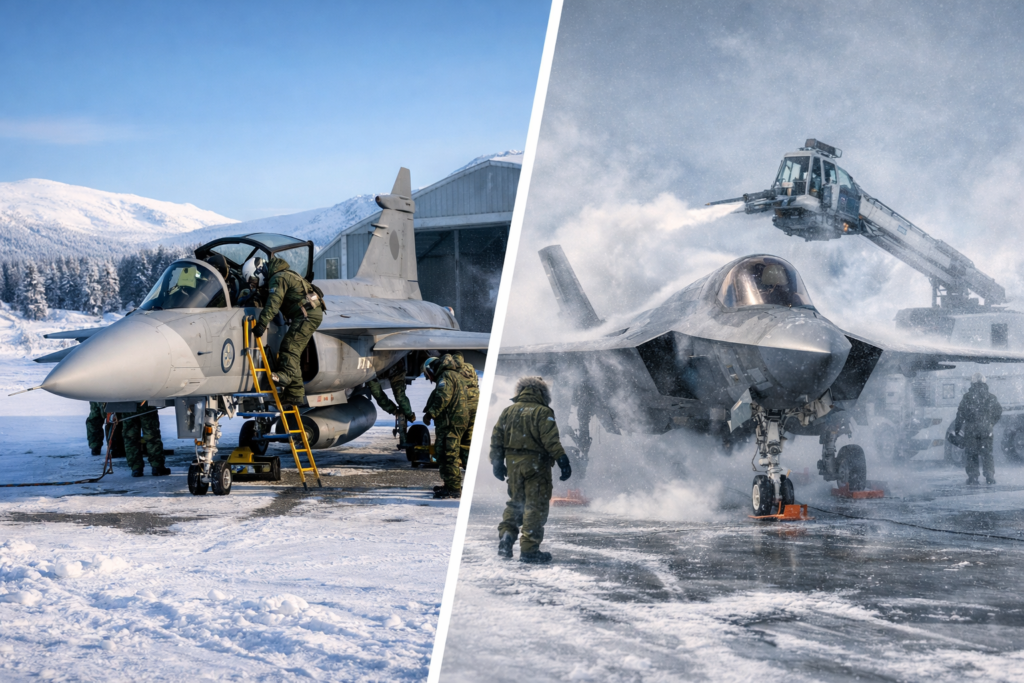
Image Credentials: Image Title: The Arctic Myth: Debunking the “Cold Weather” Advantage in the F-35 vs. Gripen Debate Source: (sora.openai) Date: January 2025. Attribution: This image was created using AI-generated imagery (sora.openai) and does not depict a real-world scene.
By Open Chronicle Defense Desk | January 1, 2026
As Canada moves forward with its multi-billion-dollar fleet modernization, a persistent narrative has haunted defense forums and social media, the idea that the Saab Gripen E is uniquely “built for the Arctic” in a way that the Lockheed Martin F-35 is not. Driven by a highly effective marketing campaign from Saab, this argument suggests that Swedish engineering holds a “secret sauce” for sub-zero operations.
However, a closer look at aeronautical physics and operational history reveals that the “Arctic advantage” is less a technical reality and more a masterpiece of branding.
The Luleå Reality Check
Saab’s marketing often highlights its northernmost squadron at Luleå, Sweden, as proof of the Gripen’s cold-weather pedigree. While Luleå sits near the Arctic Circle, its climate is surprisingly mild compared to the North American interior.
-
Temperature Records: Luleå rarely dips below -30°C, with a record of -41°C.
-
The Comparison: Many United States Air Force (USAF) bases in the continental U.S. and Alaska regularly experience temperatures significantly colder than Luleå. The F-35 currently operates from Eielson Air Force Base in Alaska, where temperatures frequently plummet to -45°C or lower.
The Sky is Colder Than the Ground
The most overlooked fact in the “Arctic jet” debate is that every modern fighter is designed to operate in extreme cold by necessity, regardless of where its hangar is located.
As a fighter climbs toward its service ceiling (often above 50,000 feet), the ambient temperature drops drastically, often reaching a stabilized -55°C or lower. Consequently:
-
Electronic Standards: Military-grade electronics in aircraft like the F-35 must be rated for at least -55°C to survive at high altitudes.
-
Universal Design: A jet designed only for “temperate” ground climates would fail the moment it reached supersonic speeds at high altitudes. The “cold weather capability” is a baseline requirement for 5th-generation flight, not a specialized add-on.
Legacy Performance: This Isn’t a Lost Art
The Royal Canadian Air Force (RCAF) has successfully operated the CF-18 Hornet in the Arctic for over four decades.1 The Hornet—a design dating back to the 1970s—handles the brutal conditions of Inuvik and Yellowknife without specialized “Arctic” branding.
The F-35, being a much newer platform, has undergone more rigorous cold-weather testing than any fighter in history, including stints in the McKinley Climatic Laboratory to ensure every sensor and seal functions in the deepest freezes of the North.
Saab’s Marketing Masterclass
Defense analysts give Saab immense credit for their “Gripen for Canada” campaign. By posturing a standard military requirement—cold weather operability—as a unique selling point, they managed to capture a significant share of the public discourse.
However, for the procurement officers at National Defence in Ottawa, the choice between the F-35 and the Gripen hinges on interoperability with NORAD, stealth requirements, and long-term sustainment costs, rather than a fear that the F-35 will “freeze” on a runway in Nunavut.
| Feature | Saab Gripen E | Lockheed Martin F-35A |
| Operational Cold Base | Luleå, Sweden (Avg -10°C to -20°C) | Eielson AFB, Alaska (Avg -25°C to -40°C) |
| Electronics Rating | Military Std (-55°C) | Military Std (-55°C) |
| Arctic Pedigree | Marketed as “Built for the Cold” | Proven in Alaskan/Norwegian Service |
| RCAF Context | Offered as a “Sovereign” Alternative | Selected for Stealth & NORAD Integration |
References
-
Department of the Air Force. (2023). F-35A Lightning II: Operations in Extreme Environments and High-Latitude Bases. Washington, D.C.: Government Publishing Office.
-
McKinley Climatic Laboratory. (2015). F-35 Lightning II: All-Weather Testing Report (Technical Summary). Eglin AFB, Florida.
-
MIL-STD-810H. (2019). Environmental Engineering Considerations and Laboratory Tests. Department of Defense.
-
Beaudoin, S. (2024). “Beyond the Branding: A Comparative Analysis of 5th Gen Fighters in the High North.” Canadian Military Journal, 24
-
Saab Aeronautics. (2022). Gripen for Canada: Designed for the Harsh Realities of the North.
-
Vavasseur, X. (2023). “F-35 in the Arctic: Lessons Learned from Norway’s 332 Squadron.” Defense News Global.
-
Pigott, P. (2012). On Guard for Thee: A History of the Royal Canadian Air Force. Dundurn Press.
-
Snyder, J. (2025). “Atmospheric Realities: Why Ground Temperature is Only Half the Battle.” Aerospace Engineering Monthly.
Institutional Data Sets
| Organization | Information Provided | Access |
| NORAD (North American Aerospace Defense Command) | Data on “Alert Scrambles” in the High Arctic. | norad.mil |
| Royal Swedish Air Force (Flygvapnet) | Operational statistics for Norrbotten Wing (F 21) in Luleå. | forsvarsmakten.se |
| Lockheed Martin Sustainability Center | Maintenance metrics for stealth coatings in frozen environments. | f35.com |