
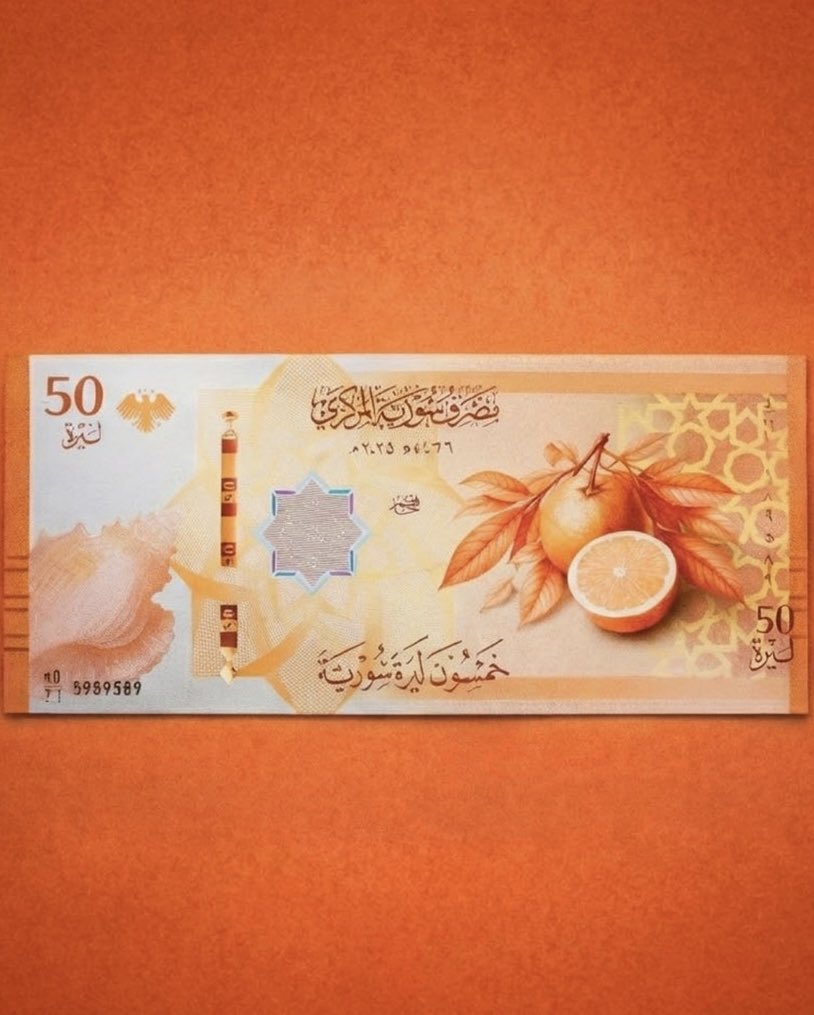
Image: from Pulse Nigeria X@PulseNigeria247
DAMASCUS — One year after the collapse of the Bashar al-Assad regime, the transitional government of the Syrian Arab Republic has taken its most significant step toward financial sovereignty. On Thursday, the Central Bank of Syria officially launched a new national currency, a move designed to curb hyperinflation and restore global confidence in an economy ravaged by 14 years of war and isolation.
Central Bank Governor Abdulkader Husrieh announced the “redenomination” of the Syrian pound during a press conference in the capital, framing the move as a clean break from the financial chaos of the previous era.
Syrian President Ahmed al Sharaa and Central Bank Governor Abdul Qader Husariya unveiled new banknotes in Damascus on December 29, without any Assad portraits
The currency was redenominated as part of broader economic reforms following the ousting of the Assad regime in December… pic.twitter.com/k9rpdDFDNp
— TRT World (@trtworld) December 30, 2025
The “Two-Zero” Reset
The centerpiece of the reform is the removal of two zeros from the national currency. Under the transition plan:
-
The Conversion: Every 100 “old” Syrian pounds will be exchanged for one unit of the “new” Syrian Arab Republic pound.
-
Automatic Adjustment: Bank balances were converted automatically at the start of 2026.
-
Transition Period: A 90-day window has been established during which both the old and new notes will circulate simultaneously to prevent market shocks.
Governor Husrieh emphasized that while the nominal value of the notes is changing, the overall money supply remains unchanged, a strategy aimed at preventing further inflationary pressure. To protect citizens, the exchange is being conducted free of all fees, taxes, or commissions.
Syria unveils new currency:
• Zeroes removed to simplify transactions
• Assad portraits replaced with local nature/produce, echoing ancient trade
• 6 denominations:
10 Damask rose
25 mulberry
50 orange/coast
100 cotton/gazelle
200 olive/horse/north
500 birds/crops/east/south pic.twitter.com/lfPEXjI0fM— Hassan I. Hassan (@hxhassan) December 29, 2025
Five Pillars of Recovery
The currency launch is part of a broader “National Recovery Plan” championed by the administration of President Ahmed al-Sharaa. The strategy rests on five fundamental goals:
-
Monetary Stability: Implementing strict financial discipline to halt the pound’s slide.
-
Forex Regulation: Establishing a stable and transparent foreign exchange market.
-
Institutional Integrity: Rebuilding effective and corruption-free financial institutions.
-
Digital Transformation: Modernizing the nation’s outdated digital infrastructure.
-
International Relations: Normalizing economic ties to lift the weight of long-standing sanctions.
Modernizing a Ruined System
Decades of war and the heavy hand of the previous dictatorship left Syria’s financial infrastructure in tatters. Husrieh acknowledged that the road ahead is steep, noting that current financial laws are outdated and data systems remain weak.
To combat the rampant counterfeiting that plagued the war years, the new banknotes are being printed by leading international companies abroad, utilizing state-of-the-art security features. “Our policy is financial discipline,” Husrieh told reporters. “There is no room for inflation in this new chapter.”
A Growing Glimmer of Hope
Despite the hurdles, there are signs of an early “peace dividend.” As millions of refugees continue to return home following the end of the conflict, the Syrian economy is reportedly outperforming initial projections. While the World Bank had forecast a modest 1% growth for 2025, Husrieh noted that early indicators for 2026 show a faster trajectory as reconstruction begins in earnest.
For the people of Syria, the new banknotes are more than just paper; they represent a bid for normalcy after a decade and a half of historic lows in living standards. The success of the “New Pound” will be the ultimate litmus test for the Sharaa administration’s ability to transition from a war footing to a stable, modern state.