
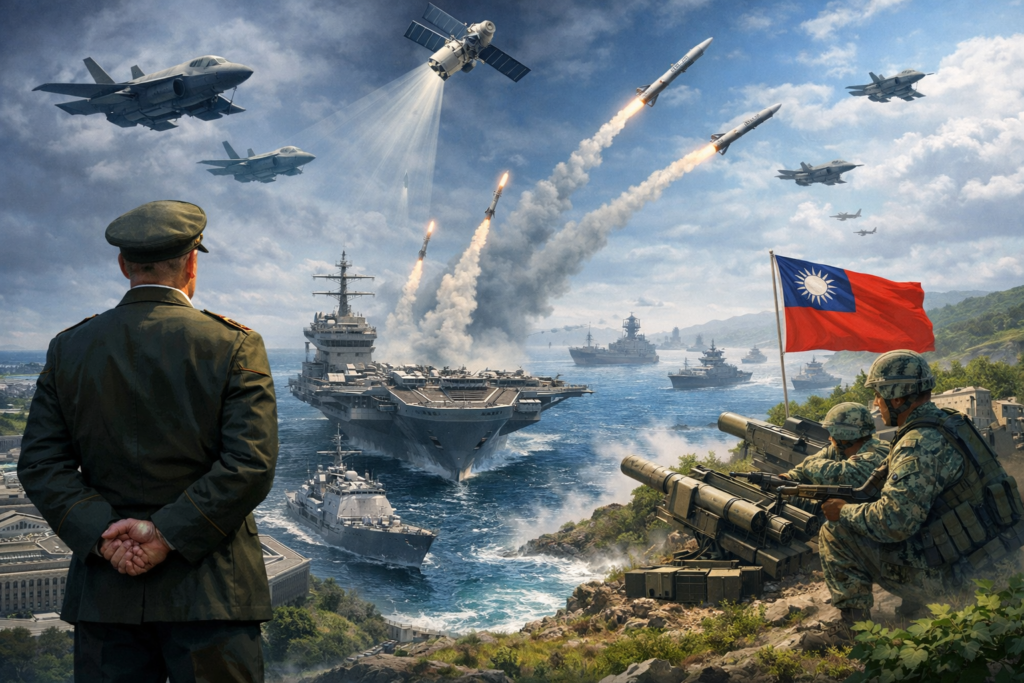
Image Credentials: Image Title: “No Boots on the Ground”: Former Pentagon Official Outlines US Strategy for Defending Taiwan Source: (Gemini) Date: January 2026. Attribution: This image was created using AI-generated imagery (Gemini) and does not depict a real-world scene.
By Open Chronicle News Desk | January 2, 2026
TAIPEI — In a revealing interview that clarifies the likely military response to a Cross-Strait conflict, former U.S. Defense Department official Tony Hu (胡振東) asserted that the United States would not need to land troops in Taiwan to successfully repel a Chinese invasion. Instead, the U.S. strategy would focus on turning the Taiwan Strait into a “hellscape” from the surrounding seas and skies.
Speaking with CTS, Hu explained that while the U.S. is committed to Taiwan’s survival, the presence of American ground forces would likely prove counterproductive during the initial stages of a conflict.
前美國空軍首席分析師
胡振東(Tony Hu)直言
台灣的防禦實力
在全球來看絕對是首屈一指‼️
引用片源:Taiwan Plus pic.twitter.com/PEs4kLxwco
— 𝓣𝓸𝓪𝓷𝓷𝓮 ღˇ◡ˇ) (@IDMTBR) January 1, 2026
The “Flank” Strategy: Defense from Afar
Hu’s core argument is that Taiwan possesses sufficient “layered defenses” to manage its own land and air territory, provided its flanks are secured by allies.
-
The Staging Grounds: U.S. forces stationed at bases in the Philippines and Japan would move closer to Taiwan to intercept threats before they reach the island.
-
Allied Coordination: Forces from Australia and Japan would join the U.S. in securing the maritime and aerial peripheries, allowing Taiwan’s military to focus entirely on defending the Strait itself.
-
The Liaison Team: The only foreign “boots on the ground” would likely be a small coordination team of 20–30 personnel stationed at Taiwan’s command center to synchronize joint operations.
“When people say, ‘The United States is not going to come to Taiwan,’ you’re right. We’re not going to come to Taiwan, but we will be around Taiwan to help protect Taiwan,” Hu explained.
The Geography of Attrition: “Hellscape” in the Strait
Hu highlighted a fundamental difference between the war in Ukraine and a potential invasion of Taiwan: the lack of cover. Unlike the wooded terrain of Eastern Europe, the 100-mile-wide Taiwan Strait offers no concealment for an invading fleet.
-
Two-Month Threshold: Hu predicted that the People’s Liberation Army (PLA) could not sustain a high-intensity attack for more than two to three months.
-
The 40% Rule: Once the PLA sustains an attrition rate of 30% to 40% and loses its major surface vessels, the maritime crossing becomes unsustainable.
-
Stinger Threat: Any airborne or helicopter-borne assaults would face thousands of Stinger missiles operated by Taiwanese forces who could strike from “behind any tree.”
The Stakes: Why the U.S. Must Intervene
According to Hu, the defense of Taiwan is not just about the island itself, but about the survival of the global international order. If the U.S. fails to help Taiwan survive, the consequences for American interests would be catastrophic:
-
Collapse of Prestige: U.S. influence in the Asia-Pacific would drop to “zero.”
-
Nuclear Proliferation: U.S. allies would likely develop their own nuclear weapons to ensure their survival.
-
Strategic Retreat: Nations like Malaysia, Vietnam, and the Philippines would align with Beijing, forcing U.S. forces to retreat back to Guam and Hawaii.
-
Economic Fallout: The regional economic importance to the U.S. makes a withdrawal untenable.
Comparison: Ukraine vs. Taiwan Conflict Scenarios
| Factor | Ukraine (Land Border) | Taiwan (Maritime Strait) |
| Concealment | High (Forests, Hills, Urban) | Zero (Open Water) |
| Troop Logistics | Continuous Land Resupply | High-Risk Amphibious Crossing |
| U.S. Troop Presence | Strategic Ambiguity/NATO Flank | Off-shore Naval/Aerial Shield |
| Survival Window | Long-term War of Attrition | 2–3 Month Decisive Window |
A Specialized Defense
Tony Hu’s insights suggest that the U.S.-Taiwan defense partnership is evolving toward a high-tech, remote-access model. By providing a protective shield around the island rather than placing troops on it, the U.S. aims to maximize its military efficacy while minimizing the logistical and political friction of a foreign military presence in Taipei.