
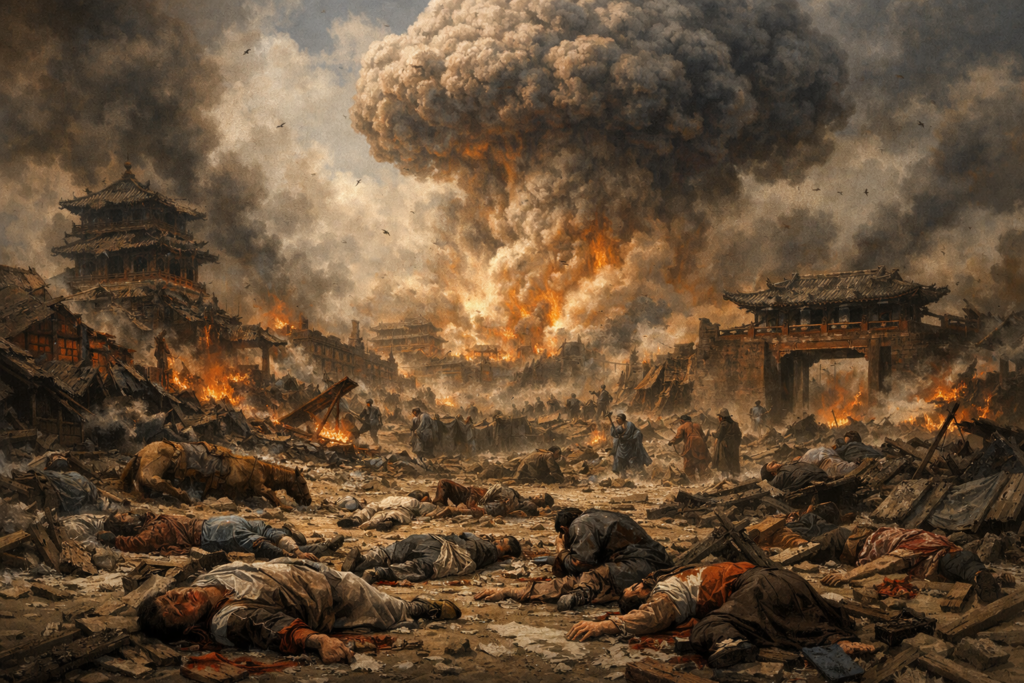
Image Credentials: Image Title: The Hiroshima of Old China: The Unsolved Mystery of the Wanggongchang Explosion Source: (sora.openai) Date: January 2026. Attribution: This image was created using AI-generated imagery (sora.openai) and does not depict a real-world scene.
By Open Chronicle History Desk | January 2, 2026
BEIJING — In the spring of 1626, a catastrophe of unimaginable proportions turned the Ming Dynasty capital into a wasteland. Known to history as the Wanggongchang Explosion, this event remains one of the deadliest and most mysterious “peacetime” disasters ever recorded. With a force comparable to a modern nuclear weapon, the blast killed over 20,000 people and left a scar on Chinese history that remains unhealed nearly 400 years later.
The Epicenter: A Powder Keg in the Palace Shadows
During the early 17th century, the Ming Empire was locked in a desperate arms race with the Manchus to the north. To defend the realm, the Ministry of Public Works operated several high-capacity armories within Beijing’s city walls.
The Wanggongchang Armory was a critical hub, staffed by 70 to 80 workers who manufactured and stored:
-
Black Powder: Massive quantities of early explosives.
-
Heavy Artillery: Cannons based on Portuguese designs.
-
Bladed Weapons: Thousands of arrows and swords.
Because the armory was located in the densely populated southwest district of the capital, the stage was set for a disaster of unprecedented scale.
The Blast: 20,000 Tons of TNT
At approximately 9:00 AM on May 30, 1626, the morning calm was shattered. A plume of smoke rose from the armory, followed by a shockwave so powerful that it was heard beyond the Great Wall, over 150 kilometers away.
-
The Shockwave: Nearly everything within a 2-square-kilometer radius was vaporized. The earth trembled 40 kilometers away in Tongzhou, leading many to believe a massive earthquake had struck.
-
The “Mushroom Cloud”: Contemporary accounts describe an enormous cloud in the shape of a “reishi mushroom” or a “rotating pillar” rising into the sky, a description eerily similar to the nuclear clouds of the 20th century.
-
The Fallout: Debris rained down across a 30-kilometer radius. One account claims a 5,000-pound stone statue was launched into the air and deposited miles away. Survivors reported a gruesome “rain” of body parts, noses, ears, and limbs, falling from the sky.
The “Unclothed” Victims
One of the strangest details recorded by Ming officials was the state of the casualties. Thousands of victims were found miles from the epicenter, completely uninjured by the fire, but stripped entirely of their clothing. Their bodies were reportedly covered in a “strange residue.”
This phenomenon has baffled investigators for centuries. In modern physics, this is sometimes attributed to a pressure vacuum or a high-velocity wind strip, though in 1626, it was seen as a supernatural or “Heaven-sent” omen.
Theories: What Caused the Disaster?
Historians and scientists have debated the cause for centuries, with a major academic conference held in 1986 to evaluate the evidence.
| Theory | Probability | Evidence / Supporting Argument |
| Gunpowder Accident | High | Massive stores of black powder were on-site; poor safety standards. |
| Earthquake & Gas | Medium | The 1986 conference concluded that an earthquake released flammable gases. |
| Super Tornado | Medium | A 2013 study argued that a tornado explains the “stripped clothing” and flying debris. |
| Meteorite Strike | Low | Explains the atmospheric intensity but lacks a distinct crater. |
| Nuclear/Extra-terrestrial | Outlandishly Low | Conspiracy theories citing the mushroom cloud and high TNT equivalence. |
Political Aftermath: The Mandate of Heaven
For the Tianqi Emperor, the explosion was a political death knell. In Chinese tradition, such a disaster in the capital was interpreted as a sign of Heaven’s Displeasure with the ruling monarch.
The Emperor, an eccentric man who preferred carpentry to governing, was already under fire for allowing the corrupt eunuch Wei Zhongxian to seize power. Critics from the Donglin Academy used the explosion to argue that the Emperor’s “Mandate of Heaven” had been revoked.8 The destabilization caused by the blast arguably contributed to the eventual collapse of the Ming Dynasty two decades later.
Statistical Summary of the Wanggongchang Explosion
-
Casualties: 20,000+ fatalities.
-
Energy Release: Estimated 10–20 Kilotons of TNT.
-
Audibility: 150 km (Beyond the Great Wall).
-
Destruction Zone: 2.0 km² (Complete obliteration).
-
Debris Radius: 30 km.
References
-
Official Gazettes of the Ming Dynasty (Ming Shilu – 明實錄).
The primary imperial record which documents the Tianqi Emperor’s reaction to the blast, the damage to the city gates, and the subsequent relief efforts.
-
Dihao, Sun. Biwen Shiji (Notes on the Catastrophe).
A contemporary eyewitness account that describes the “mushroom-shaped” cloud, the raining of body parts, and the strange phenomenon of victims being stripped of their clothes.
-
The Peking Gazette (1626 Editions).
One of the world’s oldest newspapers, which reported on the explosion to the scholar-official class throughout the empire.
Modern Scientific & Academic Studies
-
Zhaoshen, Xu. (1986). “Proceedings of the Wanggongchang Explosion Conference.” Beijing Institute of Geology.
The definitive collection of papers from the 1986 symposium where experts in ballistics, geology, and history debated the TNT equivalence and the earthquake-gas ignition theory.
-
Li, J., & Wang, Y. (2013). “A Meteorological Re-evaluation of the 1626 Beijing Disaster.” Journal of Historical Natural Disasters.
This study proposes the “Super Tornado” hypothesis to explain the localized vacuum effects and the transport of heavy stone statues over long distances.
-
Naquin, Susan. Peking: Temples and City Life, 1400–1900. University of California Press, 2000.
Provides the broader urban context of the Wanggongchang district, its industrial role, and the social impact of the disaster on the capital’s population.
Comparative Ballistics & Explosives Data
| Source | Subject Matter | Key Data Point |
| U.S. Defense Threat Agency | Black Powder Yields | Analysis of 17th-century potassium nitrate purity vs. explosive force. |
| Seismological Society of China | 1626 Seismic Records | Confirmation of the shockwave intensity felt 150km away at the Great Wall. |
| History of Science Society | Ming Military Tech | The evolution of “Great General” cannons and the storage of bulk propellant in urban centers. |
Political & Theological Analysis
-
Brook, Timothy. The Troubled Empire: China in the Yuan and Ming Dynasties. Harvard University Press, 2010.
Explores the “Mandate of Heaven” and how the Donglin Academy used the explosion as political ammunition against the Eunuch faction.
-
Wakeman Jr., Frederic. The Great Enterprise: The Manchu Reconstruction of Imperial Order in Seventeenth-Century China.
Contextualizes the explosion as a destabilizing precursor to the eventual Manchu (Qing) conquest of Beijing.