
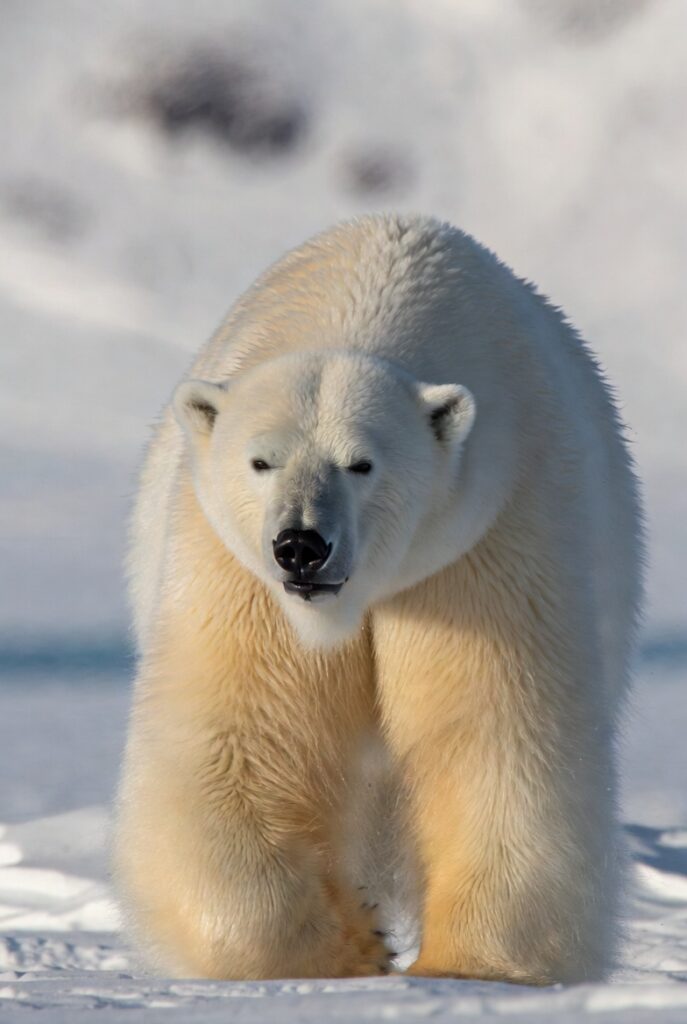
Image Credentials: Image Title: Polar Bear Attack Injures Family in Remote Arctic Russia Source: (Grok) Date: January 2026. Attribution: This image was created using AI-generated imagery (Grok) and does not depict a real-world scene.
By Open Chronicle News Desk with Agencies
Three members of the same family, including a child, were injured after a rare polar bear attack in the far north of Siberia, Russian authorities confirmed on Monday, underscoring growing concerns about human wildlife encounters in the rapidly warming Arctic.
According to the regional interior ministry, local police received an emergency report from a fishing site located around 40 kilometers from the village of Nosok, in Russia’s Krasnoyarsk region. The area lies well inside the Arctic Circle and is sparsely populated, with long distances separating settlements.
Officials said the victims were born in 1983, 2006, and 2015, indicating that the injured included two adults and a child. The family was quickly evacuated from the area and received immediate medical assistance. While authorities did not specify the severity of the injuries, they confirmed that at least one of the victims may require hospitalization.
Nosok is situated in one of Russia’s most remote Arctic zones, where encounters with polar bears remain highly unusual. Experts emphasize that attacks on humans are extremely rare, as polar bears typically avoid people. However, scientists increasingly warn that environmental pressures are altering animal behavior across the Arctic.
Shrinking sea ice, driven by accelerating climate change, is reducing polar bears’ access to their natural hunting grounds. As a result, the animals are being pushed closer to coastal communities and human activity in search of food. According to a report released last month by the U.S. National Oceanic and Atmospheric Administration, Arctic temperatures have been rising at more than twice the global average rate since 2006, dramatically reshaping ecosystems across the region.
The incident in Siberia is part of a troubling pattern of recent encounters between polar bears and humans across the Arctic. In August 2024, two polar bears attacked and killed a worker at a remote government radar installation in the Canadian Arctic. Four months later, a man in Northern Ontario was seriously injured while attempting to defend his wife during another attack.
In 2023, a polar bear killed a woman and her young son in Wales, Alaska, marking the first fatal polar bear attack in the state in three decades. Alaska remains the only U.S. state that is home to polar bears.
Wildlife experts warn that without significant action to address climate change and improve safety measures in Arctic regions, such incidents may become more frequent. For now, authorities in Krasnoyarsk have not indicated whether additional measures will be taken near Nosok, but the attack has reignited debate over how communities and governments should respond to the changing realities of life in the Arctic.