
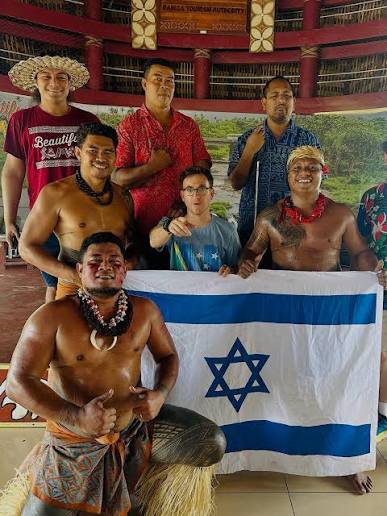
Image: from Mossad Commentary X@MOSSADil
By Open Chronicle News Desk with Agencies | January 9, 2026
Samoa’s plan to open an embassy in Jerusalem is reshaping its foreign policy profile and placing the small Pacific island nation at the center of one of the world’s most sensitive diplomatic disputes.
Prime Minister Laauli Leuatea Schmidt announced this week that his government has instructed the Ministry of Foreign Affairs to begin preparations for a Samoan embassy in Jerusalem later this year. The declaration was made during a special prayer event held in support of Israel, where Israeli and Samoan flags were displayed alongside Christian leaders. Schmidt said Samoa would follow the example set by Fiji and Papua New Guinea, two Pacific nations that have already established embassies in the city.
Israel has strongly encouraged countries to recognize Jerusalem as its capital by locating their embassies there. At present, only seven nations have done so, namely the United States, Honduras, Guatemala, Kosovo, Papua New Guinea, Paraguay, and Fiji. Argentina has also announced plans to move its embassy to Jerusalem in the coming months. Samoa’s decision, if carried out, would place it among a small group of states willing to take a position that remains highly controversial in international diplomacy.
The Pacific Island nation of Samoa will open an embassy in Jerusalem this year, the country’s prime minister told Christian leaders this week.
The news comes on the heels of similar moves by fellow Oceania nations, including Fiji, which inaugurated an embassy in Jerusalem in… pic.twitter.com/CVP4fqC8uv
— Australian Jewish Association (@AustralianJA) January 8, 2026
Jerusalem’s status lies at the heart of the Israeli-Palestinian conflict. While Israel considers the city its capital, Palestinians claim East Jerusalem as the capital of a future Palestinian state. Because of this dispute, most countries keep their embassies in Tel Aviv to avoid taking sides. Moves to open embassies in Jerusalem are therefore viewed internationally as an implicit endorsement of Israel’s claims over the entire city.
Schmidt’s support for Israel is rooted not only in diplomacy but also in religion and ideology. Since taking office in September, the Christian Democratic Party leader has repeatedly emphasized Samoa’s spiritual connection to Israel. He has said that Samoa’s founding leaders embraced what he called the God of Israel and believed that nations blessed the Jewish people would themselves be blessed. “Diplomatically, religiously and culturally, we stand with Israel,” Schmidt said after being sworn in.
Samoa, which has a population of about 220,000, gained independence in 1962 and established diplomatic relations with Israel in 1977. Although several Pacific island nations maintain close ties with Israel and frequently vote alongside Israel and the United States at the United Nations, Samoa has not traditionally been one of Israel’s most reliable supporters. The embassy announcement, therefore, marks a notable shift in its foreign policy.
The move has been welcomed by Israeli officials, who see it as another diplomatic gain at a time when Israel faces increasing scrutiny over the future of Jerusalem and the broader Middle East conflict. For Israel, each additional embassy in Jerusalem strengthens its claim that the city is its rightful capital.
However, the decision has also triggered criticism among Samoans, particularly in the diaspora. Kenty Masinalupa, a Samoan activist based in Australia, said the move was deeply troubling given Samoa’s own history of resisting colonial domination. She argued that aligning with Israel’s position on Jerusalem contradicts the values of self-determination and freedom that Samoans fought for during their struggle for independence.
“Our ancestors fought for our freedom and independence,” she said. “In that context, this decision feels like a step backward.”
As preparations move forward, Samoa now faces a balancing act between religious conviction, diplomatic alliances, and the sensitivities of a divided international community. Whether the embassy ultimately opens or encounters political resistance, the announcement has already ensured that this small Pacific nation will play an unexpectedly visible role in one of the world’s most enduring geopolitical disputes.