
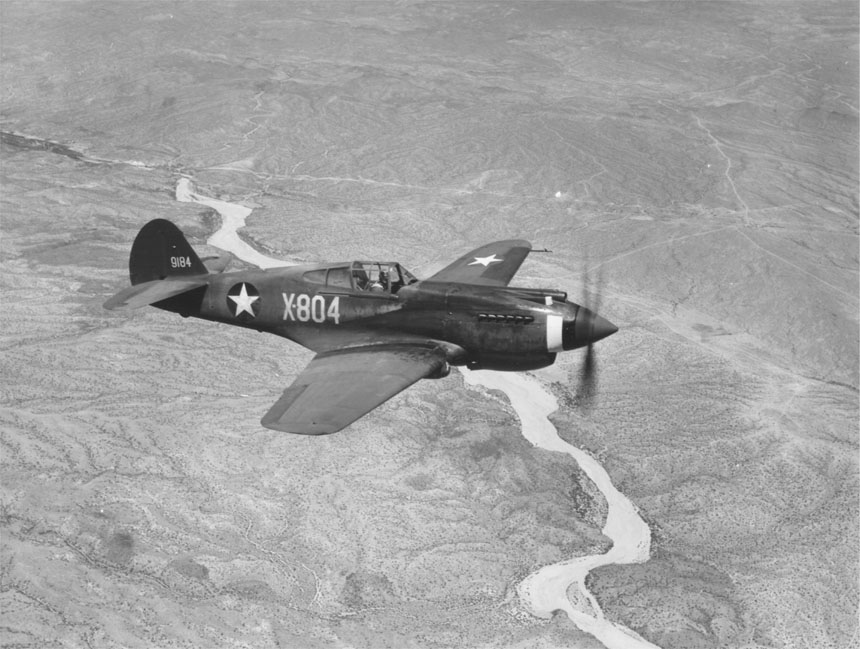
Image: A three-quarter view of a P-40B, X-804 (s/n 39-184) in flight. This aircraft served with an advanced training unit at Luke Field, Arizona. By U.S. Army (The U.S. Air Force was part of the U.S. Army during World War II, so the Army handled the air duties during that time) – http://afhra.maxwell.af.mil/photo_galleries/aaf_wwii_vol_vi/Captions/023_P-40.htm, Public Domain, (Wikipedia)
By Open Chronicle History Desk | January 9, 2026
In the early, uncertain days of World War II, when the Allied air forces faced a desperate fight for survival, it wasn’t the sleek P-51 Mustang or the agile Supermarine Spitfire that made the difference; it was the Curtiss P-40 Warhawk. While critics often focus on its modest speed or low-altitude performance, the P-40’s true strength lay in its simple, pragmatic reliability: it was there when it was needed.
After the attacks on Pearl Harbor and across North Africa in 1941, the Allies required fighters that could take to the skies immediately. The P-40, already in mass production, provided that lifeline. Serving the United States, Britain, Australia, and China, the Warhawk became the indispensable “stopgap,” holding the line long enough for the “Arsenal of Democracy” to develop and deploy the next generation of high-performance aircraft.
Beneath its unassuming profile, the P-40 featured a robust five-spar wing design, granting structural strength rare for its class. This durability allowed pilots to execute maneuvers that might have destroyed more delicate airframes. In North Africa, RAF pilots discovered that the P-40 could compete with the Messerschmitt Bf 109 at mid-altitudes, trading speed for energy retention in dogfights.
Against Japan’s nimble Zero fighters, the P-40 could not match turning agility, yet its pilots innovated. Using “Boom and Zoom” tactics, they exploited the Warhawk’s high diving speed and durability to strike from altitude and evade counterattacks. In this way, the aircraft’s limitations became a platform for tactical creativity, allowing pilots to survive and inflict damage against superior opponents.
By the war’s later stages, improved engines and superchargers brought the P-40 closer in performance to early P-51 Mustangs. However, by then, the Warhawk had already fulfilled its most critical role: it carried the brunt of the war until more advanced fighters could arrive. Its legacy endures not in speed or maneuverability, but in steadfastness and reliability under fire.
The Curtiss P-40 Warhawk demonstrated that availability and durability can outweigh raw performance. It was a workhorse that shouldered the burden of early Allied air campaigns, proving that sometimes, being ready is the greatest weapon of all.
Bibliography
- Bird, Keith. Curtiss P-40 Warhawk: The Complete History of the Fighter Aircraft of the Second World War. London: Crowood Press, 2019.
- Drendel, Lou. P-40 Warhawk in Action. Carrollton, TX: Squadron/Signal Publications, 2001.
- Green, William, and Gordon Swanborough. The Great Book of Fighters. St. Paul, MN: MBI Publishing, 2001.
- Hardesty, Von. Red Tail Captured, Red Tail Free: The Story of the Tuskegee Airmen and the Curtiss P-40 Warhawk. New York: McGraw-Hill, 2012.
- Jablonski, Edward. Airwar, 1939–1945: The Official History of the Allied Air Forces in World War II. New York: Crown Publishers, 1972.
- Wheatley, Richard. P-40 Warhawk Aces of the Pacific and CBI. Oxford: Osprey Publishing, 2014.