
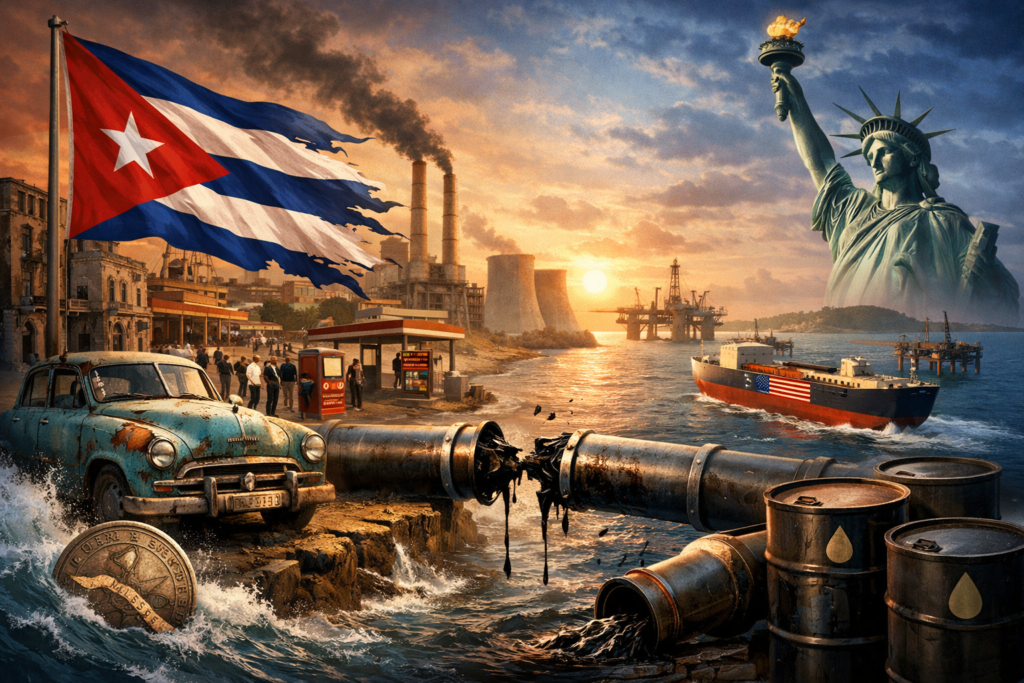
Image Credentials: Image Title: Island on the Brink: Assessing the Impact of the U.S. Oil Cutoff on Cuba’s Economy Source: (sora.openai) Date: January 2026. Attribution: This image was created using AI-generated imagery (sora.openai) and does not depict a real-world scene.
By Open Chronicle News Desk Staff with Agencies
HAVANA / WASHINGTON — The recent declaration by the Trump administration to halt all Venezuelan oil and financial aid to Cuba marks a “watershed moment” for the island’s economy. With the primary energy artery severed following the January 3 abduction of Nicolás Maduro and the subsequent U.S. naval blockade, experts warn that Cuba is descending into a state of permanent “energy shock.”
While the Cuban government maintains a stance of revolutionary defiance, the economic metrics paint a grim picture of a nation entering a total systemic contraction.
The immediate fallout is seen in the national electrical grid. Venezuela historically supplied approximately 26,500 barrels per day (bpd), covering half of Cuba’s fuel needs.
-
The Blackout Factor: Without these subsidized imports, rolling blackouts have extended from “scheduled” interruptions to unpredictable 18-to-20-hour outages across major cities.
-
Economic Paralysis: Every sector—from tourism, the island’s primary source of foreign exchange, to agriculture, relies on a stable power supply. Analysts predict that without a rapid replacement, the Cuban GDP could contract by as much as 8% in 2026.
For over two decades, the “services-for-oil” model (exchanging Cuban doctors and security personnel for Venezuelan crude) was the bedrock of the Cuban budget.
-
Vanishing Subsidies: The loss of this arrangement means Cuba must now compete on the global “hard currency” market.
-
Liquidity Crisis: With almost no foreign reserves, Havana is unable to purchase oil at current market prices from alternative suppliers like Russia or Middle Eastern nations, who are less likely to accept medical services instead of cash.
Havana has increasingly turned to Mexico for help. Mexican President Claudia Sheinbaum has noted that Mexico is now an “important supplier,” but logistical constraints and U.S. diplomatic pressure make it unlikely that Mexico City can fully replace the Venezuelan volume.
The U.S. administration’s suggestion that Cuba should “strike a deal” puts intense pressure on the Communist Party (PCC) to choose between ideological survival and economic collapse.
Economic Impact Summary: 2026 Projections
| Economic Indicator | Pre-Sanction Baseline | Post-Cutoff Projection (Q1 2026) |
| GDP Growth | -1.1% | -7.5% |
| National Grid Stability | 60% Coverage | 25% Coverage (Highly Intermittent) |
| Fuel Availability | Scarce | Critical / Non-existent at State Pumps |
| Inflation (Informal Market) | 200%+ | 450%+ |
Beyond the balance sheets, the domestic reality is one of acute hardship. Al Jazeera’s Alessandro Rampietti reports that the energy crisis is causing a domino effect on food preservation and water pumping systems.
“The US behaves like an out-of-control criminal hegemon,” stated Cuban Foreign Minister Bruno Rodríguez. However, critics of the regime argue that the crisis is a direct result of decades of over-reliance on a single, politically aligned supplier.
The Trump administration’s decision has placed Cuba in its most precarious economic position since the “Special Period” following the fall of the USSR. As the blockade holds and the tankers remain empty, the “deal” suggested by Washington may eventually become the only path to keeping the lights on in Havana.