
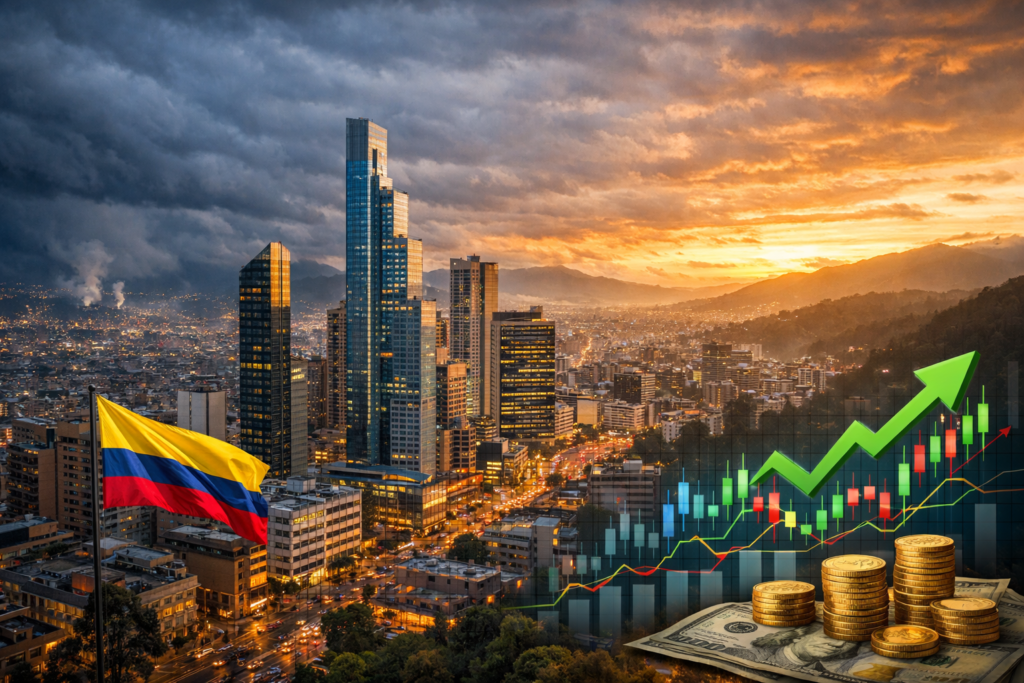
Image Credentials: Image Title: The Technocratic Exception: Why Colombia’s Economy Remains an Anchor in a Volatile Region Source: (sora.openai) Date: January 2026. Attribution: This image was created using AI-generated imagery (sora.openai) and does not depict a real-world scene.
By Open Chronicle News Desk Staff with Agencies
BOGOTÁ — As Latin America navigates a turbulent 2026, marked by shifting political tides and global market uncertainty, Colombia continues to stand out as the region’s “Technocratic Exception.” While several neighboring economies struggle with inflationary spirals and debt crises, Bogotá has maintained a level of macroeconomic discipline that remains the envy of the continent.
According to the latest reports from the IMF and regional financial analysts, Colombia’s stability is not a product of chance, but the result of a deliberate, multi-decade commitment to institutional independence and fiscal restraint.
The backbone of the “Colombian Miracle” rests on three primary institutional safeguards:
-
Central Bank Autonomy: Since 1991, the Banco de la República has operated with absolute independence from the executive branch. This “firewall” prevents the government from printing money to cover fiscal deficits—a practice that has devastated the currencies of several neighboring states.
-
The Fiscal Rule: Codified into law, this rule acts as a “straitjacket” for government spending. It mandates that any administration, regardless of political leaning, must keep the structural deficit within strict limits relative to the nation’s GDP.
-
A Professional Technocracy: Unlike many nations where key economic posts are used as political rewards, Colombia has a long-standing tradition of appointing highly trained, career economists to the Ministry of Finance and the National Planning Department (DNP).
“Colombia is one of the few countries in the region that has never defaulted on its sovereign debt in the modern era,” noted an analyst from a leading European agency. “That history creates a ‘predictability premium’ that keeps foreign direct investment (FDI) flowing, even when regional sentiment turns sour.”
This reliability has been put to the test in 2026. Despite the administration’s ambitious social reforms and the ongoing transition toward a “Green Economy,” the country’s financial markets have remained remarkably steady. Analysts credit this to the “checks and balances” provided by the autonomous judiciary and a Congress that has historically defended the Fiscal Rule.
Regional Comparison
| Country | Sovereign Credit Status (2026) | Inflation Management |
| Colombia | Investment Grade / Stable | Target-bound (Independent Bank) |
| Argentina | High Risk / Volatile | High (Subject to Political Pressure) |
| Venezuela | Restricted Default | Hyper-inflationary History |
| Chile | Investment Grade / Stable | Institutional Stability |
The primary challenge facing the Colombian model in 2026 is the transition away from fossil fuel exports. As the government halts new oil and gas exploration, the economy must find a way to replace nearly 40% of its export revenue.
“The technocrats are now facing their biggest test,” the News Desk staff reported. “The goal is to pivot toward high-tech services, sustainable agriculture, and tourism without breaking the Fiscal Rule. If they succeed, Colombia will not just be an exception in Latin America, it will be a global blueprint for emerging market resilience.”