
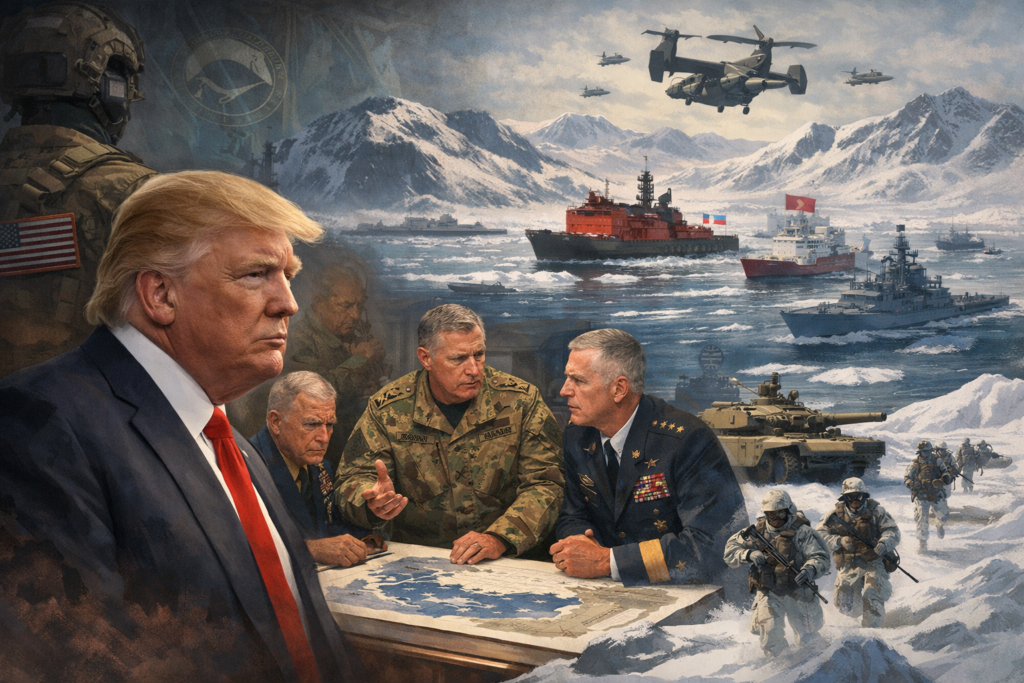
Image Credentials: Image Title: Trump Pushes U.S. Military Planning for Possible Greenland Invasion Source: (sora.openai) Date: January 2026. Attribution: This image was created using AI-generated imagery (sora.openai) and does not depict a real-world scene.
By Open Chronicle News Desk Staff with Agencies
In a startling escalation of U.S. foreign policy, President Donald Trump has reportedly directed senior U.S. special forces commanders to draft contingency plans for a possible invasion of Greenland, a move that has alarmed military leaders and NATO allies alike.
According to The Times of India, Trump asked the Joint Special Operations Command (JSOC) to begin work on a plan that would enable American forces to seize control of the strategically critical Arctic territory, which is an autonomous region within the Kingdom of Denmark. Officials cited by the report suggest that the president is driven by concerns over Russian and Chinese influence in the Arctic, though the proposal has drawn fierce resistance from senior U.S. generals.
Military Pushback and Legal Concerns
Senior military leadership has reportedly pushed back strongly against the directive, with some officials warning that planning for an invasion of a NATO ally’s territory would be illegal without congressional authorization and could fracture the alliance itself. One senior diplomatic source described the generals’ reaction as viewing the proposal as “crazy and illegal,” noting that commanders have tried to steer the president toward less contentious military options.
The resistance from military leadership highlights deep concerns in the Pentagon about the logistical, legal, and ethical ramifications of such a plan, particularly given Greenland’s status as part of Denmark and a member of the North Atlantic Treaty Organization (NATO).
Diplomatic Fallout and NATO Unity at Risk
European leaders have responded with alarm to Trump’s rhetoric. Denmark’s prime minister has warned that any attempt to take Greenland by force would effectively mean an American assault on a NATO ally and could spell the end of the alliance.
Meanwhile, officials from Greenland’s government have firmly rejected any notion of becoming part of the United States. Leaders have consistently stated that the future of the island should be decided by Greenlanders themselves, not by foreign powers.
European defense officials have also voiced concern that debates over U.S. plans to acquire or control Greenland are undermining transatlantic trust. The European Commissioner for Defence and Space warned that a military takeover of Greenland would jeopardize NATO’s cohesion and could prompt increased European investment in regional defense independent of Washington.
Strategic Context and Trump’s Rationale
Trump’s interest in Greenland stems from the island’s strategic location in the Arctic, rich natural resources, including rare earth minerals, and concerns about geopolitical competition with Russia and China for influence in the High North. The United States already maintains a military presence on the island through the Pituffik Space Base, a legacy of Cold War agreements, but Trump has gone further in suggesting that Greenland should be controlled directly by the U.S. government.
In recent remarks, Trump asserted that if the U.S. does not act, rival powers could “assume control” of Greenland, despite no evidence that Moscow or Beijing has any plans to seize the territory.
Regional and Global Implications
Any U.S. military action against Greenland would ripple far beyond the Arctic. Analysts warn that an invasion could provoke diplomatic crises across Europe, undermine collective security agreements, and embolden adversaries by exposing fractures within NATO. In the worst-case scenario, such an operation could trigger Article 5 obligations, which hold that an attack on one NATO member is an attack on all.
For now, the idea of invading Greenland remains at the planning stage, with resistance from within the U.S. military and vehement objection from allies. But the directive itself, and the anxiety it has created in capitals across the Atlantic, underscores just how turbulent geopolitical tensions have become in early 2026.