
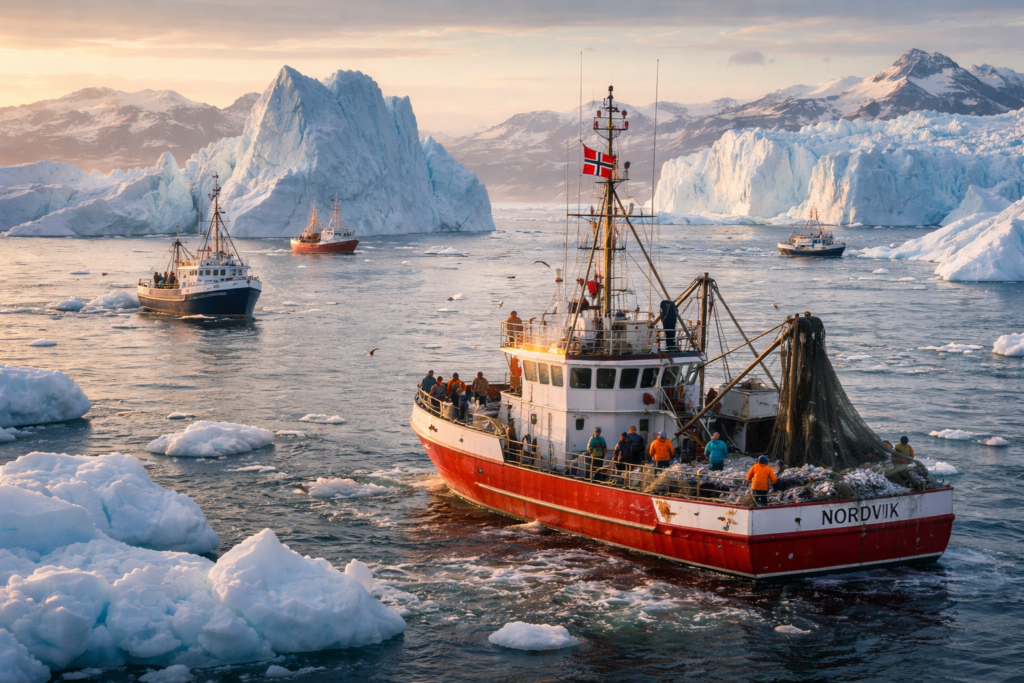
Image Credentials: Image Title: SUSTAINABILITY OVER SURPLUS: Norway and Greenland Slash 2026 Fishing Quotas Source: (sora.openai) Date: January 2026. Attribution: This image was created using AI-generated imagery (sora.openai) and does not depict a real-world scene.
By Open Chronicle News Desk Staff with Agencies
OSLO — Monday, January 12, 2026 — Against a backdrop of heightening Arctic tensions and a changing climate, Norway and Greenland have finalized a landmark bilateral fisheries agreement for 2026. The deal, characterized by significant quota reductions compared to 2025, reflects a growing commitment to the sustainable management of the North Atlantic’s fragile marine ecosystems.
The Norwegian government announced the deal on Sunday, highlighting that the negotiations were driven by the need to protect declining stocks, particularly cod in the Barents Sea.
Tightening the Net: The 2026 Numbers
The new agreement outlines a lean year for commercial fleets. In a move mirroring the broader reductions seen across the Barents Sea, both nations have agreed to lower their take to ensure long-term stock viability.
Norway’s Allocation in Greenlandic Waters:
-
Greenland Halibut: 600 tonnes in the West; 250 tonnes in the East.
-
Cod: A combined total of 720 tonnes across Eastern and Western sectors.
-
Other Species: Fixed limits on redfish (400t), cusk (360t), and roundnose grenadier (100t), plus bycatch allowances.
Greenland’s Allocation in the Barents Sea:
-
Cod: 2,920 tonnes.
-
Haddock: 533 tonnes.
-
Pollock: 454 tonnes.
-
Bycatch: 425 tonnes for miscellaneous species.
A “Constructive Cooperation”
Marianne Sivertsen Næss, Norway’s Minister for Fisheries and Ocean Policy, praised the diplomatic effort required to reach the agreement during a period of economic uncertainty for the industry.
“This agreement shows how important a close and constructive cooperation between Norway and Greenland is,” Sivertsen Næss said in a press release. “We have found solutions that consider sustainability and simultaneously ensure activity for the fisheries industry. We must stand together for the responsible management of ocean resources.”
The Barents Sea Crisis
The reductions are not arbitrary. Marine biologists have warned for the past two years that the Barents Sea cod population, a cornerstone of the Northern European economy—is facing significant pressure from rising sea temperatures and over-predation. By slashing the 2026 quotas, Oslo and Nuuk are signaling a “safety first” approach intended to prevent the kind of total stock collapse seen in other global fisheries.
Quick Look: 2026 Quota Summary
| Species | Norway’s Quota (in Greenland) | Greenland’s Quota (in the Barents Sea) |
| Cod | 720 Tonnes | 2,920 Tonnes |
| Halibut | 850 Tonnes (Total) | — |
| Haddock | — | 533 Tonnes |
| Redfish | 400 Tonnes | — |
| Pollock | — | 454 Tonnes |
The 2026 agreement proves that despite the geopolitical “storm” surrounding the Arctic, regional cooperation on environmental and resource issues remains functional. For the fishing communities from Hammerfest to Nuuk, the message is clear: the future of the industry depends on a smaller, more responsible catch today.