
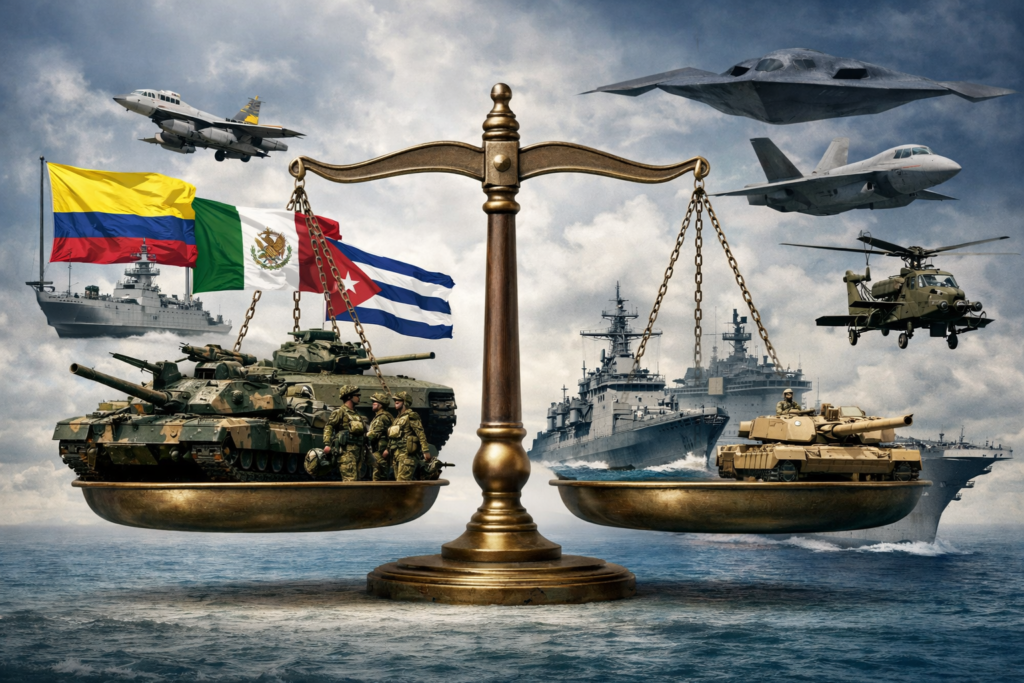
Image Credentials: Image Title: Military Balance Assessment: Colombia, Mexico, and Cuba Versus United States Power Source: (sora.openai) Date: January 2026. Attribution: This image was created using AI-generated imagery (sora.openai) and does not depict a real-world scene.
By Madison Walker | Open Chronicle Senior Editor
Rising tensions across the Western Hemisphere have refocused attention on the military balance between the United States and several Latin American states. Following Washington’s military intervention in Venezuela, President Donald Trump has issued increasingly confrontational rhetoric toward Colombia, Mexico, and Cuba. While political signaling dominates headlines, the underlying military realities reveal an overwhelming asymmetry of power.
The United States fields the most advanced and best-funded military force in history, with a 2026 defense budget of 901 billion dollars and a proposed expansion to 1.5 trillion dollars for 2027. This spending alone exceeds the combined military budgets of the next ten largest powers. Against this backdrop, Colombia, Mexico, and Cuba maintain forces primarily structured for internal security, regime survival, and asymmetric defense rather than interstate war.
Colombia operates a mid-tier military shaped by decades of internal conflict with guerrilla movements and narcotics networks. Its armed forces are optimized for counterinsurgency, territorial control, and internal stability rather than conventional deterrence against a peer adversary.
Ranked forty-sixth in the 2025 Global Firepower Index, Colombia maintains approximately 293,000 active personnel. These are supported by 436 military aircraft and a naval fleet of 233 vessels, including four submarines. The force structure blends domestically produced systems with imports from the United States, Israel, Germany, Brazil, and South Korea.
Colombia’s 2025 defense budget stands at roughly 15 billion dollars, placing it among Latin America’s top defense spenders. However, President Gustavo Petro has openly acknowledged a critical vulnerability. The country lacks modern air defense systems, a gap historically deemed acceptable because internal adversaries did not possess advanced aircraft.
Efforts to modernize are underway. A recent agreement with Sweden’s Saab will introduce 17 Gripen fighter jets, replacing Israeli Kfir aircraft that have been in service for more than four decades. Despite these upgrades, Colombia remains poorly positioned to counter advanced US air and missile capabilities.
Compounding these limitations is the persistent presence of paramilitary successor groups. Although major demobilizations occurred in the mid-2000s, armed criminal organizations with roots in earlier paramilitary structures remain active, with estimated manpower reaching 150,000.
Mexico’s military posture mirrors Colombia’s inward focus. Its armed forces are primarily tasked with counter-narcotics operations, border enforcement, and territorial control. Ranked thirty-second globally in the 2025 Global Firepower Index, Mexico fields around 412,000 active personnel.
These forces are supported by 433 aircraft and 167 naval assets. Mexico’s defense industry produces light armored vehicles, naval platforms, and small arms, while more advanced systems are largely imported from the United States.
A defining feature of Mexico’s security architecture is the expanding role of the National Guard. Established in 2019, the force has become central to domestic security operations, blurring the line between military and law enforcement roles.
Mexico’s defense spending has fluctuated sharply. Expenditure rose to 16.7 billion dollars in 2024, driven by investments in the National Guard and the Navy. In 2025, however, the budget was reduced to approximately 7.6 billion dollars as President Claudia Sheinbaum prioritized social programs.
While modernization continues at a limited pace, including the planned acquisition of a C-130J Super Hercules transport aircraft, Mexico lacks advanced air defense, strategic strike capabilities, and integrated command systems necessary to counter US military power.
Drug cartels further complicate the picture. Many operate as de facto paramilitary entities, wielding military grade weapons and exerting territorial control. Although formidable in internal conflict, these groups offer no meaningful deterrence against external military intervention.
Cuba presents a fundamentally different model. Its defense doctrine is based on nationwide mobilization and prolonged resistance rather than conventional warfare. The Revolutionary Armed Forces number approximately 45,500 active personnel, supported by a limited inventory of 31 aircraft, 113 tanks, and 19 naval vessels.
The island’s true strength lies in its paramilitary network, estimated at 1.14 million personnel. This makes it one of the largest such forces globally. These units are embedded within a territorial defense system designed to complicate occupation and impose high costs through asymmetric warfare.
Ranked sixty-seventh in the 2025 Global Firepower Index, Cuba’s conventional capabilities are constrained by fuel shortages and reliance on aging Soviet era equipment. Operational readiness and power projection are severely limited.
Recent modernization efforts have been modest. Cooperation with Belarus has focused on training and selective upgrades, including the reported modernization of S-125 Pechora air defense systems to the Pechora 2BM standard. While this improves survivability against older aircraft, it offers limited protection against modern US stealth platforms and precision munitions.
Defense spending data remains opaque. SIPRI estimated Cuban military expenditure at approximately 2.9 billion dollars in 2018, with no verified recent figures.
In purely military terms, none of the three countries can meaningfully challenge US forces in a conventional conflict. Colombia and Mexico possess capable, battle-hardened forces optimized for internal security but lack air defense, strategic depth, and advanced command systems. Cuba relies on mass mobilization and deterrence through attrition rather than technological parity.
Any confrontation would therefore be highly asymmetric. The United States would retain decisive advantages in air supremacy, intelligence, logistics, naval power, and precision strike capabilities. For Colombia, Mexico, and Cuba, military preparedness is less about defeating the United States and more about managing internal stability, signaling resilience, and deterring political coercion through the costs of escalation rather than battlefield dominance.
The Grand Strategy Institute
Continue Exploring Strategic Analysis
Return to The Grand Strategy Institute for strategic assessments, long-form analysis and research examining geopolitics, military affairs, international security, emerging technologies and the changing international order.
← Back to The Grand Strategy Institute