
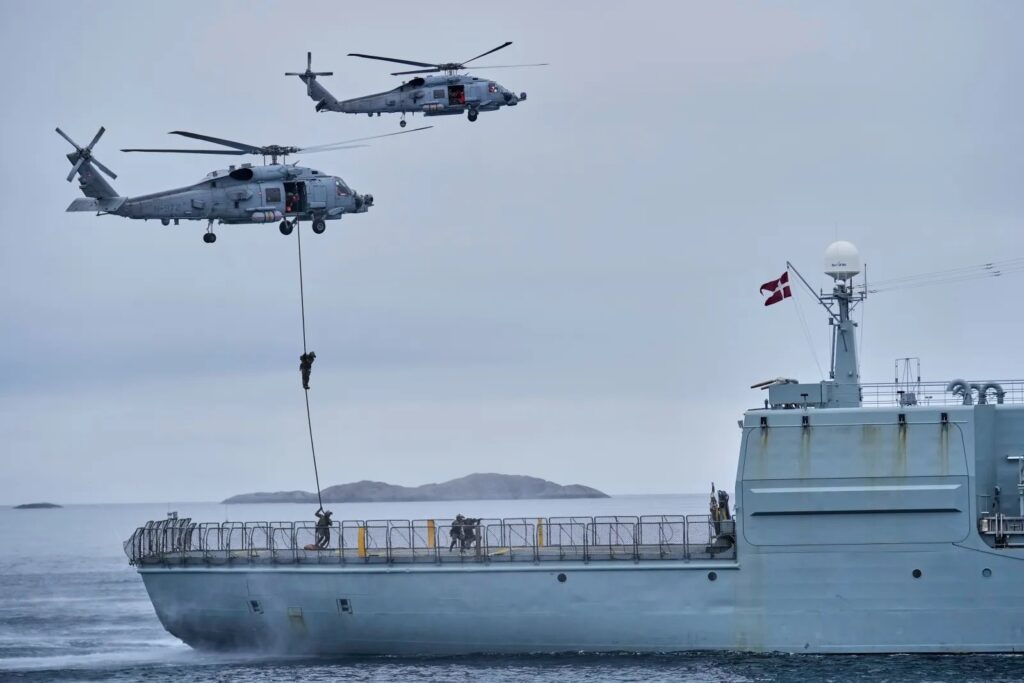
Image: from Kingsley Chukwuka X@profilopolitics
By Open Chronicle News Desk Staff with Agencies
European military personnel have begun arriving in Greenland, underscoring rising geopolitical tensions after a high-level meeting between United States, Danish, and Greenlandic officials in Washington ended without a breakthrough on the island’s future. The deployment comes amid continued disagreement over Washington’s interest in Greenland, a mineral-rich autonomous territory of the Kingdom of Denmark that has become a focal point of broader Arctic security concerns.
Troops from France, Germany, Sweden, and Norway are among those deploying to Greenland’s capital, Nuuk, as part of a reconnaissance mission aimed at strengthening the island’s security posture. French President Emmanuel Macron confirmed that the first contingent of French soldiers is en route, while Germany announced the deployment of a 13-strong Bundeswehr reconnaissance team through the weekend, under Denmark’s invitation. Greenland’s Deputy Prime Minister Mute Egede said that aircraft, ships, and military personnel from NATO allies can be expected in the coming days, largely for training and cooperative exercises.
European troops arrive in Greenland as talks with US highlight ‘disagreement’ over island’s future https://t.co/qOlWWQbGYZ
— LB Press-Telegram (@presstelegram) January 15, 2026
The moves followed a meeting in Washington on Wednesday between U.S. Vice President JD Vance, Secretary of State Marco Rubio, Danish Foreign Minister Lars Løkke Rasmussen, and Greenland’s foreign minister. Danish officials described the outcome as highlighting a “fundamental disagreement” with the United States over Greenland’s status and future. Rasmussen stressed that negotiations did not change Copenhagen’s position on sovereignty, and he reiterated opposition to any notion of U.S. ownership or control over the territory.
President Donald Trump has repeatedly voiced his belief that the United States should assert greater control over Greenland, arguing that the island is vital to U.S. security interests, particularly in countering perceived Russian and Chinese influence in the Arctic. Trump’s assertions have reignited a controversial debate about Greenland’s strategic significance, even though Denmark has maintained that Greenland’s defense and sovereignty should remain within NATO’s existing framework.
The European deployments have been framed by participating countries as cooperative efforts to bolster regional security and demonstrate solidarity with Denmark. In Copenhagen, Danish defence officials also announced plans to heighten the kingdom’s military presence on and around Greenland in close coordination with allies, calling the decision necessary amid an unpredictable security environment.
Despite the tension, officials from all sides emphasize that dialogue continues. Rasmussen said that a working group with U.S. counterparts will focus on addressing American security concerns while respecting Denmark’s “red lines,” but he acknowledged that the failure to resolve core issues at the Washington meeting leaves substantial differences intact.
Public sentiment in Greenland reflects mixed emotions amid the dispute. Many residents welcome the presence of NATO allies and the diplomatic engagement, but there is palpable anxiety about becoming the centre of a geopolitical standoff involving major powers. Greenlandic leaders have reiterated that the island is “not for sale” and reaffirmed their commitment to Denmark and NATO as frameworks for security and self-governance.
The deployment of European troops to Greenland marks a significant moment in Arctic geopolitics, as allied nations seek to demonstrate unity and reassure local populations while maintaining pressure on Washington to respect existing sovereignty arrangements.