
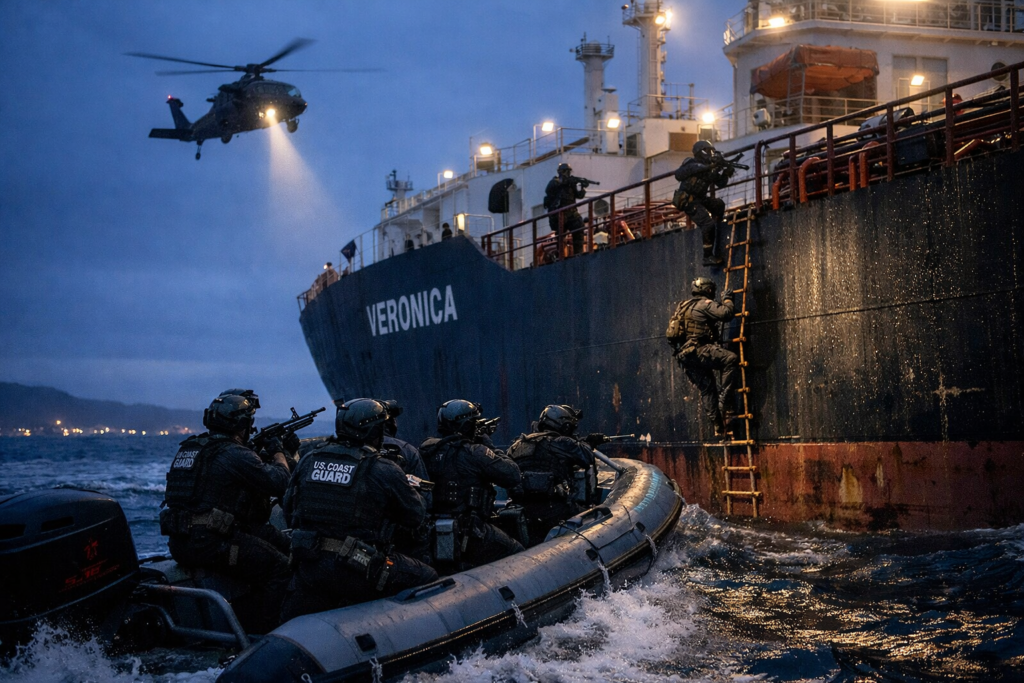
Image Credentials: Image Title: U.S. Marines Seize Sixth Tanker in Caribbean Blockade Source: (sora.openai) Date: January 2026. Attribution: This image was created using AI-generated imagery (sora.openai) and does not depict a real-world scene.
Off the Coast of Aruba | Open Chronicle Defense and Energy Desk with Agencies | Thursday, January 15, 2026
In a bold expansion of Washington’s campaign to control Venezuelan oil exports, United States forces seized the Motor Tanker Veronica in a pre-dawn boarding operation off the coast of Aruba. The action marks the sixth such interception in recent weeks amid an aggressive maritime campaign to enforce sanctions and tighten U.S. control over South American energy flows.
The operation was executed by Marines and U.S. Coast Guard tactical teams launched from the deck of the aircraft carrier USS Gerald R. Ford in the Caribbean Sea. The seizure was conducted without incident in international waters, with photographs and video released by Homeland Security officials showing helicopters and boarding teams securing the vessel.
U.S. authorities describe the Veronica as part of a “shadow fleet” of tankers used to evade American sanctions on Venezuelan oil exports. Listed as flying the flag of Guyana, the tanker has a history of changing names and registries, a tactic often associated with vessels that move sanctioned cargoes to disguise their origin and destination.
Early this morning, a Coast Guard tactical team conducted a pre-dawn boarding and seizure of Motor Tanker Veronica in the Caribbean. As another sanctioned ghost fleet tanker, Motor Tanker Veronica had previously passed through Venezuelan waters, and was operating in defiance of… pic.twitter.com/MyWyQGH1h0
— Secretary Kristi Noem (@Sec_Noem) January 15, 2026
The seizure comes amid heightened U.S. efforts to enforce a maritime quarantine on sanctioned vessels in the Caribbean and surrounding waters. The campaign, drawing on deployments by the U.S. Southern Command and coordinated across multiple agencies, reflects a shift toward direct maritime interdiction rather than reliance solely on financial sanctions.
In statements accompanying the announcement, U.S. officials framed the Veronica capture as a necessary step to prevent the movement of crude oil sold outside legally sanctioned channels. Homeland Security Secretary Kristi Noem reiterated that ships violating the established quarantine “will not escape American justice.”
Veronica’s last known position was near Aruba on January 3, and maritime tracking data indicated the vessel was partially laden with crude oil at that time. Prior vessels seized under the campaign have also been tied to oil shipments linked to Venezuela and, in some cases, associated with Russian ownership or management.
This latest capture is part of a broader strategic effort by the Trump administration to reassert control over Venezuelan oil resources following significant political upheaval in the country. Washington’s campaign has included not only naval interdictions but also discussions with major oil executives about a substantial investment plan aimed at rehabilitating Venezuela’s production and distribution infrastructure. The administration is reportedly seeking to sell tens of millions of barrels of seized crude to fund reconstruction and modernization efforts.
Critics argue that the intensification of interceptions raises complex legal and diplomatic questions, particularly given the operation’s conduct in international waters and the involvement of vessels flagged under third-party registries. Nevertheless, U.S. officials maintain that the move is part of sustained efforts to enforce sanctions and clamp down on illicit networks exploiting Venezuelan oil exports.
As the Caribbean maritime campaign continues, the capture of the Veronica underscores the United States’ willingness to project naval power in pursuit of economic and security objectives tied to energy resources, setting the stage for further actions against sanctioned tankers associated with the broader “shadow fleet.”