
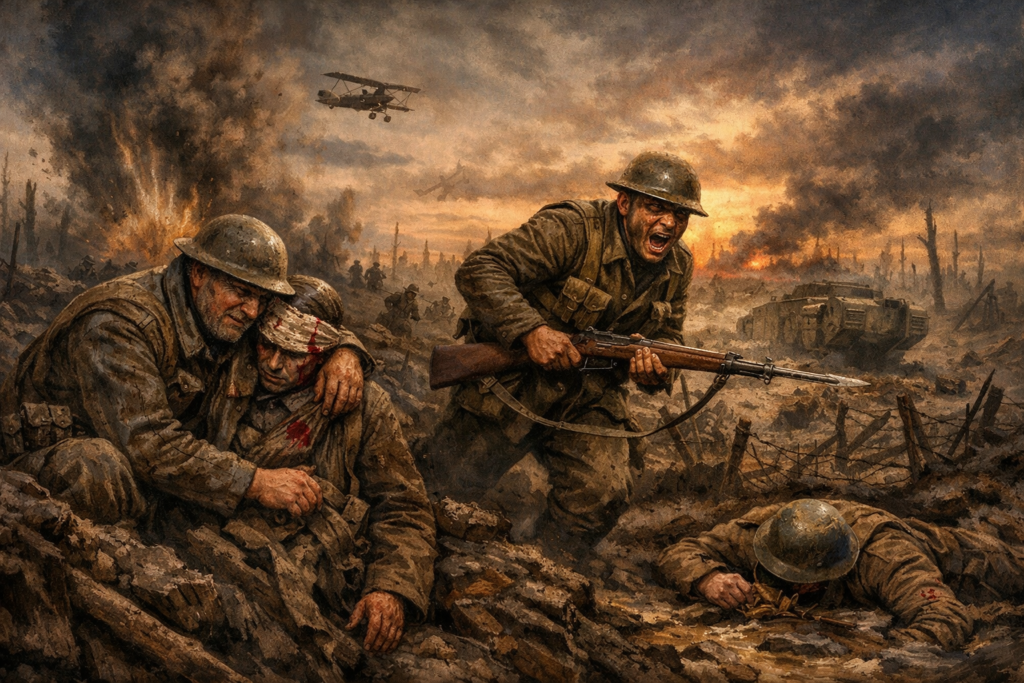
Image Credentials: Image Title: The Vanishing Veterans: Survival and Sacrifice on the Western Front, 1914–1918 Source: (sora.openai) Date: January 2026. Attribution: This image was created using AI-generated imagery (sora.openai) and does not depict a real-world scene.
By Open Chronicle History Desk | January 15, 2026
By 1918, the landscape of the First World War had changed so dramatically that very few of the men who had answered the call in 1914 remained on active duty. This was not solely a consequence of the staggering mortality rates, though they were horrific, but also due to the simple arithmetic of war: armies almost always expand as conflicts endure, and the Great War was no exception.
When Britain first sent its Expeditionary Force in 1914, only around 150,000 troops were deployed. By 1918, the total number of British men recruited or conscripted to fight had swelled to nearly four million. Even if every 1914 soldier had miraculously survived the early carnage, they would have constituted less than 4 percent of the total wartime force. In reality, the attrition was severe: by the Christmas Truce of that first year, roughly two-thirds of the original troops had become casualties, with only a trickle of reinforcements arriving to maintain the lines before the campaigns of 1915.
The experience of the First Canadian Division illustrates the brutal scale of loss. The division initially comprised 17,873 infantrymen, supported by medical personnel, logistics staff, and artillery units. At the Battle of Second Ypres in April 1915, their first major engagement, over 6,000 Canadians were killed or wounded in just four days, with infantrymen suffering the majority of losses. By the war’s end, the First Canadian Division had endured 52,559 casualties, including 15,055 deaths. This total represented nearly three times the division’s original strength, and the number of fatalities almost equaled the number of men who had originally enlisted.
German units faced comparable devastation. The 16th Bavarian Reserve Infantry Regiment, which included a young Adolf Hitler, had recruited some 16,000 men, but almost all the 1914 members had perished or been incapacitated by the time 1918 arrived. Hitler’s own company experienced one of the war’s many catastrophic engagements on October 29, 1914, suffering 208 casualties out of 250 men, a staggering 83 percent loss. Remarkably, Hitler himself survived the war, though he was convalescing in a hospital on Armistice Day.
Survival odds varied drastically by role. Doctors, nurses, logistics personnel, and artillerymen had far greater chances of making it through the four-year conflict than infantrymen slogging through trench warfare, subject to constant shellfire, gas attacks, and machine-gun fire. Entire companies and battalions across the French, German, British, and Canadian armies could be reduced to a single man in the aftermath of heavy engagements.
The result was a profound generational shift within armies. By the end of the war, the soldiers who had begun the fight in 1914 were as rare as the untouched poppies of No Man’s Land, reminders of both the unimaginable sacrifice endured and the relentless human toll exacted by industrialized warfare. The few survivors embodied not only courage and endurance but the stark reality of a conflict that reshaped nations, societies, and the very nature of combat.
References
- Keegan, John. The First World War. Vintage Books, 2000.
- Strachan, Hew. The First World War, Volume I: To Arms. Oxford University Press, 2001.
- Sheffield, Gary. Forgotten Victory: The First World War Myths and Realities. Headline Book Publishing, 2001.
- Cook, Tim. At the Sharp End: Canadians Fighting the Great War 1914–1916. Viking Canada, 2007.
- Morton, Desmond. When Your Number’s Up: The Canadian Soldier in the First World War. Random House Canada, 1993.
- Holmes, Richard. The Western Front. BBC Books, 2001.
- Stevenson, David. Cataclysm: The First World War as Political Tragedy. Basic Books, 2004.
- Evans, Richard J. The Coming of the Third Reich. Penguin Press, 2003.
- Asquith, H. H. The War Speeches of the Rt. Hon. H. H. Asquith. Oxford University Press, 1918.
- Commonwealth War Graves Commission. Casualty Statistics of the First World War.