
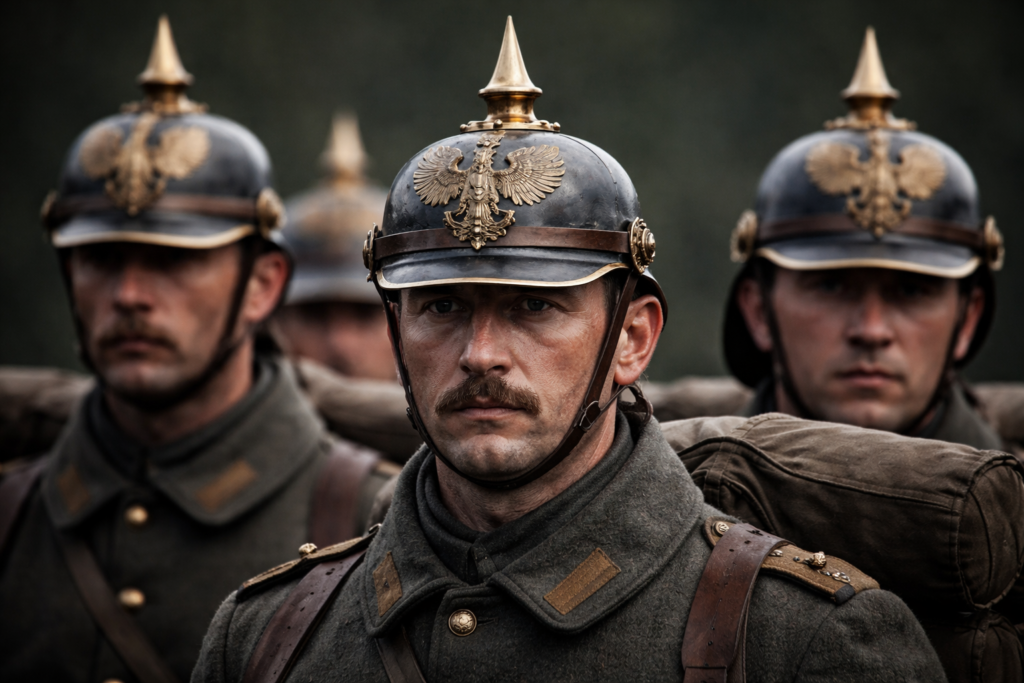
Image Credentials: Image Title: Spikes or Symbolism: The Truth Behind Germany’s Pickelhaube Helmet in World War ISource: (sora.openai) Date: January 2026. Attribution: This image was created using AI-generated imagery (sora.openai) and does not depict a real-world scene.
By Open Chronicle History Desk | January 16, 2026
The spiked helmets worn by German soldiers during the early years of the First World War have long inspired curiosity and myth. To modern eyes, the Pickelhaube appears flamboyant, even impractical, raising a persistent question. Did the spike offer any real military advantage, or was it merely ceremonial?
To answer this, it is important first to clarify what kind of advantage a helmet could realistically provide. A helmet does not create strategic superiority in the sense of long-term planning or battlefield maneuver. Its purpose is far more limited, to reduce head injuries and thereby preserve fighting strength. Any benefit was therefore marginal and individual rather than decisive.
The Pickelhaube, literally meaning “pick hat,” was introduced into Prussian service in the nineteenth century and later adopted across the German states. Made primarily from boiled leather, it was lightweight and rigid by the standards of its time. The spike mounted at the crown was originally functional in theory, designed to deflect downward saber blows away from the skull. In addition, the helmet featured a rear projection that extended over the neck, a protective feature with roots stretching back to ancient armor designs.
This concept was not entirely without precedent. During the Crimean War, particularly after the British Heavy Brigade’s charge at Balaclava in 1854, medical observers noted severe head wounds among Russian soldiers. Sabers, when striking from above, could split headgear and skull alike. In this context, any design that redirected a blade away from the head might have offered limited protection against cavalry weapons. The spike also served as a mounting point for plumes and insignia, reinforcing unit identity and parade ground prestige, a matter taken seriously by nineteenth century armies.
However, by the time the First World War erupted, the nature of combat had changed dramatically. Sabers were no longer the primary threat. Artillery dominated the battlefield, and overhead shrapnel bursts became one of the deadliest sources of injury. Against high-velocity fragments raining down from above, the leather Pickelhaube offered little protection. The spike itself provided no defensive value in this environment and, in some cases, may even have made soldiers more visible.
As casualties mounted, the limitations of the Pickelhaube became undeniable. In 1916, the German army replaced it with the Stahlhelm, a steel helmet inspired by the medieval sallet. This new design offered far superior protection against shrapnel and debris, addressing the realities of industrialized warfare rather than the romanticized combat of an earlier era.
In conclusion, the spike on the German helmet was not purely decorative, but its practical value belonged to a different age. It reflected a transitional moment in military history, when armies still prepared for wars of maneuver and cavalry charges, unaware of how completely modern firepower would redefine the battlefield. By the First World War, the Pickelhaube had become a symbol of tradition overtaken by technology, respected for its heritage but rendered obsolete by the demands of total war.
References
- Gudmundsson, Bruce I. Stormtroop Tactics: Innovation in the German Army, 1914–1918. Praeger, 1989.
- Showalter, Dennis. The Wars of German Unification. Bloomsbury Academic, 2004.
- Keegan, John. The First World War. Vintage Books, 2000.
- Lepage, Jean-Denis G. G. Military Helmets of the World. Schiffer Publishing, 2009.
- Summerfield, Stephen, and Stephen Bull. German Army Headgear 1914–1945. Osprey Publishing, 2000.
- Duffy, Christopher. The Military Experience in the Age of Reason. Routledge, 1987.
- Haythornthwaite, Philip J. The World War One Source Book. Arms and Armour Press, 1992.
- Holmes, Richard. Tommy: The British Soldier on the Western Front. HarperCollins, 2004.