
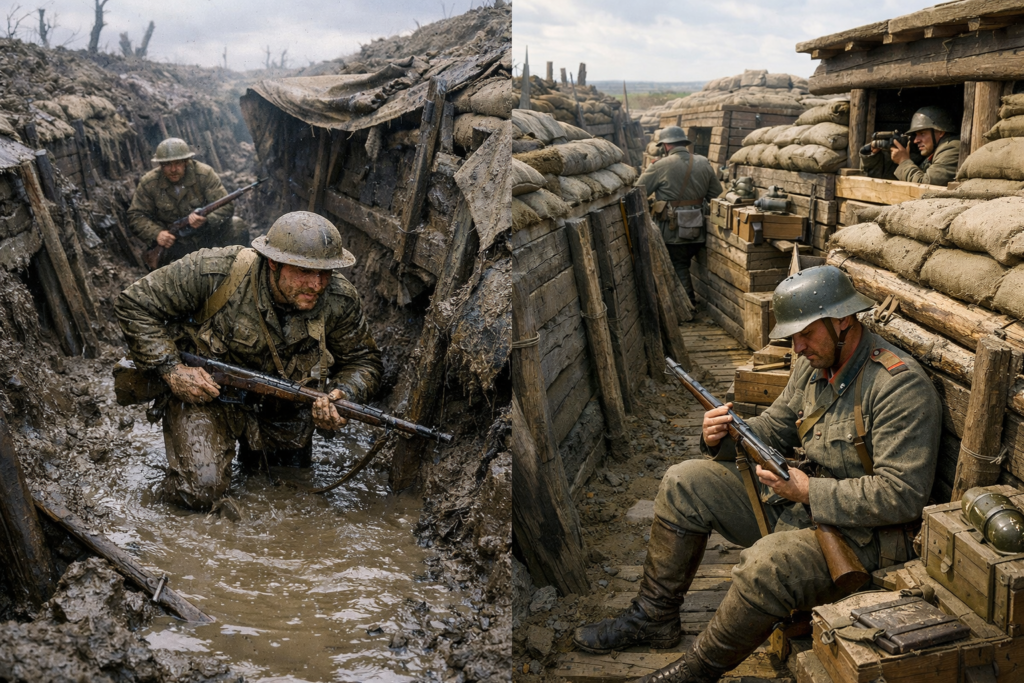
Image Credentials: Image Title: Image Credentials: Image Title: Spikes or Symbolism: The Truth Behind Germany’s Pickelhaube Helmet in World War ISource: (sora.openai) Date: January 2026. Attribution: This image was created using AI-generated imagery (sora.openai) and does not depict a real-world scene. Source: (sora.openai) Date: January 2026. Attribution: This image was created using AI-generated imagery (sora.openai) and does not depict a real-world scene.
By Open Chronicle History Desk | January 16, 2026
During the First World War, British and German soldiers faced one another from opposing trench systems that stretched for hundreds of miles across the Western Front. On the surface, their circumstances appeared similar, the same war, the same weapons, the same weather. Yet life inside those trenches could not have been more different. While many British soldiers lived knee deep in mud and water, German troops often occupied dry, reinforced positions that offered a degree of safety and stability. This contrast was not accidental. It was the result of geography, timing, and fundamentally different military philosophies.
The Advantage of High Ground
One of the most decisive factors was elevation. The German army advanced early in the war and secured much of the higher ground. This single advantage shaped daily survival. Water flows downhill, and trenches dug on lower ground naturally collect rain and groundwater. British trenches, often positioned on flatter or lower terrain, became waterlogged, their walls collapsing and floors turning into sucking mud.
German trenches, by contrast, benefited from gravity. Rainwater drained away instead of pooling. Floors remained comparatively dry, and trench walls were more stable. What seemed like a modest geographic advantage translated into vastly improved living conditions and reduced illness, fatigue, and trench foot.
Different Strategic Assumptions
Beyond geography, the two armies built their trenches with different expectations. The German command believed they would hold their ground for an extended period. Their trench systems were designed for long-term occupation. They invested time and resources into deep dugouts, reinforced with timber, brick, and concrete. Some shelters descended thirty feet underground, protecting from artillery fire and sheltering from the elements. Many even had wooden floors, bunks, and electric lighting.
British commanders, especially early in the war, viewed trenches as temporary positions. They feared that too much comfort would sap offensive spirit. If soldiers felt secure, they might hesitate to go over the top. As a result, British trenches were often crude and minimally reinforced. Discomfort was seen as a motivator, a harsh reminder that the war would be won through movement and attack rather than passive defense.
A Shock at Close Quarters
When British troops finally captured German trenches, they were stunned. The enemy positions felt like another world. Officers could walk through dugouts without sinking into mud. Shelters were dry, solid, and organized. For men who had endured years of cold, filth, and collapsing trenches, the contrast was almost unbelievable.
The war had been the same on both sides, the same shells and bullets flying overhead. Yet a small difference in elevation, combined with a different approach to planning and permanence, created radically different experiences. In the trenches of the Western Front, geography and doctrine decided whether a soldier lived in misery or relative security.