
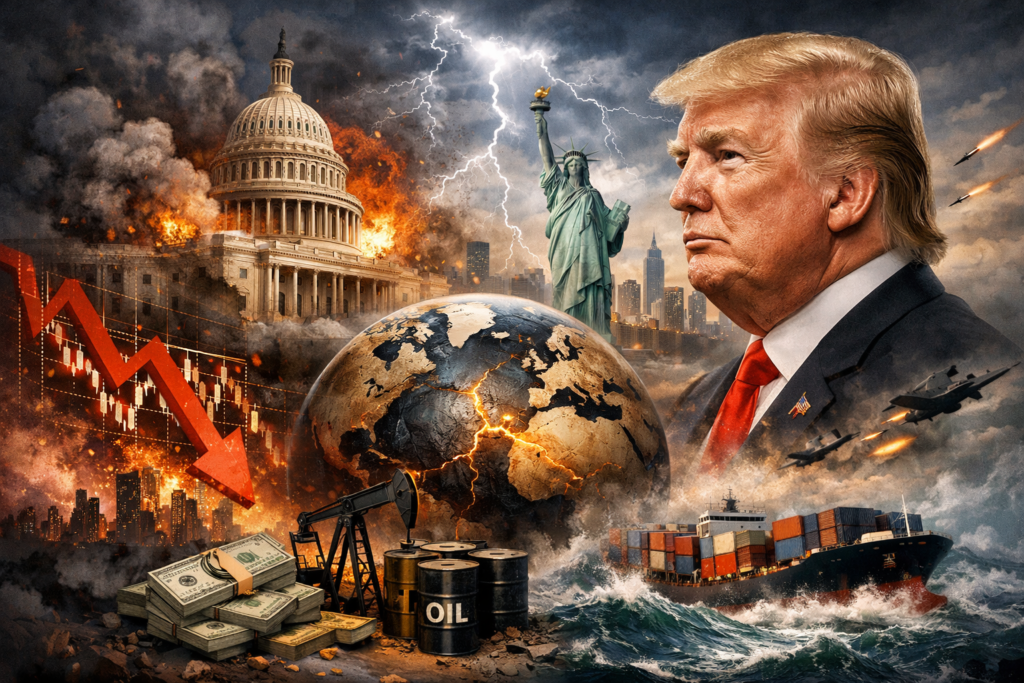
Image Credentials: Image Title: The Trump Disruption: One Year of Global Economic Turbulence Source: (sora.openai) Date: January 2026. Attribution: This image was created using AI-generated imagery (sora.openai) and does not depict a real-world scene.
By Open Chronicle Desk | January 21, 2026
Exactly one year after Donald Trump’s second inauguration, the global economic map has been redrawn by a series of high-stakes “shocks.” In a recent analysis for O Globo, veteran commentator Miriam Leitão argued that the administration has successfully “disorganized” the global economy, moving away from a rules-based system toward a landscape of permanent volatility.
The Dismantling of the Trade Order
Leitão’s critique centers on the collapse of multilateralism. Over the past twelve months, the U.S. has increasingly used tariffs not just as economic tools, but as geopolitical weapons.
-
The “Greenland Tariffs”: Relations with Europe have reached a historic low following Trump’s decision to impose tariffs as a response to the EU’s refusal to facilitate his Greenland ambitions. European leaders at Davos 2026 described the move as a “wrecking ball” for international manufacturing.
-
Secondary Sanctions: Most recently, Trump threatened a 25% surcharge on any country maintaining trade relations with Iran. This move hits emerging markets like Brazil particularly hard, as they maintain a significant trade surplus with Iran (approx. $2.9 billion in exports).
The Assault on Central Bank Independence
Perhaps the most significant “foundational shift” identified by Leitão is the unprecedented pressure on the Federal Reserve.
-
The DoJ Investigation: Market confidence was rattled earlier this month when the U.S. Department of Justice launched an investigation into Fed Chair Jerome Powell over alleged cost overruns in the Fed’s building renovations, a move many analysts view as a pretext to force rate cuts.
-
Fiscal Dominance: Critics warn that the U.S. is entering an era of “fiscal dominance,” where the central bank effectively becomes a department of the executive branch. “If the Fed acts on politics rather than data,” Leitão warns, “the result could resemble the 1970s.”
Market Reactions and the “Super Dollar”
Paradoxically, while Trump’s policies create instability, the U.S. dollar has remained surprisingly resilient. This “Super Dollar” is a double-edged sword:
-
Inflation Export: High U.S. rates and a strong dollar make imports cheaper for Americans, but export inflation to the rest of the world.
-
Debt Stress: For emerging markets like Brazil and Mexico, the strong dollar makes servicing dollar-denominated debt significantly more expensive.
-
Alternative Systems: In response, states are accelerating “de-dollarization.” China’s CIPS (Cross-Border Interbank Payment System) has seen a massive surge in transactions, signaling a fragmented, multipolar monetary future.
The “Economic Fog”
As 2026 begins, central bankers find themselves navigating what Bloomberg Economics calls an “economic fog.” With the U.S. withdrawing from global norms and the threat of large-scale deportations and further tariffs looming, the “Washington Consensus” has officially been replaced by a “Trump Disruption.”