
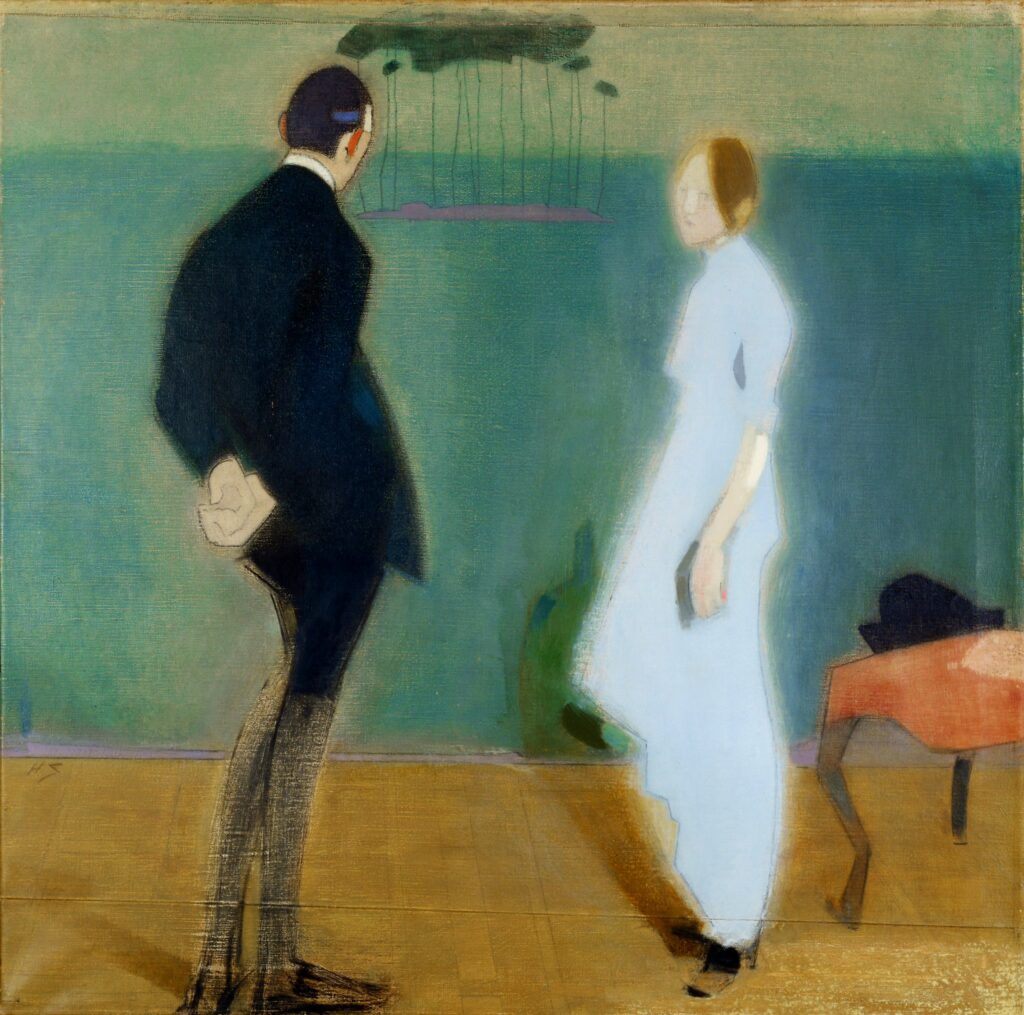
Image: From SantiagoArt X@SantiagoArtis “Helene Schjerfbeck (Finnish, 1862-1946) The Tapestry, 1914 Private Collection, Stockholm”
By Open Chronicle Arts Desk | January 21, 2026
There is a specific kind of violence in a whisper. In the silent, north-facing rooms of rural Finland, Helene Schjerfbeck (1862–1946) spent decades experimenting with visual subtraction, scraping away the surface of the world until only its essential, haunting pulse remained.
Now, in a landmark exhibition titled “Seeing Silence: The Paintings of Helene Schjerfbeck”, reviewed in the latest issue of The New Yorker, The Metropolitan Museum of Art finally introduces American audiences to the artist who is arguably the most radical modernist you’ve never heard of.
Meet the modernist the world almost overlooked. ✨ "Seeing Silence: The Paintings of Helene Schjerfbeck" is now open at The Met!
Beloved across the Nordic countries, Schjerfbeck (1862–1946) spent decades working in near-isolation—quietly reinventing her style from traditional… pic.twitter.com/3o2qDnMVuA
— The Metropolitan Museum of Art (@metmuseum) December 5, 2025
The Evolution of an Outlier
For over a century, the history of Modernism was a story told through the loud, masculine centers of Paris and Berlin. Schjerfbeck’s retrospective at The Met (running through April 5, 2026) offers a necessary recalibration. It tracks her journey from a nineteenth-century prodigy, a master of academic realism who won a bronze medal at the 1889 Paris World’s Fair, to a hermit-like innovator who predated the minimalist movements of the mid-twentieth century.
The exhibition begins with the lush, light-drenched naturalism of her youth, exemplified by The Convalescent (1888). But the narrative shifts dramatically as Schjerfbeck retreats to the town of Hyvinkää to care for her ailing mother. In this isolation, her work began to “thirst for spareness.” The faces of her sitters became flat planes of ochre and chalky white; their eyes turned into dark, impenetrable voids.
Helene Schjerfbeck
(Finnish, 1862-1946)
The Tapestry, 1914
Private Collection, Stockholm
[ Schjerfbeck was a Finnish modernist painter renowned for her unique approach to portraiture and her expressive style]. pic.twitter.com/p59tEpjiTY— SantiagoArt (@SantiagoArtis) January 16, 2026
Models as Mannequins
Curators Dita Amory and Anna-Maria von Bonsdorff highlight a peculiar tension in Schjerfbeck’s process: her relationship with silence. She treated her models, often family members or local villagers, not as psychological subjects, but as formal objects. She reportedly required them to sew or read in total stillness, using them as “mannequins” to study the way light interacts with volume.
This wasn’t coldness; it was a devotion to the canvas. In the Met’s galleries, viewers can stand inches away from works like The Seamstress and witness the “technical violence” of her hand. Schjerfbeck didn’t just apply paint; she attacked it, sanding down layers of pigment to expose the raw tooth of the canvas, creating a textured vulnerability that feels startlingly contemporary in 2026.
The Final Reckoning: The Self-Portraits
The emotional core of the exhibition lies in the final rooms, which house her legendary series of self-portraits. Spanning eighty years, they document a slow, unflinching dissolution.
As she aged, and as the shadows of World War II fell over Finland, Schjerfbeck turned the mirror on herself with “goblin-mode” honesty. The late self-portraits are skull-like and spectral. The flesh recedes, leaving behind a series of nearly abstract marks that ask a fundamental question: What is left of us when everything else is stripped away?
Why Now?
The Met’s decision to grant Schjerfbeck a solo retrospective, the first for a Finnish artist in the museum’s history, reflects a broader cultural hunger for “authentic” isolation in our hyper-connected digital age. In a world of AI-generated saturation, Schjerfbeck’s “Seeing Silence” reminds us that the most profound artistic breakthroughs often happen far from the center, in the quiet spaces where an artist is brave enough to sit alone with the truth.
IF YOU GO: * Exhibition: Seeing Silence: The Paintings of Helene Schjerfbeck * Venue: The Metropolitan Museum of Art, Gallery 964
-
Dates: December 5, 2025 – April 5, 2026
-
Highlights: Don’t miss the 1944 charcoal and watercolor self-portraits; they are a masterclass in economy of line.
Open Chronicle Arts Magazine
Explore the world of art, creativity and culture. Discover extraordinary artists, timeless masterpieces, contemporary movements and the stories behind the works that shape our world.
Back to Arts Magazine