
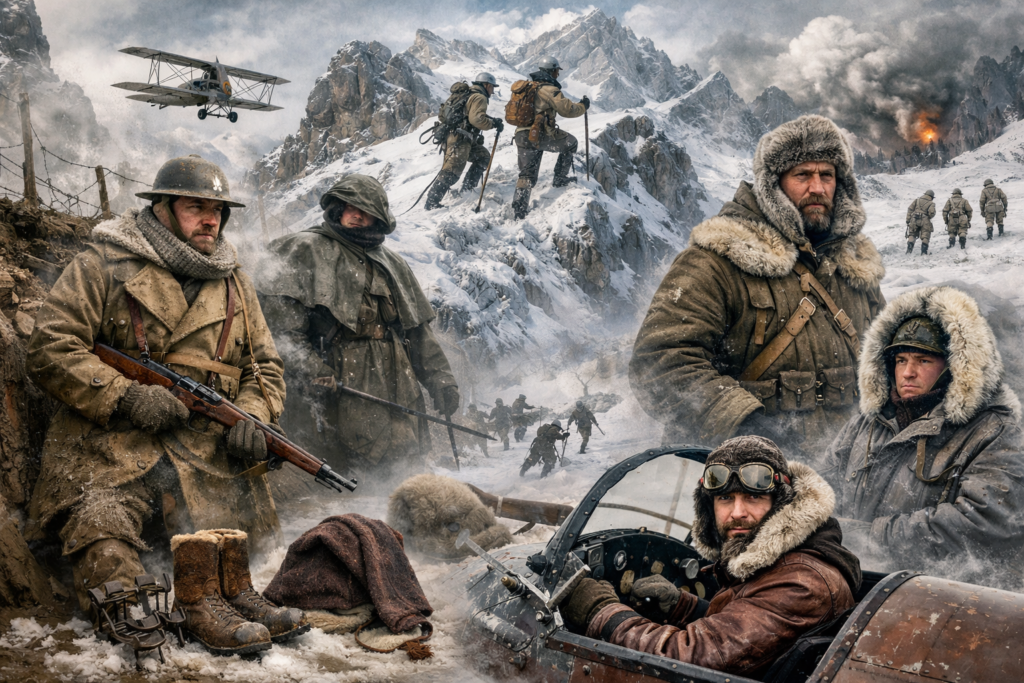
Image Credentials: Image Title: The War Within the War: How WWI Decided the Future of Winter Fashion Source: (sora.openai) Date: January 2026. Attribution: This image was created using AI-generated imagery (sora.openai) and does not depict a real-world scene. Source: (sora.openai) Date: January 2026. Attribution: This image was created using AI-generated imagery (sora.openai) and does not depict a real-world scene.
By Open Chronicle History Desk | January 17, 2026
As the world marks the 110th anniversary of the outbreak of the Great War, the National WWI Museum and Memorial has released a startling new study. It details how the “war unto itself”, the fight against freezing temperatures, did more than just kill soldiers; it fundamentally revolutionized the way we dress in the 21st century.
While history books often focus on the knee-deep mud of the Western Front, it was the brutal winters of 1916 and 1917 that acted as a laboratory for modern outerwear.
The Brutality of the Trenches: Breaking the “Campaign Season”
Before 1914, European wars were largely seasonal affairs. WWI shattered this tradition, forcing millions to endure year-round warfare in some of the most unforgiving climates on Earth.
-
The Western Front: In the sodden fields of Belgium and France, woolen uniforms became death traps, absorbing water and caking with mud until they weighed over 30 kilograms. To fight back, British and Canadian forces pioneered the use of canvas “rain capes,” the ancestors of the modern poncho.
-
The Eastern Front & Siberia: American and Russian forces faced sub-zero realities. Russian troops relied on the bashlik, a long-tailed wool hood, while U.S. troops in Siberia were issued specialized fur-lined “Arctic” kits to prevent “White Death” (hypothermia).
-
The Alpine War: In the Italian Dolomites, the war went vertical. Soldiers faced the dual threat of snipers and avalanches. To survive, they pioneered the use of mountaineering gear—crampons and pickaxes—creating the blueprint for today’s specialized mountain divisions.
Functional Innovation: The Rise of the Trench Coat
Perhaps no legacy is more enduring than the trench coat. While soldiers were originally issued heavy serge “greatcoats,” these were impractical in cramped, wet trenches.
-
Burberry & Aquascutum: Competing British manufacturers developed a lighter, chemically-treated “gabardine” cloth. This fabric was breathable yet waterproof, allowing for a shorter, more mobile cut.
-
Officer’s Choice: Initially a bespoke item for wealthy British officers, the coat featured epaulettes for rank and D-rings for gear. Its silhouette became a status symbol, eventually transitioning from a tool of survival to a global fashion icon still seen on runways in 2026.
-
The Layering Doctrine: WWI popularized the “onion” method, layering wool thermals, cardigans, and overcoats. This remains the gold standard for cold-weather survival in every modern military.
The “Red Baron” and 80-mph Ice Boxes
The study also highlights the extreme measures taken by early aviators. Flying in open-cockpit planes at 17,000 feet meant enduring temperatures far below zero, exacerbated by an 80-mph wind chill.
The legendary German ace Manfred von Richthofen, the “Red Baron,” was famously equipped like an Arctic explorer. He wore custom-made flying boots made from narrow sections of fur-out pelts and massive sheepskin-lined leather coats. To prevent facial frostbite from the spray of castor oil and freezing air, pilots often smeared their faces with thick layers of whale oil or grease.