
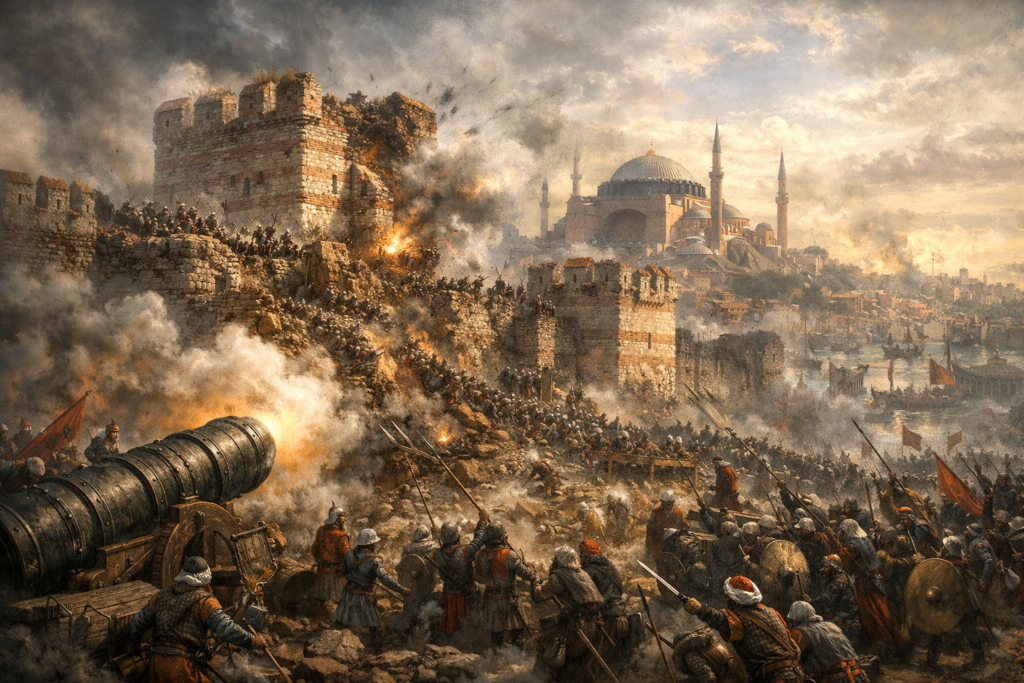
Image Credentials: Image Title: When Stone Met Gunpowder: The Last Medieval Siege of Constantinople Source: (sora.openai) Date: January 2026. Attribution: This image was created using AI-generated imagery (sora.openai) and does not depict a real-world scene.
By Open Chronicle History Desk
In the spring of 1453, the fate of the medieval world narrowed to a single city. Constantinople, capital of the Roman Empire in the East for more than a thousand years, stood behind walls that had defied every enemy since late antiquity. Yet for the first time, those walls faced a weapon that belonged to a new age.
The siege of Constantinople is often remembered as the moment medieval warfare gave way to early modern war. It was not simply a clash between Christians and Muslims, or Romans and Ottomans. It was a collision between a defensive system perfected over centuries and a technology that had only recently matured enough to defeat it.
A city built for an older kind of war
The Theodosian Walls, completed in the fifth century, were the most sophisticated fortifications in the medieval world. Three successive lines of defense, massive stone towers, a wide moat, and carefully engineered angles made them nearly impregnable to rams, ladders, siege towers, and catapults. For centuries, attackers broke themselves against them.
Medieval siege warfare relied on endurance. Armies starved cities, undermined walls, or attempted assaults that could last years. Constantinople’s walls were designed for exactly this kind of conflict, and they worked.
But by the fifteenth century, warfare was changing faster than fortifications could adapt.
The arrival of gunpowder warfare
Gunpowder artillery had existed in Europe and the Islamic world for over a century, but by the 1400s, it reached a decisive threshold. Cannons grew larger, metallurgy improved, and rulers began concentrating resources to deploy artillery on a scale never seen before.
Sultan Mehmed II understood this better than any contemporary ruler. Rather than relying on traditional siege methods alone, he committed enormous wealth to artillery. Foundries cast massive bronze bombards capable of hurling stone balls weighing hundreds of kilograms. Transporting these guns required teams of oxen, reinforced roads, and constant repairs, but Mehmed accepted the cost.
Constantinople could not match this escalation. The Roman defenders possessed some cannons, but they were small, few in number, and difficult to use effectively on medieval walls never designed to support such recoil. The empire’s economic collapse meant there was no way to produce or maintain heavy artillery in sufficient quantity.
Adaptation under pressure
Despite their disadvantages, the defenders did not simply rely on stone. They repaired breaches nightly, filled damaged sections with earth and rubble to absorb impacts, and redeployed troops constantly to threatened sectors. These methods reflected medieval defensive ingenuity pushed to its limits.
The city also benefited from the sea. The great chain across the Golden Horn prevented the Ottoman fleet from attacking the weaker northern walls. Yet even here, innovation prevailed. Mehmed ordered ships hauled overland on greased logs, bypassing the chain entirely. This maneuver shocked the defenders and widened the battlefield beyond the traditional medieval framework.
Isolation and the failure of Christendom
Constantinople’s fall was not inevitable solely because of cannons. It was also the result of isolation. Western Europe possessed artillery and manpower, but political divisions, exhaustion from earlier wars, and distrust between Latin and Greek Christians prevented a coordinated response.
A small number of foreign volunteers, most notably Genoese soldiers under Giovanni Giustiniani, played crucial roles in the defense. But no relief army came. No Western artillery train arrived. The city faced a gunpowder empire alone.
The end of a medieval order
On May 29, 1453, Ottoman forces breached the walls and entered Constantinople. Emperor Constantine XI died fighting, the last Roman emperor falling in the streets of his capital. The city that had once defined the medieval world became the capital of a rising imperial power.
The siege marked more than the end of a state. It symbolized the close of an era in which stone walls, feudal levies, and traditional siegecraft dominated warfare. After Constantinople, European fortifications would change. Star forts, angled bastions, and earth-filled defenses emerged in response to cannon fire.
The Middle Ages did not end overnight. But when the walls of Constantinople fell to gunpowder, it became clear that the medieval balance between offense and defense had been broken.
References
-
Runciman, Steven. The Fall of Constantinople 1453. Cambridge University Press, 1965.
-
Nicolle, David. Constantinople 1453: The End of Byzantium. Osprey Publishing, 2000.
-
Crowley, Roger. 1453: The Holy War for Constantinople and the Clash of Islam and the West. Hyperion, 2005.
-
Norris, John. Early Gunpowder Artillery: 1300–1600. Brill, 2019.
-
Parker, Geoffrey. The Military Revolution: Military Innovation and the Rise of the West, 1500–1800. Cambridge University Press, 1988.
-
Haldon, John. The Byzantine Wars. Tempus Publishing, 2001.
-
Ágoston, Gábor. Guns for the Sultan: Military Power and the Weapons Industry in the Ottoman Empire. Cambridge University Press, 2005.
-
Kafadar, Cemal. Between Two Worlds: The Construction of the Ottoman State. University of California Press, 1995.