
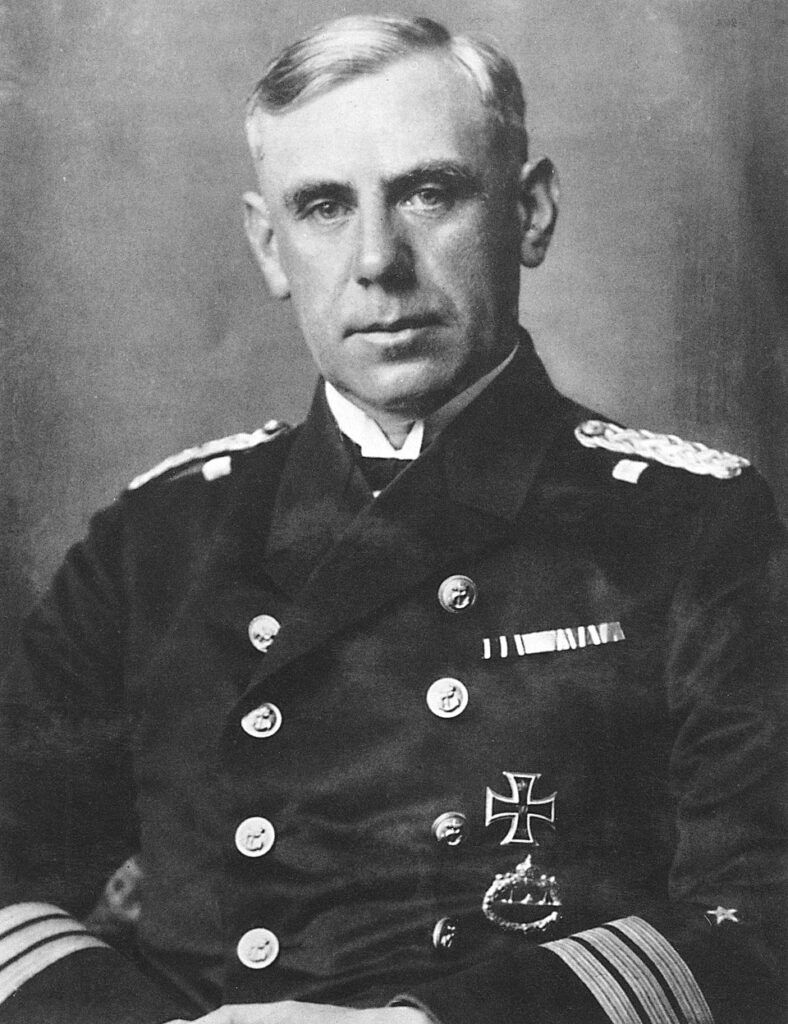
Image: Canaris as a Korvettenkapitän, 1924–31 By Unknown author – Thede Palm: Några studier till T-kontorets historia. Stockholm 1999. Public Domain, (Wikipedia)
By Open Chronicle History Desk
On March 17, 1943, in a quiet, wood-paneled office in Berlin, Admiral Wilhelm Canaris read a report that changed everything. There were no maps of collapsing fronts, no warnings of secret weapons, no news of a catastrophic defeat. Instead, the document described something far more devastating.
It described a factory.
The report detailed an American industrial facility so vast and so efficient that it was projected to produce one four-engine heavy bomber every single hour. To much of the German high command, the claim sounded absurd. It was dismissed as crude propaganda, exaggerated to the point of parody. But to the intelligence officers who had pieced the data together, it was unmistakable.
This was not an exaggeration. It was arithmetic.
Canaris, head of the Abwehr, was not blinded by ideology. He understood a reality that many around Adolf Hitler refused to accept. Modern war was no longer decided primarily by battlefield brilliance or personal courage. It was decided by industrial capacity, logistics, and time. And the numbers emerging from the United States spelled disaster for Germany.
The intelligence did not arrive as a single revelation. It accumulated slowly, carried through neutral diplomats, foreign engineers, and even Germany’s own allies. Conversations mentioned production targets inflated by extra zeros. Reports described aircraft assembly lines operating like automobile plants. Japanese naval attachés sent assessments filled with barely concealed alarm.
All paths led to the same place, the Willow Run Bomber Plant in Michigan.
Operated by Ford, Willow Run applied automobile mass production techniques to the B-24 Liberator, an eighteen-ton aircraft made up of more than a million parts. In Germany, producing a comparable bomber took weeks or months. At Willow Run, the goal was one completed aircraft every sixty minutes.
Canaris and his analysts calculated what this meant.
One bomber per hour meant twenty-four per day. More than seven hundred per month. From a single factory.
At that moment, the entire German aircraft industry struggled to approach even a fraction of that output. If the report was accurate, Germany had not merely lost air superiority. It had already lost the war.
Yet truth collided with ideology.
When Canaris presented the findings to Hermann Göring, the reaction was ridicule. Göring scoffed that Americans could manufacture refrigerators and razor blades, not combat aircraft. To accept the report would have meant admitting that the Luftwaffe was about to be buried beneath an industrial force it could never counter.
The document was dismissed.
Ignored.
When similar figures reached Hitler, the response was harsher. The notion that a democracy he regarded as weak and degenerate could outproduce the so-called master race on such a scale was intolerable. The numbers were rejected not because they lacked evidence, but because believing them would shatter the myth sustaining the regime.
Meanwhile, across the Atlantic, the impossible was already routine.
At Willow Run, tens of thousands of workers labored day and night. Women, immigrants, African Americans, and people previously excluded from heavy industry filled the factory floor. Bombers rolled off the assembly line not as symbols of genius, but as products of process. The United States was not relying on miracle weapons. It was a perfect repetition.
On March 17, 1943, German intelligence officers grasped a truth that power refused to acknowledge.
This was no longer a war of generals or soldiers.
It was a war of mathematics.
And Germany was already losing to time itself.
References
-
Overy, Richard. Why the Allies Won. W. W. Norton & Company, 1995.
-
Tooze, Adam. The Wages of Destruction: The Making and Breaking of the Nazi Economy. Allen Lane, 2006.
-
Higham, Robin, and Carol Williams, eds. Flying Combat Aircraft of WWII. Airlife Publishing, 1993.
-
Herman, Arthur. Freedom’s Forge: How American Business Produced Victory in World War II. Random House, 2012.
-
Murray, Williamson, and Allan R. Millett. A War To Be Won: Fighting the Second World War. Harvard University Press, 2000.
-
U.S. National Park Service. “Willow Run and the Arsenal of Democracy,” historical archives and wartime production records.
-
Kershaw, Ian. Hitler: Nemesis. Penguin Books, 2001.
-
CIA Historical Review Program. German Intelligence Assessments of Allied Industrial Capacity, 1942–1943.