
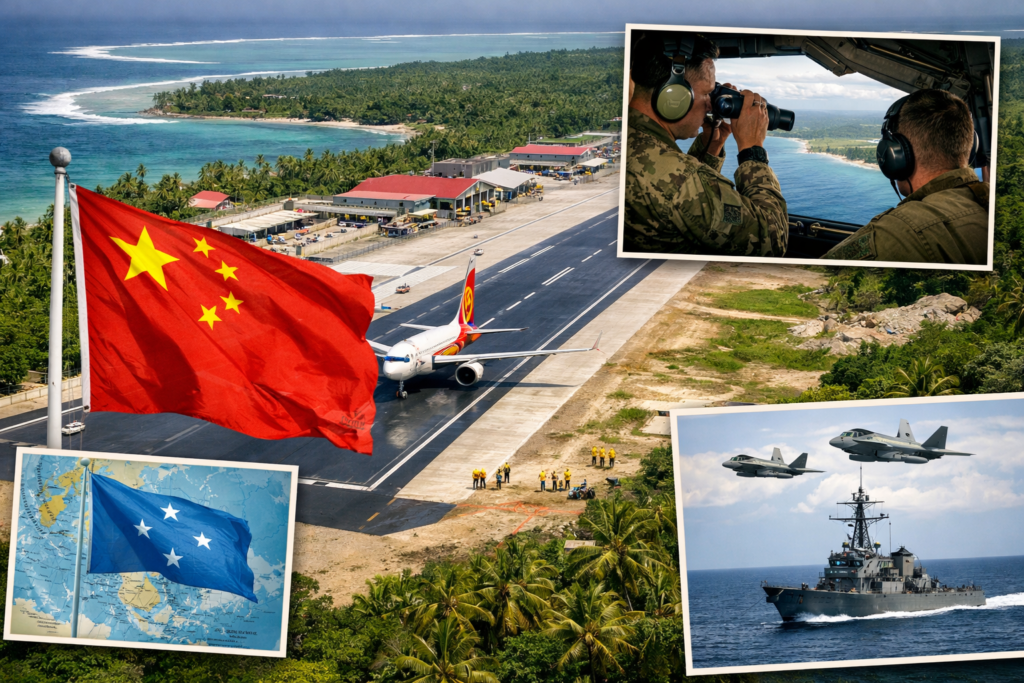
Image Credentials: Image Title: Pacific Alert: China Expands Strategic Footprint in Micronesia with New Infrastructure as U.S. Experts Urge Immediate Action Source: (sora.openai) Date: January 2026. Attribution: This image was created using AI-generated imagery (sora.openai) and does not depict a real-world scene.
By Open Chronicle News Desk
PALIKIR, MICRONESIA – A series of major infrastructure projects led by the People’s Republic of China has sparked intense security concerns in Washington, as Beijing reportedly secures a deeper foothold in the strategically vital Federated States of Micronesia (FSM). The latest development, the opening of a new runway on the Yap islands, has prompted urgent calls for the United States to counter what critics describe as an “infiltration” of key Pacific territories.
The new runway and surrounding facilities, built under the guise of boosting local tourism and connectivity, are being viewed through a military lens by U.S. defense analysts. Experts warn that such infrastructure could easily be repurposed to support Chinese military aircraft, potentially threatening U.S. dominance in the “Second Island Chain” and complicating defense logistics for the territory of Guam.
🚨🚨🚨 China is methodically chipping away at America’s Pacific defense architecture, and Yap’s Woleai airfield is the latest warning sign.
Despite the Federated States of Micronesia’s Compact of Free Association with Washington, Beijing has secured a deal to refurbish the… https://t.co/6dYHOQ06fw pic.twitter.com/8VA9MoeEfj
— Byron Wan (@Byron_Wan) December 23, 2025
“Beijing is not just building roads and runways; they are embedding themselves into the sovereign architecture of the Pacific,” stated a security analyst familiar with the region. “By the time the U.S. realizes the full scope of these ‘civilian’ projects, the strategic landscape will have already shifted.”
The infrastructure push in Micronesia is part of a broader pattern of Chinese investment across the Pacific, often involving long-term loans and state-backed construction firms. For the FSM, which maintains a “Compact of Free Association” with the United States, the presence of Chinese state-run projects creates a delicate diplomatic balancing act. While local leaders often welcome the investment to address critical developmental needs, the U.S. has increasingly urged its Pacific partners to consider the long-term security implications of Chinese involvement.
As tensions in the Indo-Pacific remain at a fever pitch, Republican lawmakers and military leaders are calling on the Biden administration to provide more robust economic alternatives to Pacific Island nations. The goal, advocates argue, is to ensure that these vital territories do not feel compelled to turn to Beijing for basic infrastructure needs, thereby preserving the “Free and Open Indo-Pacific” doctrine.
With the 2026 defense budget currently under debate, the “Micronesia Infiltration” is expected to become a central talking point for those pushing for increased maritime security funding and a renewed focus on Pacific diplomacy.