
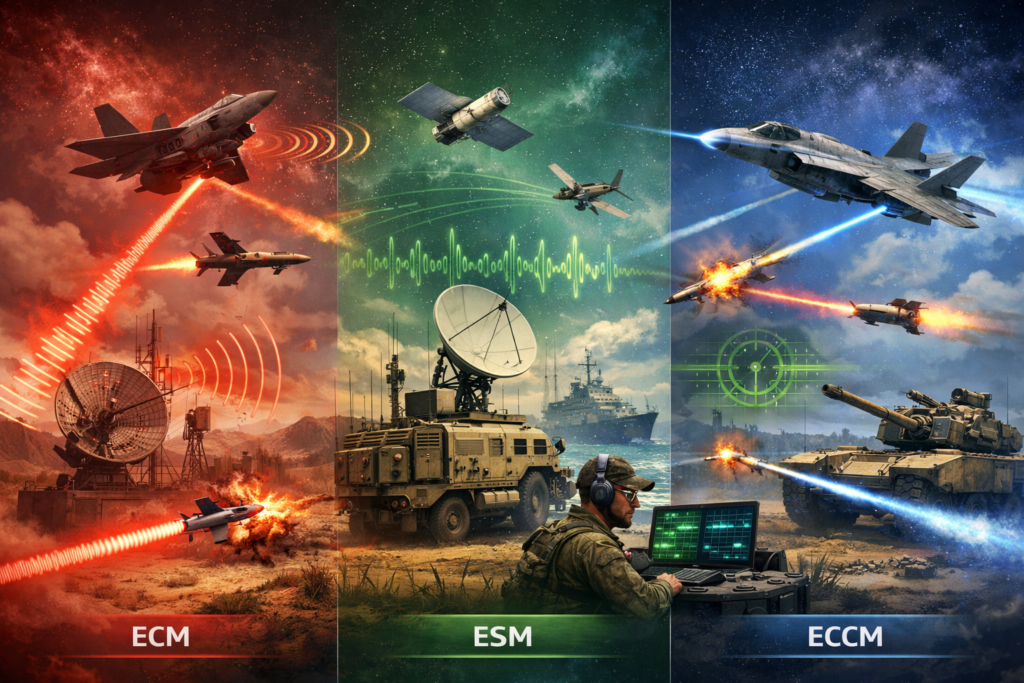
Image Credentials: Image Title: The Invisible Front: How Electronic Warfare is Shaping the Future of Combat Source: (sora.openai) Date: January 2026. Attribution: This image was created using AI-generated imagery (sora.openai) and does not depict a real-world scene.
By Open Chronicle Military Desk
WASHINGTON D.C. — While traditional warfare is fought on land, at sea, and in the air, a silent and invisible battle is raging across the electromagnetic spectrum. Electronic Warfare (EW), once a niche capability, has emerged as a primary domain of conflict, capable of neutralizing multi-million dollar weapon systems without firing a single kinetic round.
According to a comprehensive technical analysis by defense experts, EW is broadly defined as the use of any part of the electromagnetic spectrum, including radio waves, infrared, and even visible light, to attack an enemy or impede their operations. The field is typically categorized into three distinct pillars: Electronic Countermeasures (ECM), Electronic Counter-Countermeasures (ECCM), and Electronic Support Measures (ESM).
Jamming: Overwhelming the Senses
The most recognizable form of EW is jamming. Unlike popular depictions in fiction, jamming rarely makes a target “invisible.” Instead, it creates a “mess of returns” on enemy sensors, making it impossible for them to distinguish a real aircraft or ship from a false signal.
Low-tech solutions like “chaff”, thin strips of aluminum dropped to confuse radar, remain in use, but they are increasingly supplemented by advanced active jammers. These systems emit powerful signals that mimic enemy radar frequencies, sending back false data regarding bearing and distance to prevent a “firing solution.”
The stakes are particularly high regarding GPS. “Modern warfare has become over-reliant on satellite navigation,” the report notes. In regions like Ukraine and Syria, Russian systems such as the Murmansk-BN, a platform capable of jamming communications over thousands of kilometers, have demonstrated the ability to disrupt entire military networks and precision-guided munitions.
The Rise of Counter-Drone EW
The proliferation of cheap, explosive-laden consumer drones has forced a rapid evolution in EW tactics. Defending against a $500 drone with a $100,000 missile is economically unsustainable. As a result, portable and vehicle-mounted jammers have become vital for protecting high-value targets, from military bases to presidential motorcades.
In 2018, the attempted assassination of Venezuelan President Nicolás Maduro via drone highlighted a vulnerability that EW is now being rushed to fill.
The Evolution of Defense: ECCM and Stealth
As jamming technology improves, so do the methods to defeat it. Electronic Counter-Countermeasures (ECCM) now include “home-on-jam” missiles that actually track the source of a jamming signal. Modern AESA (Active Electronically Scanned Array) radars are also becoming harder to jam because they can rapidly shift frequencies, forcing a jammer to spread its power too thin to be effective.
A Domain of Its Own
The importance of the electromagnetic spectrum is so great that NATO now classifies Electronic Warfare as its own dedicated “warfighting environment,” alongside space and cyberspace.
History shows the cost of ignoring this invisible front. During World War II, a German failure to correctly identify the frequency of Britain’s “Chain Home” radar system allowed the RAF to use its limited fighter force with devastating efficiency. Experts warn that in a modern peer-to-peer conflict, the side that loses control of the spectrum will likely lose the war before the first shot is even fired.