
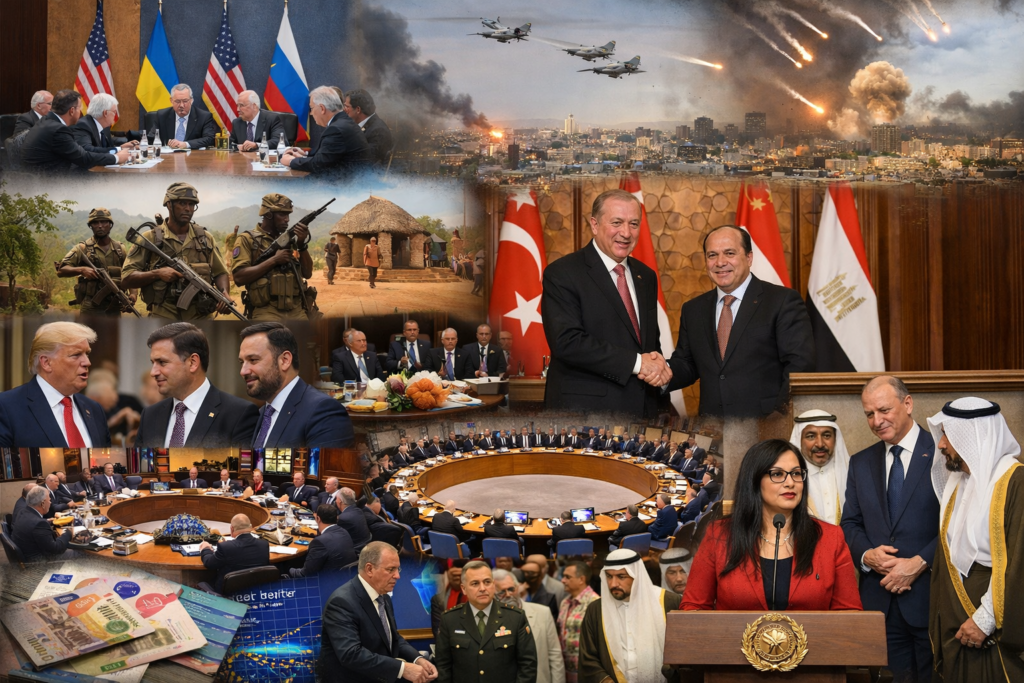
Image Credentials: Image Title: Global News Brief: Key Events and Developments for February 4, 2026 Source: (sora.openai) Date: January 2026. Attribution: This image was created using AI-generated imagery (sora.openai) and does not depict a real-world scene.
Global News Brief | February 4, 2026
By Open Chronicle Staff
Diplomacy, security tensions, and economic signals dominate the global agenda as leaders and institutions engage across multiple regions.
In the Middle East, US President Donald Trump’s special envoy Steve Witkoff is set to join Ukraine-Russia peace talks in Abu Dhabi, where delegations are resuming US-mediated negotiations aimed at ending the war that began in 2022. At the same time, Israel remains on heightened security alert amid reports of preparations for a potential US strike on Iran, following an Israeli military drill simulating a large-scale Iranian missile attack on major cities.
In Africa, attention is focused on Sudan’s South Kordofan state after the army announced it had lifted the siege on Kadugli, raising hopes for improved humanitarian access amid ongoing conflict.
In Türkiye and Egypt, President Recep Tayyip Erdogan is visiting Cairo for high-level talks with President Abdel Fattah el Sisi. The visit includes the signing of bilateral agreements, a joint press conference, and the Türkiye Egypt Business Forum, signaling renewed momentum in political and economic relations.
In Washington, President Trump is scheduled to give a closed-door television interview and attend internal policy talks at the White House. Separately, US Secretary of State Marco Rubio is hosting the inaugural Critical Minerals Ministerial, bringing together delegations from more than 50 countries to strengthen and diversify global supply chains. Vice President JD Vance is also expected to attend.
At the United Nations, the Security Council will convene to assess the global threat posed by ISIS, based on the secretary general’s latest strategic report, with senior counterterrorism officials briefing members.
In Latin America, Venezuela’s acting president Delcy Rodriguez will address the nation to mark one month since the US military operation that led to the capture of former president Nicolas Maduro. The event underscores continuing political upheaval and international scrutiny.
In Europe and the Gulf, German Chancellor Friedrich Merz is beginning a three-day tour of Saudi Arabia, Qatar, and the United Arab Emirates, accompanied by a business delegation, to discuss regional stability and economic cooperation. Across Europe, political reactions continue following the release of extensive new documents related to Jeffrey Epstein, triggering debate and statements in several countries.
In Asia, China’s top legislative body is expected to decide the fate of two senior generals under investigation for disciplinary violations. Pakistan is hosting Kazakh President Kassym Jomart Tokayev for high-level talks in Islamabad, while Kyrgyzstan is welcoming the B5 plus 1 Forum, bringing together Central Asian and US business leaders in Bishkek. Russia’s Foreign Ministry spokeswoman Maria Zakharova is also holding her weekly press briefing in Moscow.
On the economic front, Eurostat is releasing January inflation data for the eurozone, with markets expecting inflation to fall further after easing to 1.9 percent in December.
In special reports, analysts examine whether the European Union can genuinely pursue strategic autonomy from the United States on China policy, amid deep structural dependence on Washington. In Spain, a landmark decision to regularize around half a million undocumented migrants is explored through the lens of citizen pressure, political backlash, and long term migration challenges. In Pakistan, a deadly fire at a Karachi shopping mall has renewed warnings over unchecked urban growth, weak regulation, and systemic failures in one of the world’s fastest-growing megacities.
Together, these developments reflect a world shaped by fragile diplomacy, shifting alliances, economic uncertainty, and growing pressure for structural reform across regions.