
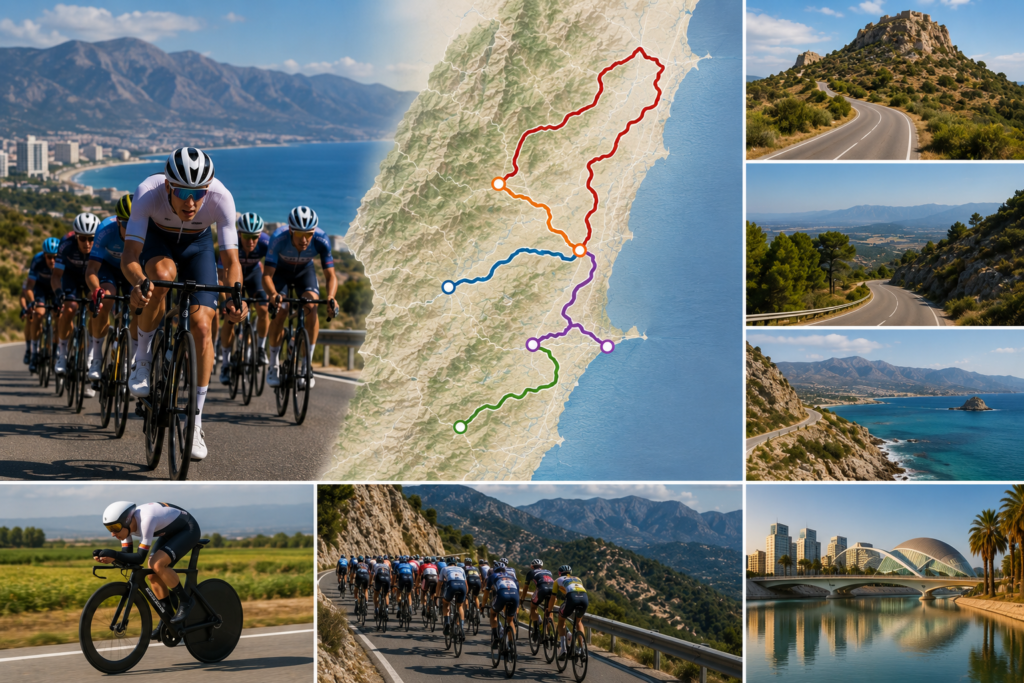
Image Credentials: Image Title: Tour of Valencia 2026 Route: A Balanced Test of Speed, Climbing and Time-Trial Power. Source: (chatgpt.com) Date: July 2026. Attribution: This image was created using AI-generated imagery (chatgpt.com) by Open Chronicle and does not depict a real-world scene.
By Open Chronicle News Desk with Agencies
The 2026 Volta a la Comunitat Valenciana offered a varied and demanding five-day route that tested every aspect of modern stage racing. Covering approximately 600 kilometres between 4 and 8 February, the race featured three hilly stages, an individual time trial and a decisive queen stage in the mountains.
Designed to suit sprinters, puncheurs, climbers and time-trial specialists alike, the route ensured that the battle for the general classification remained open until the penultimate day.
Stage 1 – Early hills before a likely sprint
The opening stage immediately introduced riders to the rolling terrain of the Valencian Community.
Although the route included the Alto de los Madroños and a series of climbs around Oropesa during the final 40 kilometres, the profile was not considered selective enough to eliminate the sprinters.
Teams with fast finishers were expected to control the race before a reduced bunch sprint decided the first leader’s jersey.
The stage represented the first opportunity for the peloton to establish the early hierarchy while allowing the fastest riders to compete for victory.
Stage 2 – A decisive race against the clock
The second day featured the race’s only individual time trial, a 17.5-kilometre test between Carlet and Alginet.
The opening section demanded excellent bike-handling skills through several technical corners before the riders tackled a three-kilometre climb.
A rapid descent into Alginet completed a course that rewarded both power and technical ability.
For the general classification contenders, this stage represented the first major opportunity to create meaningful time gaps.
Stage 3 – Flat opening, explosive finale
Stage 3 presented two very different races within one day.
The opening 100 kilometres were largely flat, allowing breakaway specialists an opportunity to establish an advantage.
However, the character of the stage changed dramatically in the second half, where riders faced two consecutive climbs before a long descent towards the finish.
The terrain favoured aggressive racing, with climbers, puncheurs and strong all-rounders all capable of contesting the victory.
Stage 4 – The Queen Stage
The race reached its climax on Stage 4.
Widely regarded as the decisive day of the race, the queen stage featured:
- Five classified climbs
- Approximately 3,300 metres of elevation gain
- A demanding route through the mountainous interior of the Valencian Community
Among the key ascents was the Alto del Miserat, before attention turned to the race’s defining challenge.
The final selection was expected on the steep slopes leading to Cumbres del Sol, one of Spanish cycling’s most famous finishing climbs.
Although the summit lay 12 kilometres from the finish in Teulada, the climb itself was steep enough to encourage attacks from the strongest climbers and general classification favourites.
Any rider hoping to win the overall title needed to perform at their highest level on this stage.
Stage 5 – Breakaway specialists get one final chance
The closing stage travelled from Bétera to the city of Valencia, following a route that had already become familiar in recent editions.
Along the way, riders crossed:
- Puerto de Oronet
- Puerto del Garbí
The profile closely resembled the final stages used in both the 2023 and 2024 editions.
History suggested that aggressive racing would once again prevail.
In 2023, Rui Costa won after defeating Thymen Arensman in a sprint from the breakaway.
A year later, Will Barta claimed victory with a memorable long-range solo attack.
The repeated success of breakaways on this terrain meant teams would need to carefully judge whether to chase or allow escapees to fight for the stage victory.
A route offering opportunities for every rider
The organisers once again produced a route that balanced different cycling disciplines.
Sprinters had chances to shine on the flatter stages, while the individual time trial rewarded specialists against the clock.
The hilly terrain encouraged aggressive racing throughout the week, and the queen stage ensured the strongest climber would ultimately shape the battle for the overall title.
With only around 600 kilometres of racing, every stage carried significant importance, leaving little room for mistakes.
An ideal early-season challenge
The Volta a la Comunitat Valenciana has become one of the premier early-season stage races on the European calendar, attracting many of the world’s leading riders as they prepare for the spring classics and Grand Tours.
Its combination of technical roads, varied terrain and demanding climbs provides an ideal first examination of form, while the spectacular landscapes of eastern Spain continue to make it one of the most visually impressive races of the season.
The 2026 route maintained that tradition, delivering a compact but highly competitive parcours capable of producing exciting racing from the opening stage to the finish in Valencia.