
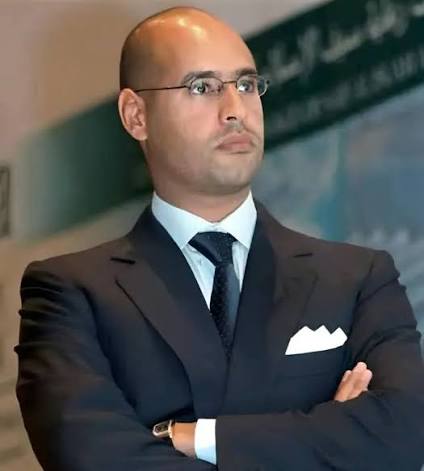
Image: from New Direction AFRICA X@Its_ereko
By Open Chronicle Staff
ZINTAN, Libya — Saif al-Islam Gaddafi, the once-heralded “reformist” heir to Libya’s fallen dictator Muammar Gaddafi, was assassinated on Tuesday, February 3, 2026. The 53-year-old was reportedly killed during a sophisticated raid on his residence in the western city of Zintan, a location that served as both his prison and his sanctuary for over a decade.
The news was confirmed late Tuesday by his legal counsel, Khaled al-Zaidi, and his political advisor, Abdullah Osman. According to reports from his political team, a four-man commando unit carrying out a “cowardly and treacherous assassination” stormed the residence at approximately 2:00 PM local time.
A Professional Strike
Details emerging from the scene suggest a highly coordinated operation. Assailants reportedly disabled the residence’s surveillance cameras before breaching the perimeter. While some early reports suggested a “direct confrontation” or a shootout, the consensus from Gaddafi’s inner circle describes an execution-style killing.
“Four masked men stormed the house and killed him,” a statement from his political office read. “He clashed with the attackers in a desperate attempt to defend himself, but they had prepared to conceal the traces of their heinous crimes.”
The 444 Combat Brigade, one of Libya’s most powerful armed factions, has “categorically” denied any involvement in the killing. The Libyan Attorney General’s Office has since opened an investigation, though official confirmation from the Government of National Unity (GNU) in Tripoli remains pending.
The Man Who Would Be King
Saif al-Islam’s death marks the violent end of a complicated and often contradictory life. Educated at the London School of Economics and fluent in English, he was for years the “Western-friendly” face of the Gaddafi regime. He played a pivotal role in negotiating Libya’s abandonment of its weapons of mass destruction (WMD) program in 2003 and securing compensation for the families of the Lockerbie bombing victims.
However, his reputation as a liberal reformer vanished in February 2011. As the Arab Spring reached Libya, Saif al-Islam chose family loyalty over his democratic rhetoric. In a famous televised address, he wagged his finger at the nation, warning that “rivers of blood” would flow if the protests continued and calling the rebels “rats”—a phrase his father would later use before his own brutal death in Sirte.
🚨🇱🇾 BREAKING: Saif al-Islam Gaddafi, son of late Libyan leader Muammar Gaddafi, has been assassinated. pic.twitter.com/nVtM1gzJsn
— Jackson Hinkle 🇺🇸 (@jacksonhinklle) February 3, 2026
A Political Ghost
Captured in November 2011 while trying to flee to Niger, Saif al-Islam spent six years in a Zintan prison. Despite being sentenced to death in absentia by a Tripoli court in 2015 and being wanted by the International Criminal Court (ICC) for crimes against humanity, he was granted amnesty by a rival eastern-based government in 2017.
In November 2021, he made a shock public appearance in the southern city of Sabha to register as a presidential candidate. His bid, which relied on nostalgia for the stability of the Gaddafi era, proved so polarizing that it contributed to the total collapse of the 2021 election process. Until his death, he remained a powerful, if hidden, symbol for those who remained loyal to the former Jamahiriya.
A Nation in Fragments
The assassination of the most prominent surviving Gaddafi son threatens to further destabilize a country already torn between rival administrations in Tripoli and Benghazi. Analysts warn that his death may turn him into a martyr for the “Green” movement (Gaddafi loyalists), potentially sparking retaliatory violence across the tribal south and western highlands.
As of Wednesday morning, the identity of the four gunmen remains unknown. In the vacuum of Libya’s fractured security landscape, many fear that the truth behind the raid in Zintan may be buried along with the last true heir of the Gaddafi dynasty.