
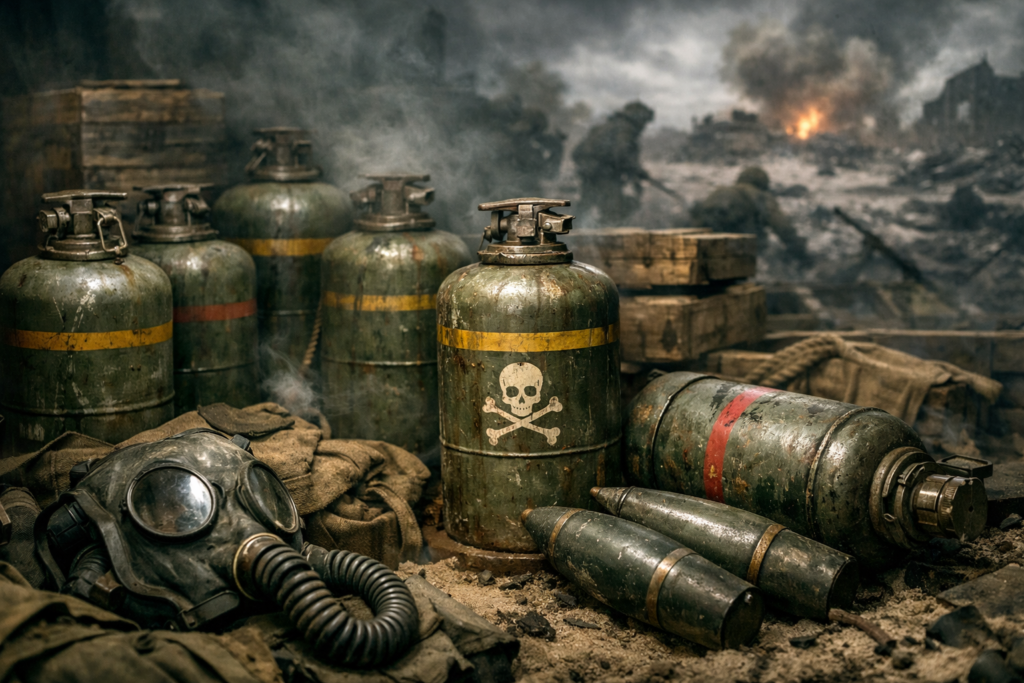
Image Credentials: Image Title: The Great Restraint: Why the Reich’s Gas Remained Bottled Source: (sora.openai) Date: February 2026. Attribution: This image was created using AI-generated imagery (sora.openai) and does not depict a real-world scene. Source: (sora.openai) Date: February 2026. Attribution: This image was created using AI-generated imagery (sora.openai) and does not depict a real-world scene.
By the Open Chronicle History Desk
For over eight decades, students of history have grappled with a chilling paradox: why did a regime that showed no hesitation in orchestrating industrial-scale genocide refrain from using its most advanced “miracle weapons” on the battlefield?
Germany entered World War II with a terrifying technological lead. While the Allies were still relying on World War I-era mustard gas, Nazi scientists had synthesized nerve agents, Tabun and Sarin, against which Allied gas masks and protective gear were virtually useless. Yet, from the beaches of Normandy to the ruins of Berlin, these canisters remained sealed.
The Myth of the Corporal’s Conscience
A popular narrative suggests that Adolf Hitler’s refusal to use chemical weapons stemmed from his own trauma. In October 1918, as a young corporal, Hitler was temporarily blinded by a British gas attack at Ypres.
However, modern scholarship suggests that “squeamishness” is a poor fit for a man who oversaw the Holocaust. While his personal experience likely shaped his perspective, the “Table Talks” and military records suggest a far more cold-blooded calculus.
The Churchillian Ultimatum
The most immediate deterrent was the credible threat of overwhelming retaliation. Winston Churchill was under no illusions about the stakes. He famously stated that he would “drench the German cities” in poison gas should the Wehrmacht initiate chemical warfare.
The logistical reality backed this up. While Germany had better gas, the Allies had more of it and, crucially, total air superiority by 1943.
-
The RAF Stockpile: Approximately 30,000 tons of chemical agents.
-
The USAAF Factor: Over 100,000 tons of chemical munitions waiting in reserve.
-
The Delivery Gap: Germany lacked the heavy bombers and fuel to strike British cities effectively by mid-war, whereas the Allies were already flattening German industrial centers with conventional explosives.
The Anthrax Factor and Biological Brinkmanship
While chemical warfare was a “known” quantity, the biological front was even more clandestine. The British “Operation Vegetarian” showcased a terrifying readiness to destroy the German food supply.
The British produced roughly 5 million linseed cattle cakes laced with anthrax spores. The plan was to drop these over German pastures, decimating the livestock and causing a secondary epidemic among the human population. This was a “doomsday” weapon that Hitler, despite his collaboration with the infamous Japanese Unit 731, simply could not match in scale or delivery capability.
Logistic and Military Hesitation
Beyond the fear of retaliation, the German military high command (OKW) was pragmatically opposed to gas for several reasons:
-
Horse-Drawn Logistics: The Wehrmacht relied heavily on millions of horses for transport. Protecting animals from gas was nearly impossible, and losing them would have paralyzed the army.
-
Unpredictable Winds: On the vast Eastern Front, shifting winds made gas a liability that could easily blow back onto German lines.
-
The Intelligence Failure: German intelligence erroneously believed the Allies had also discovered nerve agents. They feared that if they used Tabun, the Allies would retaliate with something equally advanced (even though the Allies didn’t actually have it yet).
Bibliography
-
Churchill, Winston. The Second World War. Vol. 4, The Hinge of Fate. Boston: Houghton Mifflin, 1950.
-
Harris, Robert, and Jeremy Paxman. A Higher Form of Killing: The Secret History of Chemical and Biological Warfare. New York: Random House, 2002.
-
Picker, Henry. Hitler’s Table Talk, 1941-1944: His Private Conversations. Translated by Norman Cameron and R.H. Stevens. New York: Enigma Books, 2000.
-
Schmidt, Ulf. Secret Science: A Century of Poison Warfare and Human Experiments. Oxford: Oxford University Press, 2015.