
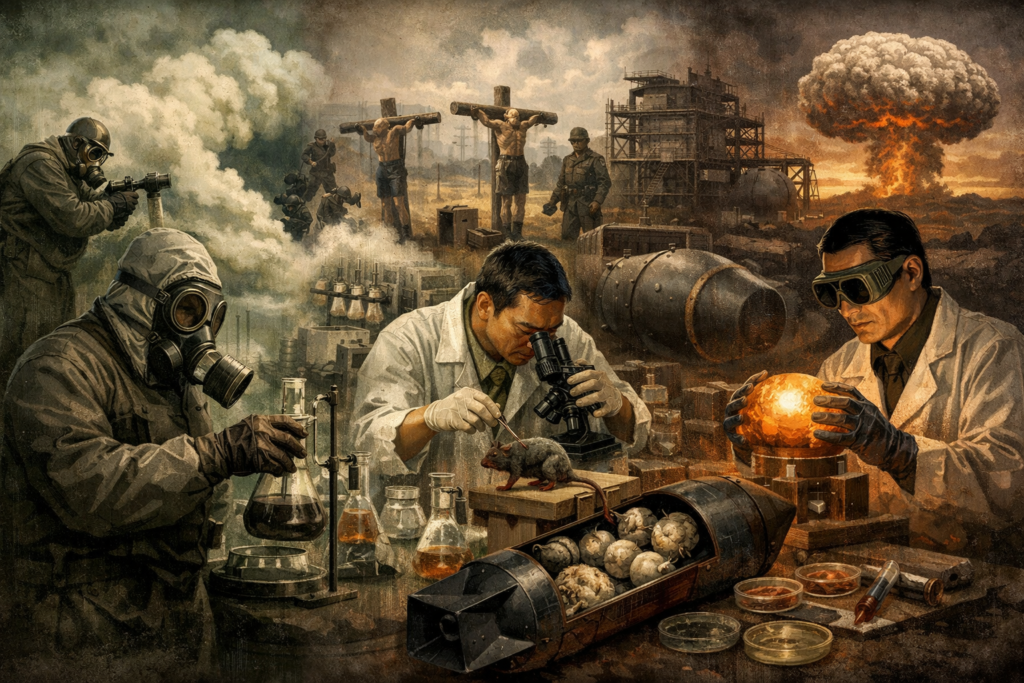
Image Credentials: Image Title: The Black Projects of the Rising Sun: Japan’s Hidden WMD Program Source: (sora.openai) Date: February 2026. Attribution: This image was created using AI-generated imagery (sora.openai) and does not depict a real-world scene.
Open Chronicle History
Vol. 33 | Issue 05 | Special Report: The Factories of Death
By the Open Chronicle History Desk
While the mushroom clouds over Hiroshima and Nagasaki have come to define the catastrophic end of World War II, a darker, often suppressed narrative exists: the extensive and successful developmentand deployment of Weapons of Mass Destruction (WMDs) by Imperial Japan. Far from being a mere victim of the atomic age, Japan operated a sophisticated “triad” of chemical, biological, and nuclear programs that rivaled, and in the case of germ warfare, exceeded the lethality of the Allied powers.
Okunoshima: The Island Erased from the Map
The heart of Japan’s chemical arsenal was Okunoshima, a small island in the Inland Sea. From 1929 to 1945, the island was literally removed from Japanese maps to preserve secrecy. Here, the military produced massive quantities of mustard gas, lewisite, and cyanogen chloride.
Unlike the European theater, where chemical weapons remained a deterrent, Japan used them extensively in China. Archival research indicates that at least 839,956 individual munitions—including artillery shells, mortar rounds, and hand grenades—were manufactured and shipped to the Chinese front.
-
The Aftermath: In 1945, retreating Japanese forces attempted to bury the evidence, dumping hundreds of thousands of shells into rivers or burying them in pits.
-
The Human Toll: In the decades since, these leaking “discarded” weapons have caused numerous fatalities and persistent health crises for Chinese civilians and construction crews.
Unit 731: The Factory of Genocidal Science
The most macabre chapter of Japan’s WMD program was conducted by Unit 731 in Manchukuo (Manchuria). Under the direction of Dr. Shiro Ishii, this facility became a “factory of death,” where human beings were treated as “maruta” (logs) for gruesome experimentation.
The scale of production was staggering. Researchers developed weaponized strains of anthrax, glanders, and the bubonic plague. These were not just laboratory samples; they were used in field operations that created “rotted leg villages”, areas where biological agents caused survivors to suffer from necrotic tissue and open wounds for the remainder of their lives.
Failed Strikes and the “Cherry Blossoms” Plan
Japan’s biological reach was intended to span the Pacific:
-
Submarine Logistics: A submarine carrying biological cargo was sunk by Allied forces before it could strike.
-
The Glider Incident: German-made gliders, repurposed for bioweapon delivery, crashed short of their Pacific targets.
-
Operation Cherry Blossoms at Night: Planned for September 1945, this mission involved using submarine-launched planes to drop plague-infected fleas over San Diego, California. The plan was only halted by the Japanese surrender in August.
The Axis Liaison: Riems Island and the Nuclear Race
The Third Reich was a keen observer of Japanese “success.” Nazi scientist Kurt Blome maintained a technical data-sharing arrangement with Unit 731, mirroring his own work on Riems Island. Simultaneously, figures like Erich Schumann—central to Germany’s nuclear effort—pushed for biological strikes against the American mainland to disrupt agriculture and public health.
Perhaps most controversial is Japan’s own nuclear pursuit. Operating in both Tokyo and Hungnam (modern North Korea), Japanese physicists were racing to enrich uranium. While they failed to complete a functional device before the war’s end, their willingness to use such a weapon was absolute.
The “Victim Narrative” vs. Statistical Reality
The modern historical memory often frames Japan solely as the victim of WMDs. However, when examining the casualty figures of Japan’s chemical and biological campaigns in China, a different picture emerges.
| Weapon Category | Estimated Casualties (Low) | Estimated Casualties (High) |
| Japanese Chemical/Biological | 40,000 | 500,000+ |
| Atomic (Hiroshima/Nagasaki) | 129,000 | 226,000 |
If the higher estimates are correct, Japanese WMDs claimed more lives than the two atomic strikes combined.
Bibliography
-
Barenblatt, Daniel. A Plague upon Humanity: The Secret History of Japan’s Germ Warfare Operation. New York: HarperCollins, 2004.
-
Gold, Hal. Unit 731 Testimony: Japan’s Wartime Human Experimentation Program. Tokyo: Tuttle Publishing, 2011.
-
Grundon, Nicholas. “The Forgotten Victims of Okunoshima.” The Asia-Pacific Journal: Japan Focus 1, no. 6 (2003).
-
Tsuneishi, Keiichi. The Unit 731 and the Japanese Imperial Army’s Biological Warfare Program. Lanham: Rowman & Littlefield, 2005.