
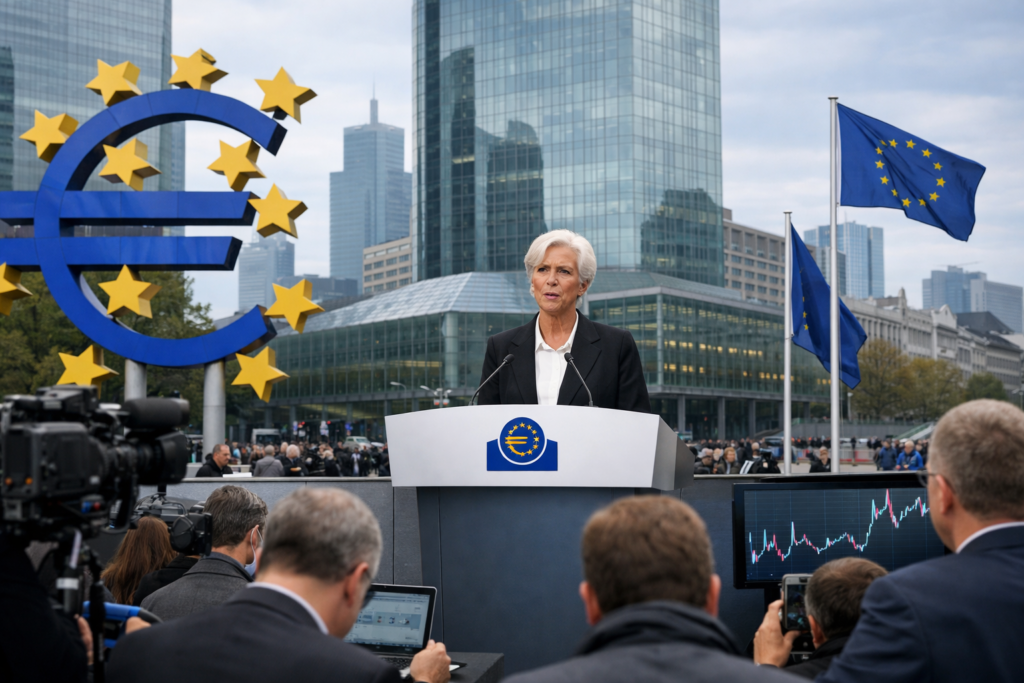
Image Credentials: Image Title: ECB Holds Rates Steady Amidst Fragile Growth and Inflation Uncertainty Source: (sora.openai) Date: February 2026. Attribution: This image was created using AI-generated imagery (sora.openai) and does not depict a real-world scene.
By Open Chronicle Staff with Agencies | February 5, 2026
FRANKFURT — The European Central Bank (ECB) has opted to maintain its key interest rates at their current levels following its first major policy meeting of 2026. The decision, announced today in Frankfurt, reflects a cautious “wait-and-see” approach as the Eurozone grapples with a combination of stagnant growth and fluctuating inflation data.
The Governing Council confirmed that the deposit facility rate will remain at 2.00%, while the main refinancing operations and the marginal lending facility rates stay at 2.15% and 2.40%, respectively.
1/2 It's @ecb #monetarypolicy day!
With euroarea medium-term inflation +/- at target, #ECB Governing Council is expected to keep its key interest rates on hold (DFR at 2.00%, MRO at 2.15% and MLF at 2.40% since the mini cut of June 2025), preserving ECB flexibility capacities, pic.twitter.com/gbRlGDvxck— Émilie Vanderhulst 🌻 🇧🇪🇪🇺 (@BirdingBrussels) February 5, 2026
A Data-Dependent Path
In a statement following the meeting, ECB officials reiterated their commitment to a “meeting-by-meeting” strategy. While inflation has cooled significantly from the peaks seen in previous years, the bank remains wary of underlying price pressures, particularly in the services sector and volatile energy markets.
“The Governing Council is determined to ensure that inflation returns to its 2% medium-term target promptly,” the bank stated. “Current data suggests that while we are on the right trajectory, the risks surrounding the inflation outlook remain balanced, necessitating a prudent monetary stance.”
The decision comes amid revised staff projections that suggest a more tepid recovery for the Eurosystem. Growth for 2026 is now estimated at a modest 1.0%, a slight downward revision from previous forecasts, as high borrowing costs continue to dampen industrial investment and consumer spending across the bloc.
Market Reaction and “Higher for Longer”
Financial markets reacted with relative calm to the announcement, as most analysts had priced in a hold. However, the tone of the meeting suggests that any hopes for aggressive rate cuts in the first half of the year may be premature.
Economists note that the ECB is balancing a delicate “double act”: attempting to stifle the last remnants of inflation without tipping the Eurozone’s largest economies, such as Germany, into a deeper recession.
The bank also highlighted the continued role of the Transmission Protection Instrument (TPI), a tool designed to prevent “disorderly market dynamics” that could see borrowing costs for more indebted member states, like Italy and Greece, spike disproportionately compared to their neighbors.
Eyes on the Horizon
The focus now shifts to the ECB’s next moves in late spring. With the U.S. Federal Reserve also signaling a cautious approach to its own rate cycle, the ECB appears content to remain in a holding pattern until more definitive wage and productivity data become available in the second quarter.
As Eurozone citizens continue to face high mortgage and loan repayments, today’s decision serves as a reminder that the era of “easy money” remains a distant memory, even as the immediate threat of runaway inflation begins to fade.