
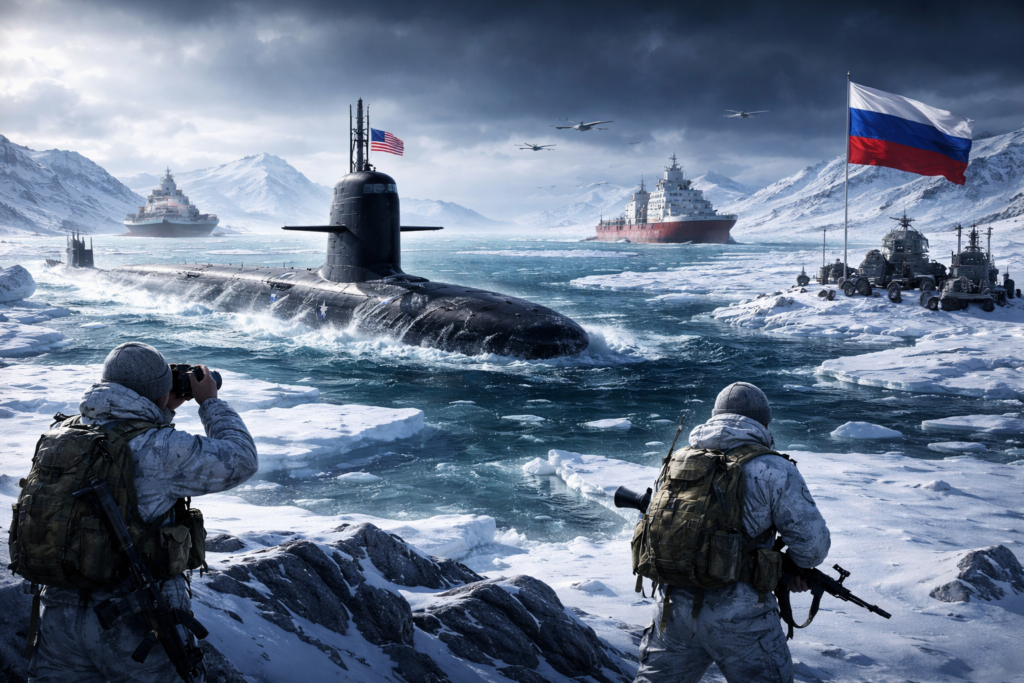
Image Credentials: Image Title: Arctic Brinkmanship: The Thaw that Rekindled a Cold War Source: (sora.openai) Date: February 2026. Attribution: This image was created using AI-generated imagery (sora.openai) and does not depict a real-world scene.
By José Carlos Palma for The Grand Strategy Institute | February 5, 2026
As the “Last Ice Area” of the Queen Elizabeth Islands continues its unprecedented structural breakdown, the Arctic has shifted from a scientific concern to the premier arena for 21st-century great power competition. For decades, the region was governed by the mantra “High North, Low Tension.” Today, as the ice recedes, that peace is being replaced by a race to secure the world’s final untapped resource frontier.
A new report from Euronews highlights a sobering reality, while the Arctic environment is opening up at a record pace, Western allies currently lack the specialized military capabilities to withstand its harsh conditions and effectively counter a rapidly mobilizing Russia.
The strategic landscape of 2026 is defined by a deep and growing rift within the NATO alliance. President Donald Trump has reignited his interest in the strategic value of Greenland, characterizing it as essential to U.S. national security. This “interest and authority” approach has triggered a “fundamental disagreement” in Nuuk and Copenhagen, with many European capitals viewing it as an inhibition of Danish sovereignty.
In a rare display of alliance-wide solidarity against American pressure, France, Germany, Sweden, Norway, and the UK have deployed military personnel to Greenland. The message from Europe is clear, Arctic security cannot be separated from European security. The opening of a French consulate in Greenland later this month further symbolizes Europe’s intent to maintain a direct hand in the region’s governance, with or without Washington’s consultation.
While the West navigates internal diplomatic fractures, Moscow is moving with “icebreaker speed.” Russia currently controls nearly half of the Arctic coastline and has aggressively reinstated Cold War-era outposts.
Russia’s Arctic Posture:
-
Icebreaker Supremacy: Russia maintains a fleet of nuclear-powered icebreakers that dwarfs the combined capabilities of all NATO members.
-
Denial of Access: Deployment of sophisticated S-400 air defense systems and hypersonic missile batteries across the High North has created a formidable “Anti-Access/Area Denial” (A2/AD) bubble.
-
Energy Weaponization: Moscow is leveraging the Northern Sea Route (NSR) as a primary transit route for energy exports to Asia, bypassing traditional chokepoints and shortening transit times by up to 40%.
The geopolitical stakes are amplified by what lies beneath the melting Greenland ice. As the global transition to green energy accelerates, the demand for rare earth minerals, essential for everything from wind turbines to high-tech weaponry, has made the Arctic a “resource stronghold.”
The discovery that these minerals are no longer speculative but accessible has turned the Arctic into a prize for which major powers are willing to risk miscalculation. The fear in Brussels and London is that if Europe lacks a sufficient input in Arctic decision-making, it will be sidelined in the race for these critical components of 21st-century industrial power.
The 2026 reality is that the Arctic has already been militarized, not just by troop deployments, but by the climate itself. Deterrence in the High North now depends as much on infrastructure redundancy and rapid repair of subsea cables as it does on traditional naval power.
For the Grand Strategy Institute, the conclusion is inevitable: The Arctic is the “opening of a strategic window” that world institutions are currently failing to match. As the ice thins, the margin for error in the High North vanishes with it.
The Grand Strategy Institute
Continue Exploring Strategic Analysis
Return to The Grand Strategy Institute for strategic assessments, long-form analysis and research examining geopolitics, military affairs, international security, emerging technologies and the changing international order.
← Back to The Grand Strategy Institute