
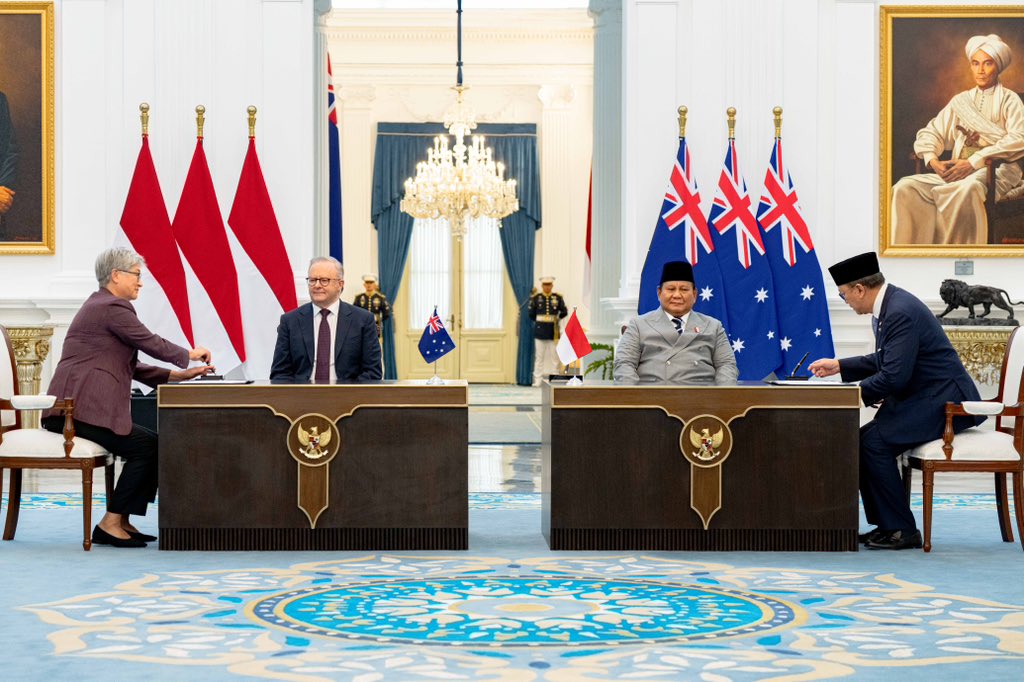
Image: from Senator Penny Wong X@SenatorWong
By Open Chronicle Staff
JAKARTA — In a move described as a “watershed moment” for the Indo-Pacific, Australia and Indonesia have formally entered into a historic treaty-level defense agreement, signaling the deepest level of security cooperation in the history of the two neighbors.
The pact, finalized during a high-profile visit to Jakarta by Australian Prime Minister Anthony Albanese, represents a significant upgrade in bilateral relations. Negotiated throughout late 2024 and ratified under the leadership of Indonesian President Prabowo Subianto, the treaty moves beyond simple cooperation into a binding legal framework that allows the two nations’ militaries to operate from each other’s soil.
Beyond Diplomacy: A Binding Commitment
While the two nations have shared security ties for decades, most notably via the 2006 Lombok Treaty, this new agreement is the first to be elevated to a full treaty status that specifically targets military interoperability.
“This is the most significant defense agreement in the history of our two countries,” Prime Minister Albanese stated during the signing ceremony at the Presidential Palace. “It is a vital plank for our mutual security and a testament to the deep strategic trust that now defines our partnership.”
President Prabowo, who had previously championed the accord during his tenure as Defense Minister, echoed these sentiments, emphasizing that the deal reflects a “shared destiny” determined by geography and mutual respect for sovereignty.
Building stronger ties with our neighbours makes us all safer. 🇦🇺🇮🇩
Today, President Prabowo and I signed a historic Treaty on Common Security, taking Australia–Indonesia defence and security cooperation to a new level.
And a new economic agreement will boost trade, investment… pic.twitter.com/OezVAmwLpr
— Anthony Albanese (@AlboMP) February 6, 2026
Key Provisions and Regional Impact
The treaty provides a framework for:
-
Joint Operations: Streamlined logistics and legal protections to allow the Australian Defence Force (ADF) and the Indonesian National Armed Forces (TNI) to operate within each other’s territories for joint exercises and humanitarian missions.
-
Maritime Security: Enhanced cooperation in the South China Sea and the shared maritime boundaries to combat illegal fishing, piracy, and people smuggling.
-
Intelligence and Counter-Terrorism: Deeper sharing of strategic information to mitigate regional threats.
-
Technical Cooperation: A commitment to joint research in defense science and technology.
Navigating a Complex Landscape
The agreement comes at a time of heightened tension in the Indo-Pacific, as both nations navigate the growing influence of China. For Australia, the treaty secures a partnership with its most populous neighbor, a critical gatekeeper of the region’s sea lanes. For Indonesia, the pact bolsters its defense capabilities while maintaining its long-standing “non-aligned” foreign policy.
Analysts suggest the treaty is a strategic masterstroke, allowing Indonesia to modernize its military infrastructure through Australian partnership without formally joining a Western-led military alliance.
“Indonesia has historically been reluctant to enter into extensive military arrangements,” said one regional expert. “The fact that this pact is treaty-level indicates a profound shift in how Jakarta views its security environment.”
A Shared Future
Beyond the hardware and drills, the agreement sets the stage for annual ministerial-level consultations, ensuring that security remains at the forefront of the bilateral agenda. As the two nations look toward 2040, when Indonesia is projected to become one of the world’s largest economies, this security bedrock is seen as essential for the economic prosperity of the entire region.
With the ink now dry, the focus shifts to implementation. Both governments have expressed a desire to move quickly, with the first of a series of “complex” joint exercises expected to commence within the year.