
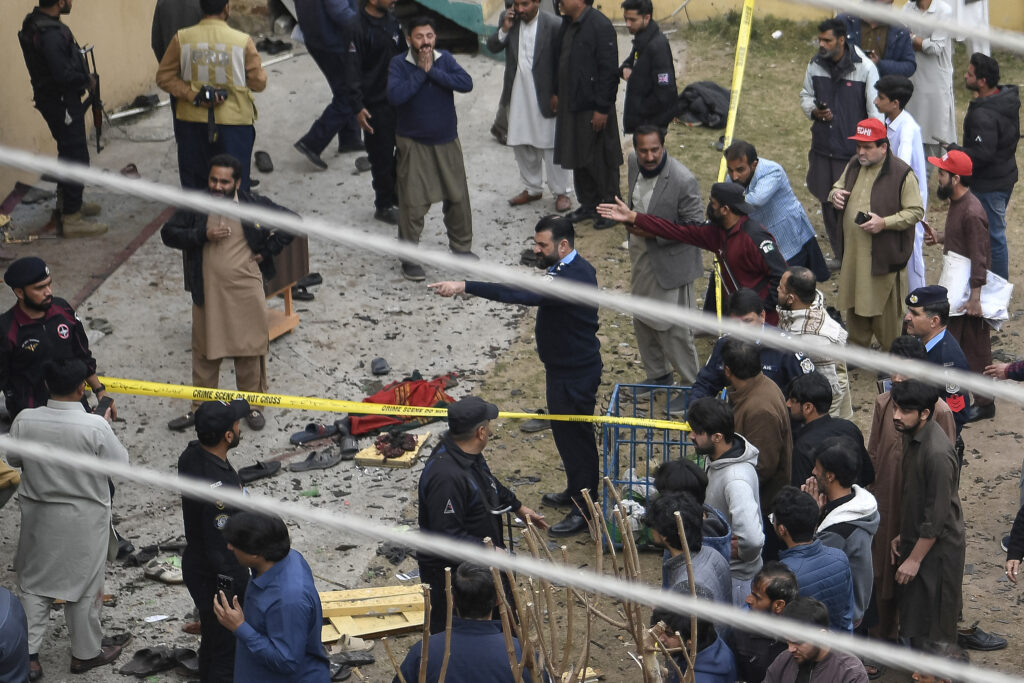
Image: from Muslim X@Muslim
By Open Chronicle Staff | February 6, 2026
ISLAMABAD — A devastating suicide bombing ripped through a Shia mosque on the outskirts of Pakistan’s capital during Friday prayers, killing at least 31 people and wounding nearly 170 others. The attack, which struck during the peak of the holy day’s congregation, marks one of the deadliest acts of sectarian violence to hit Islamabad in recent years.
The explosion occurred at the Imambargah Khadijat-ul-Kubra in the Tarlai suburb, a sprawling religious center for the city’s Shia minority. Witnesses described a scene of absolute carnage as the force of the blast shattered the mosque’s windows and sent plumes of black smoke into the afternoon sky.
#WATCH: “We ourselves lifted 25 to 30 bodies. Who will be held accountable for them?”
Survivors recount the panic and bloodshed after a blast hit a Shiite mosque in Islamabad during Friday prayers, claiming at least 31 lives and wounding 169. https://t.co/RhTjFEVPTe pic.twitter.com/5H8qz9Y4TD
— Arab News Pakistan (@arabnewspk) February 6, 2026
“Horrific Silence”
According to police and eyewitness accounts, the attacker approached the mosque’s entrance as hundreds were gathered for prayer. Security guards at the gate reportedly confronted the individual, sparking a brief exchange of gunfire. During the struggle, the bomber managed to detonate his explosive vest at the main entrance.
“I was parking my car when the blast happened. It threw me against the door,” said Zahir Hussain, a regular at the mosque. “After the sound, there was a horrific silence. Then I saw things I don’t have words to explain.”
Ambulances and private vehicles rushed the injured to the Pakistan Institute of Medical Sciences (PIMS) and other local hospitals, many of which quickly reached full capacity and declared a state of emergency.
A suicide blast in Shia mosque has killed more than 31 people in Islamabad, Pakistan. Jinnah made a country for Muslims but Muslims kill more Muslims than any other religion in Pakistan. pic.twitter.com/YQcVaY8bgs
— Ashok Swain (@ashoswai) February 6, 2026
Rising Tensions and High Alerts
While no group has formally claimed responsibility, security sources indicated the attacker is suspected to be a foreign national linked to “Fitna al-Khawarij”, a term used by the Pakistani government to refer to the banned Tehreek-e-Taliban Pakistan (TTP).
The timing of the attack is particularly sensitive. It occurred during a two-day state visit by Uzbekistan President Shavkat Mirziyoyev and follows a surge in militant activity across the country, including major clashes with Baloch separatist groups in the south just last week. The capital had already been on high alert following a suicide bombing at a district court complex nearly three months ago that killed 12 people.
National Condemnation
President Asif Ali Zardari and Prime Minister Shehbaz Sharif issued stern condemnations, labeling the attack a “crime against humanity.” Prime Minister Sharif has ordered a high-level investigation into the security lapse, vowing that those responsible will be “identified and punished.”
“The nation stands united against this cowardice,” said Interior Minister Mohsin Naqvi. “Targeting a house of worship is a direct attack on our social fabric.”
As investigators sift through the debris of the Tarlai mosque, the residents of Islamabad are left grappling with a renewed sense of vulnerability in a city once considered a relatively haven from the country’s broader regional conflicts.