
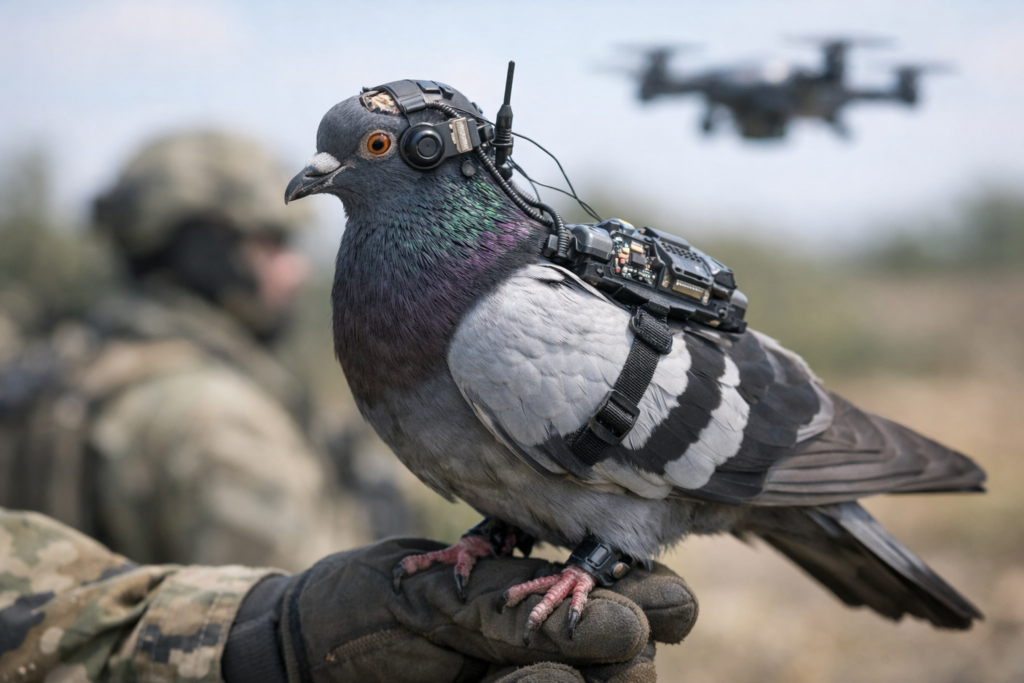
Image Credentials: Image Title: Avian Cyborgs: Russia Tests Neural-Linked ‘Biodrones’ Amid Growing Military Fears Source: (sora.openai) Date: January 2026. Attribution: This image was created using AI-generated imagery (sora.openai) and does not depict a real-world scene.
By Open Chronicle Staff | February 6, 2026
MOSCOW — In a development that blurs the line between science fiction and modern warfare, a Russian neurotechnology startup has begun field-testing “cyborg pigeons”, live birds equipped with brain implants and neural interfaces that allow them to be remotely steered like mechanical drones.
The project, code-named “PJN-1” and led by the Moscow-based firm Neiry, has successfully demonstrated that a flock of pigeons can be navigated from a laboratory into the wild and back using GPS-guided neural stimulation. While the company insists the technology is intended for civilian infrastructure monitoring and search-and-rescue missions, international security experts are sounding the alarm over its potential as a covert weapon of war.
🔴 Russian scientists are developing cyborg pigeon drones that could be used for covert surveillance or warfare pic.twitter.com/e4RRti6rzX
— The Telegraph (@Telegraph) February 5, 2026
The “Willing” Drone
Unlike traditional animal training, which relies on behavioral conditioning, Neiry’s technology uses electrodes surgically implanted into specific regions of the pigeon’s brain. These electrodes are connected to a “backpack” containing a stimulator, a flight controller, and solar panels.
According to Neiry CEO Alexander Panov, the device does not force movement; rather, it sends electrical impulses that influence the bird’s own “desires.” By stimulating certain neural pathways, the operator can make the bird “want” to turn left or right.
“There is no training required,” the company stated in a recent press release. “Any animal becomes remotely controllable after the operation.”
The birds are also outfitted with chest-mounted cameras. To address privacy concerns, the company claims to use artificial intelligence to blur faces in real-time—a feature critics find cold comfort given the technology’s inherent stealth.
Surpassing the Mechanical
The push for biological drones stems from the limitations of current hardware. Traditional quadcopters are loud, have limited battery life, and are easily detected by radar. A pigeon, however, can travel up to 300 miles a day, blend into urban environments, and navigate through narrow spaces where a mechanical drone might crash.
Panov indicated that pigeons are only the beginning. The company has plans to expand the interface to other species: ravens for carrying heavier payloads, seagulls for coastal surveillance, and albatrosses for long-range maritime monitoring.
Military Alarms and Ethics
The timing of the tests has raised eyebrows in Western defense circles. James Giordano, a scientific advisor to the U.S. Department of Defense, warned that such “biodrones” could serve as discreet delivery systems for biochemical agents or high-resolution surveillance tools capable of infiltrating enemy lines undetected.
Furthermore, investigative reports have linked Neiry’s funding to individuals close to the Kremlin and research institutes associated with Katerina Tikhonova, the daughter of President Vladimir Putin. While Neiry denies direct government involvement, the strategic value of the technology in the context of the ongoing conflict in Ukraine has led many to view it as an extension of Russia’s growing arsenal of “animal-based” weaponry, which already reportedly includes trained dolphins at naval bases.
Ethicists have also condemned the project. Nita Farahany, a bioethicist at Duke University, described the practice as “repugnant,” arguing that turning sentient beings into remotely controlled commodities crosses a fundamental moral boundary.
As the “PJN-1” project moves toward industrial deployment, the sight of a pigeon in the sky may soon carry a new, more unsettling significance.