
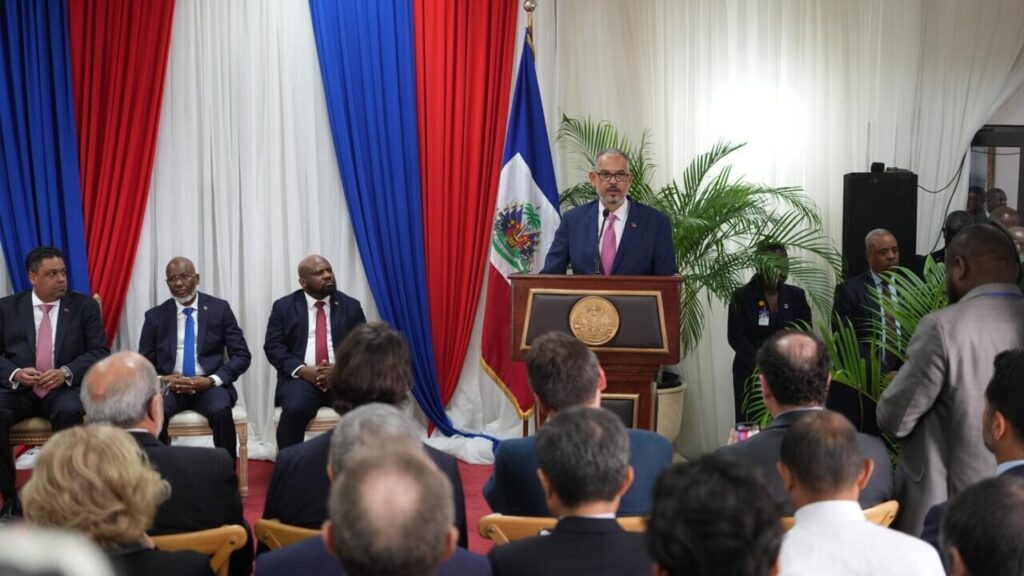
Image: from FRANCE 24 X@FRANCE24
By Open Chronicle Staff with Agencies | Saturday, February 7, 2026
PORT-AU-PRINCE — In a pivotal move for the future of the Caribbean nation, Haiti’s Transitional Presidential Council (CPT) officially dissolved on Saturday, handing over full executive authority to Prime Minister Alix Didier Fils-Aimé. The transition marks the end of a turbulent two-year period for the unelected council, which had struggled to address the country’s escalating gang violence and internal political fractures.
The handover ceremony took place at the Villa d’Accueil in the capital, coinciding with the historic February 7 date, the traditional day for Haitian presidential inaugurations. With the CPT now disbanded, Fils-Aimé and his Council of Ministers will govern as the country prepares for its first general elections in a decade, currently slated for later this year.
Haiti’s presidential council stepped down on Saturday after almost two years of tumultuous rule alongside a U.S.-backed prime minister, who is expected to remain in power as the country prepares for the first general elections in a decade.
For more: https://t.co/MLh89ILFAX pic.twitter.com/GvjUoOOwn5
— CNC3TV (@CNC3TV) February 7, 2026
Survival of the Prime Minister
Fils-Aimé’s consolidation of power comes just two weeks after a dramatic attempt by the CPT to oust him. In late January, a majority of the council members voted to dismiss the Prime Minister, a move that was immediately met with fierce opposition from the United States.
The U.S. State Department, spearheaded by Secretary of State Marco Rubio, characterized the removal attempt as “unlawful” and warned that those seeking to undermine stability would face a “steep cost.” In the days following the dispute, the U.S. revoked the visas of several council members and a cabinet official, a show of force that ultimately saw the council’s plan to replace Fils-Aimé collapse.
U.S. Military Presence in Port-au-Prince
To reinforce stability during the transition, the U.S. government recently deployed three naval vessels, the USS Stockdale, the USCGC Stone, and the USCGC Diligence, to the Bay of Port-au-Prince. The Pentagon stated the deployment is part of an operation to combat drug trafficking and ensure a “safer and more prosperous Haiti.”
However, the presence of foreign warships has been met with mixed reactions. While some see it as a necessary deterrent against gangs like the Viv Ansanm coalition—which controls nearly 90% of the capital—others view it as foreign interference in Haiti’s internal affairs.
The Challenges Ahead
Prime Minister Fils-Aimé now faces the daunting task of stabilizing a nation where the UN estimates over 4,000 people were killed by gang violence in 2025 alone. His administration is tasked with two primary pillars: restoring public security and organizing credible elections by August 2026.
“The presidential council has done its work by paving the way for governance mindful of security and electoral issues,” Fils-Aimé stated briefly during the handover. He is expected to address the nation later this evening to detail his government’s roadmap for the coming months.