
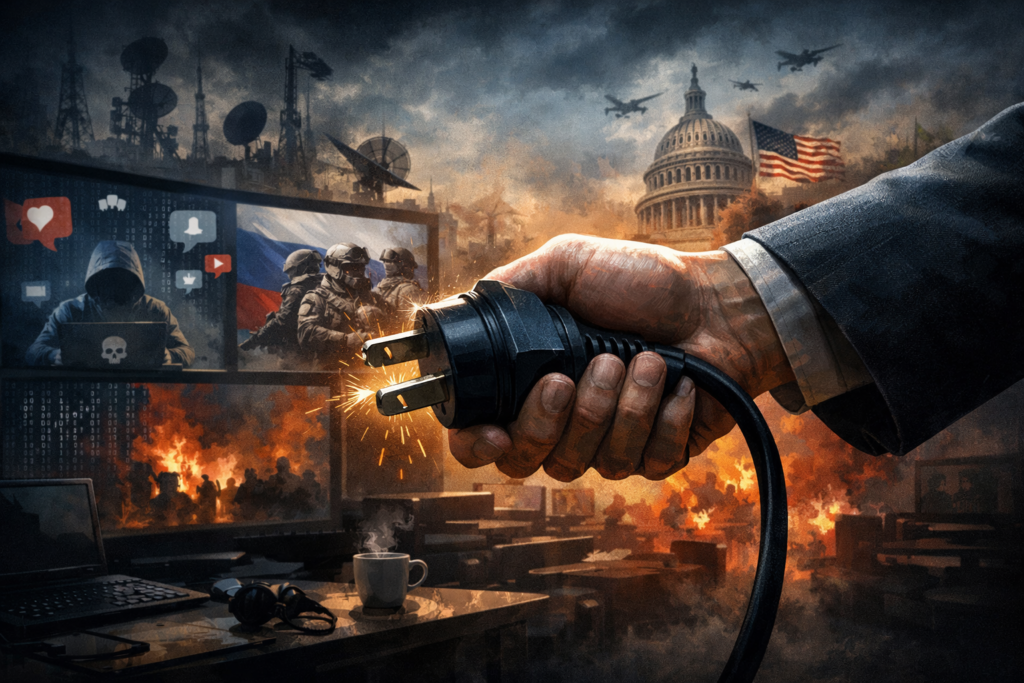
Image Credentials: Image Title: Information Warfare and the Temptation to Pull the Plug Source: (sora.openai) Date: January 2026. Attribution: This image was created using AI-generated imagery (sora.openai) and does not depict a real-world scene.
OPEN CHRONICLE | The Strategic Ledger of Global Security
By Elliot Hayes* | February 13, 2026
There is a quiet weapon that more governments are reaching for when confronted with unrest, dissent, or cultural anxiety. It is not a missile, nor a police force, nor even a propaganda campaign. It is a switch.
When the Taliban rulers of Afghanistan shut down the national internet, they justified the move as a moral safeguard. Citizens, they argued, were accessing material deemed inappropriate under their interpretation of Islamic law. The decision was drastic, but it was not unique. Across India, Iran, Iraq, Senegal, and Syria, internet shutdowns have become a recurring tool of governance. Sometimes they are targeted at specific platforms such as X or Facebook. Sometimes they are regional. Occasionally, as in Iran during periods of nationwide protest, they are total.
What we are witnessing is not merely censorship. It is the weaponisation of connectivity itself.
Modern regimes understand that the internet is not just a communications platform. It is an amplifier. It multiplies criticism, organizes protest, and exposes uncomfortable truths. In authoritarian systems, where legitimacy often rests on controlling narratives, that amplification can feel existential.
Iran’s total shutdown during nationwide unrest was a defensive manoeuvre. By severing access, authorities aimed to fragment coordination among demonstrators and isolate them from global attention. Without video uploads, live streams, or encrypted messaging, protest movements lose momentum and visibility.
Russia offers perhaps the clearest case study of what might be called the internet paradox. On the one hand, online discourse has complicated the Kremlin’s war effort in Ukraine. Information about battlefield losses, mobilisation pressures, and internal dissent spread rapidly despite legal prohibitions against criticising the war. News of soldiers allegedly being executed for refusing to fight, described in grim language as being zeroed out, travelled faster than official denials. Families learned alternative versions of events through online channels that the state could not fully seal.
This digital transparency made mobilisation harder. Millions of military-age Russians reportedly left the country. Attempts to prosecute online critics proved counterproductive. Courts could not keep up. Suppression generated more attention, not less.
On the other hand, the same internet that spreads dissent is indispensable to Russia’s economy, logistics, and military coordination. Financial transactions, rail networks, energy systems, and global trade all rely on cross-border connectivity. Turning off the internet to silence critics risks paralysing the very machinery that sustains state power.
Hence, the experiment with a Sovereign Internet, a domestically controlled network capable of disconnecting from the global web. The idea is strategic insulation. In theory, Russia could isolate its digital ecosystem in moments of crisis, allowing only state-approved services to function. In practice, tests revealed technical complications. Large-scale communication systems, including those tied to national infrastructure, require at least partial integration with international networks. A prolonged digital secession would disrupt economic flows and damage competitiveness.
The same tension exists in China’s more mature model of digital sovereignty and in Iran’s ongoing efforts to build a parallel infrastructure. The objective is not total isolation at all times, but selective insulation when politically necessary.
The geography of internet shutdowns is telling. They occur most frequently in the Middle East, Africa, and South Asia, regions where political systems often confront volatile social pressures and demographic change. Russia stands out as the principal European state moving decisively toward systemic restriction.
Yet the underlying impulse is not confined to one culture or ideology. It is structural. Governments increasingly view information as a domain of warfare. Control over digital space becomes synonymous with control over stability.
Early internet pioneers warned that open networks would threaten totalitarian governance. They predicted that regimes would eventually attempt to reclaim authority over digital flows. That moment has arrived.
There is an irony at the heart of these efforts. The internet is both destabilising and stabilising. It exposes corruption and failure, but it also enables commerce, innovation, education, and military efficiency. It accelerates protest, but it also enables emergency response and economic growth.
Shutting it down can buy time. It can fragment opposition and reduce international scrutiny. But it also signals insecurity. It reveals that a regime lacks confidence in its ability to persuade rather than silence.
Moreover, shutdowns erode trust. Citizens learn that access to information is contingent, fragile, and politically manipulated. Businesses face uncertainty. Investors hesitate. Skilled workers emigrate. The short-term gain in narrative control may translate into long-term institutional weakness.
The internet paradox remains unresolved. It is too troublesome for many governments to tolerate in its open form, yet too vital to abandon. As more states experiment with sovereign or semi-sovereign networks, the global web risks fragmenting into controlled digital blocs.
Information warfare is no longer about hacking servers or spreading disinformation alone. It is about deciding who gets to connect at all.
The question facing the world is whether the future internet will remain a shared global commons or become a patchwork of gated national intranets, activated and deactivated at the discretion of political power. The answer will shape not only the flow of information but the balance between authority and freedom in the digital age.
The Grand Strategy Institute
Continue Exploring Strategic Analysis
Return to The Grand Strategy Institute for strategic assessments, long-form analysis and research examining geopolitics, military affairs, international security, emerging technologies and the changing international order.
← Back to The Grand Strategy Institute