
Image: Verteidigungsministerium X @BMVg_Bundeswehr
By José Carlos Palma*
For decades, Europe lived comfortably under the American security umbrella. Procurement decisions reflected that reality. When serious capability gaps appeared, Washington could usually fill them. When crises erupted, American logistics, intelligence, and industrial scale carried the alliance.
That era is ending.
The war in Ukraine was not only a brutal land conflict on Europe’s eastern flank. It was a strategic shock. European NATO members were forced to confront a hard truth. Russia is not a distant problem, and the United States is increasingly focused on China and the Pacific. The result is a gradual but unmistakable shift toward building a more autonomous European defense industry.
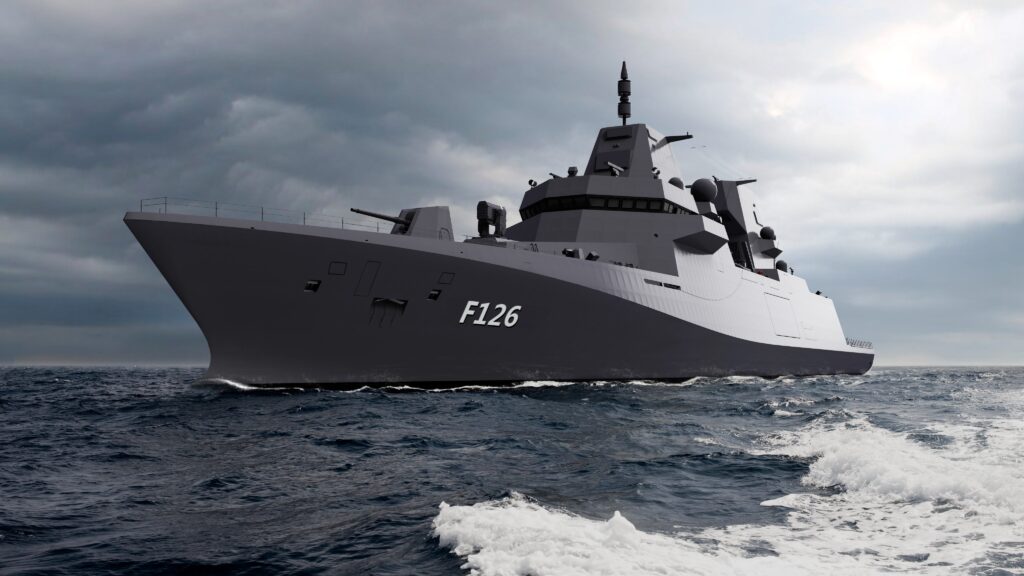
Germany’s F126 frigate program is a symbol of this transition. These 10,000-ton warships, the largest to serve in the German navy since the Second World War, represent more than naval modernization. They embody a broader rethinking of responsibility. Each vessel carries advanced radars, sonar, vertical launch systems capable of hosting up to 64 anti-aircraft missiles, Naval Strike Missiles, layered close-in defenses, and aviation facilities for helicopters and unmanned systems. Designed for long deployments with relatively small crews supported by automation, the F126 is built for sustained presence rather than port-bound caution.
Yet the road to capability has not been smooth. The earlier F125 class, led by the Baden Württemberg, stumbled badly during sea trials. Software failures, command system bugs, sensor problems, and even a noticeable list forced the Navy to reject the first ship. It was embarrassing. It was also necessary. Accepting flawed systems for political convenience would have eroded credibility far more deeply.
In a sense, the F125 episode was a growing pain. Europe is rediscovering what it means to rely on its own industrial base for high-end, software-intensive, networked warships. Modern naval vessels are floating data centers as much as they are steel hulls. Command and control systems, automated damage control, integrated sensors, and satellite links are complex ecosystems. Bugs are not cosmetic flaws. They are combat risks.
If Europe wants strategic autonomy, it must also accept the friction of rebuilding industrial depth and technological integration.
The Ukrainian example reinforces this lesson. In the early months of the invasion, domestic production sustained Ukrainian forces. Russia targeted those facilities with missiles and air strikes, forcing Kyiv to rely heavily on imports from the United States and NATO. Industrial vulnerability became a battlefield reality.
History offers an even sharper warning. After the collapse of the Soviet Union, Russia found itself dependent on Ukrainian manufacturers for critical components, including helicopter engines from Motor Sich and naval facilities in Crimea. When Ukraine halted key shipments, Russian modernization slowed. After 2014, and especially after 2022, sanctions further exposed Moscow’s reliance on Western components. Substituting suppliers proved difficult. Production continued, but quality and quantity suffered.
Interdependence can be efficient in peacetime. In war, it becomes leverage.
Europe has drawn its own conclusions. Expanding domestic arms production is not merely about jobs or prestige. It is about deterrence. A credible defense posture requires secure supply chains for munitions, engines, electronics, and software. It requires the ability to surge output under pressure. It requires resilience against sanctions, cyber interference, and missile strikes.
At the same time, there is a danger in swinging too far toward fragmentation. A European defense industry that duplicates efforts across multiple national lines risks inefficiency and spiraling costs. True autonomy does not mean every country builds everything. It means Europe collectively ensures that essential capabilities cannot be switched off by external shocks.
The broader geopolitical context makes this urgency unavoidable. The United States is recalibrating toward the Indo-Pacific. China is expanding its military and industrial capacity. Russia, despite sanctions and battlefield losses, retains significant military potential. In this environment, Europe cannot assume that American capacity will always be concentrated on European security.
The F126 frigate sliding down the ways in a German shipyard is therefore more than a naval milestone. It is a statement. Europe is beginning to accept that security is not outsourced indefinitely. It must be manufactured, tested, debugged, and deployed at home.
Strategic autonomy is expensive. It is technically demanding. It comes with public setbacks and political controversy. But the alternative is dependency in a world where supply chains are weapons and industrial capacity is power.
Europe’s arsenal is awakening. The question is whether it can coordinate its industrial revival quickly enough to match the scale of the threats it now recognizes as real.
The Grand Strategy Institute
Continue Exploring Strategic Analysis
Return to The Grand Strategy Institute for strategic assessments, long-form analysis and research examining geopolitics, military affairs, international security, emerging technologies and the changing international order.
← Back to The Grand Strategy Institute