
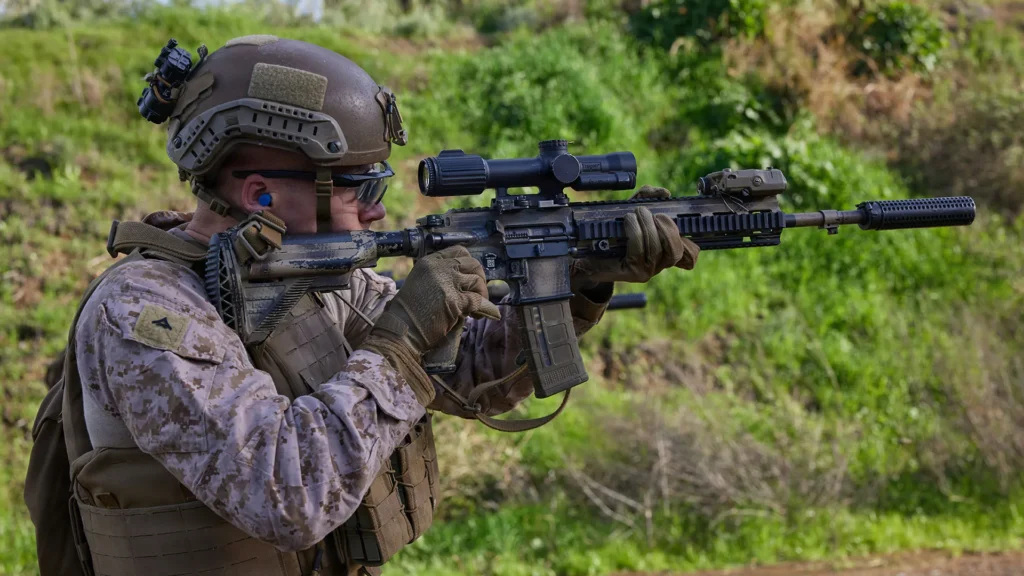
Image: A Marine fires a M27 rifle during range day with the Cyprus Special Forces at Pyrga, Cyprus, on Jan 29, 2026. Marine Corps photo by Cpl. Garrett Gillespie.
By Open Chronicle Staff | Saturday, February 21, 2026
QUANTICO, VA — The United States Marine Corps has officially declined to follow the Army’s lead in adopting the new M7 Next Generation Squad Weapon, opting instead to retain the M27 Infantry Automatic Rifle (IAR) as its primary service weapon for the foreseeable future.
The decision, confirmed by a Marine Corps spokesperson earlier this week, marks a significant divergence in small arms procurement between the two branches. While the Army is currently fielding the M7 and its 6.8mm ammunition to modernize lethality, the Marines argue that their current platform better serves the specific demands of amphibious and expeditionary warfare.
@SecWar
Why don’t you do something useful and cancel the Army’s M7 rifle, and make the Marines M27 IAR the standard rifle for both branches. It makes zero sense having each branch with different caliber rifles. Logistically nightmare. pic.twitter.com/VDU6t5UYHO— Joe Blow (@JoeBlowq6) February 13, 2026
“Unique Service Requirements”
In a statement to defense reporters, a Marine Corps spokesperson emphasized that the decision was based on operational alignment.
“The Marine Corps will retain the M27 for our close combat formations as it best aligns with our unique service requirements, amphibious doctrinal employment of weapons, and distinct modernization priorities,” the spokesperson said. “We will continue to monitor the development of the M7 to inform future requirements, but for now, the M27 remains the standard.”
The M27, a variant of the Heckler & Koch HK416, was first introduced to the Corps in 2011 to replace the M249 squad automatic weapon. Since then, its role has expanded to become the standard-issue rifle for all Marine infantrymen, praised for its reliability and precision in diverse environments.
The Weight of Controversy
The Army’s M7 rifle, and the 6.8mm cartridge it fires, was designed to overcome the limitations of the long-standing 5.56mm round, offering greater range and the ability to pierce modern body armor. However, the system has faced scrutiny regarding its weight and ammunition capacity.
During recent defense exhibitions, critics noted that the M7 is significantly heavier than the M4 or M27 platforms. Furthermore, the M7’s standard 20-round magazine reduces the “basic load” of ammunition a soldier can carry compared to the 30-round magazines of the 5.56mm systems. While the Army and manufacturer Sig Sauer have worked to lighten the rifle, reportedly shaving the weight down from 8.3 to 7.6 pounds in recent iterations, these concerns appear to have influenced the Marine Corps’ cautious approach.
The U.S. Army is facing internal criticism over the new M7 (XM7) assault rifle chambered in 6.8×51mm, which began field trials with frontline units in late 2023. pic.twitter.com/QlWNG2vbV8
— OutlawMusicCo (@FreedomNews419) May 14, 2025
Logistics and Interoperability
Beyond the physical specs of the rifle, the Marine Corps’ decision simplifies its logistics chain. By sticking with the M27, the Corps maintains commonality in ammunition (5.56mm) with many NATO allies and its own current inventory, avoiding the massive logistical undertaking of transitioning to an entirely new caliber while simultaneously restructuring under its “Force Design” initiative.
The Marines have a history of independent weapon selection. In the 1980s and 90s, the Corps famously stuck with the M16A2 rifle long after other branches had moved toward shorter carbines, citing the superior accuracy of the longer barrel for their marksman-centric doctrine.
Despite the rejection of the M7, the Marines noted they would ensure “seamless interoperability across the Joint force,” suggesting that the two branches will continue to train together effectively despite carrying different rifles into battle.