
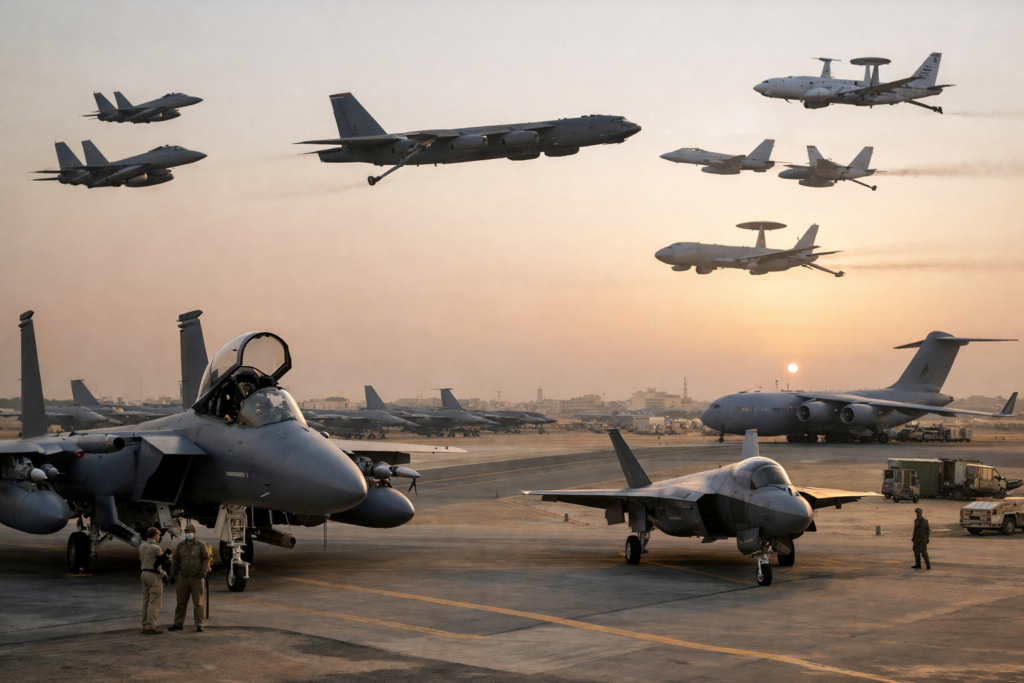
Image Credentials: Image Title: Massive U.S. Air Power Surge: Over 300 Military Aircraft Deployed to CENTCOM Amid Iran Tensions Source: (sora.openai) Date: Feb 2026. Attribution: This image was created using AI-generated imagery (sora.openai) and does not depict a real-world scene.
By Open Chronicle Staff
Tuesday, February 24, 2026
ISTANBUL — In a dramatic escalation of military readiness in the Middle East, open-source intelligence (OSINT) reports indicate that the United States has assembled a formidable air force of more than 300 military aircraft within the U.S. Central Command (CENTCOM) area of responsibility.
The buildup, tracked by analysts following the movement of dozens of jets to regional bases, comes as tensions between Washington and Tehran reach a critical flashpoint. The aircraft are primarily stationed at key hubs including Al-Udeid Air Base in Qatar, Muwaffaq Salti Air Base in Jordan, and Prince Sultan Air Base in Saudi Arabia. This aerial armada also includes carrier air wings aboard the USS Abraham Lincoln and the USS Gerald R. Ford.
A Logistics Marathon
The scale of the deployment is underscored by the logistical effort required to sustain it. Since early January, an estimated 270 flights by C-17 and C-5 heavy transport aircraft have been recorded, ferrying equipment, personnel, and advanced missile defense systems, including Patriot and Terminal High Altitude Area Defense (THAAD) batteries.
Supporting this strike force is a massive “gas station in the sky,” consisting of approximately 75 KC-46 and KC-135 strategic tankers currently deployed or en route to the region to ensure continuous flight operations.
Composition of the Fleet
The assembled force represents a diverse array of American “iron,” heavily weighted toward offensive capabilities:
-
Fighters: The backbone of the fleet consists of 84 F-18E/F Super Hornets, 36 F-15E Strike Eagles, 48 F-16s, and 42 F-35A/C stealth fighters.
-
Specialized Roles: The deployment includes 18 EA-18G “Growlers” for electronic warfare, 12 A-10C “Warthogs” for close air support, and a suite of AWACS and communication nodes to coordinate complex strikes.
-
The “Raptor” Factor: On Tuesday, the arrival of 12 U.S. F-22 “Raptors”, the most advanced stealth fighters in the world, further signaled a shift toward “penetrating” capabilities against sophisticated enemy air defenses.
Notably absent from recent movements are the B-2 stealth bombers, which were last utilized during Operation Midnight Hammer in June of last year.
The Israel Factor
While the U.S. buildup has captured global attention, analysts point out that Israel’s own air force effectively doubles the firepower available for potential strikes against Iran. With a fleet of over 280 combat aircraft, including nearly 50 F-35s, Israeli forces are reportedly in a high state of coordination with their American counterparts.
Military observers suggest that this level of concentration, unseen in recent years, serves a dual purpose: acting as a massive deterrent against Iranian aggression while providing the President with an immediate “kinetic option” should diplomatic efforts fail.
As the skies over the Middle East grow increasingly crowded with high-tech weaponry, the international community remains on high alert for the first signs of engagement in what has become a powder keg of global security.