
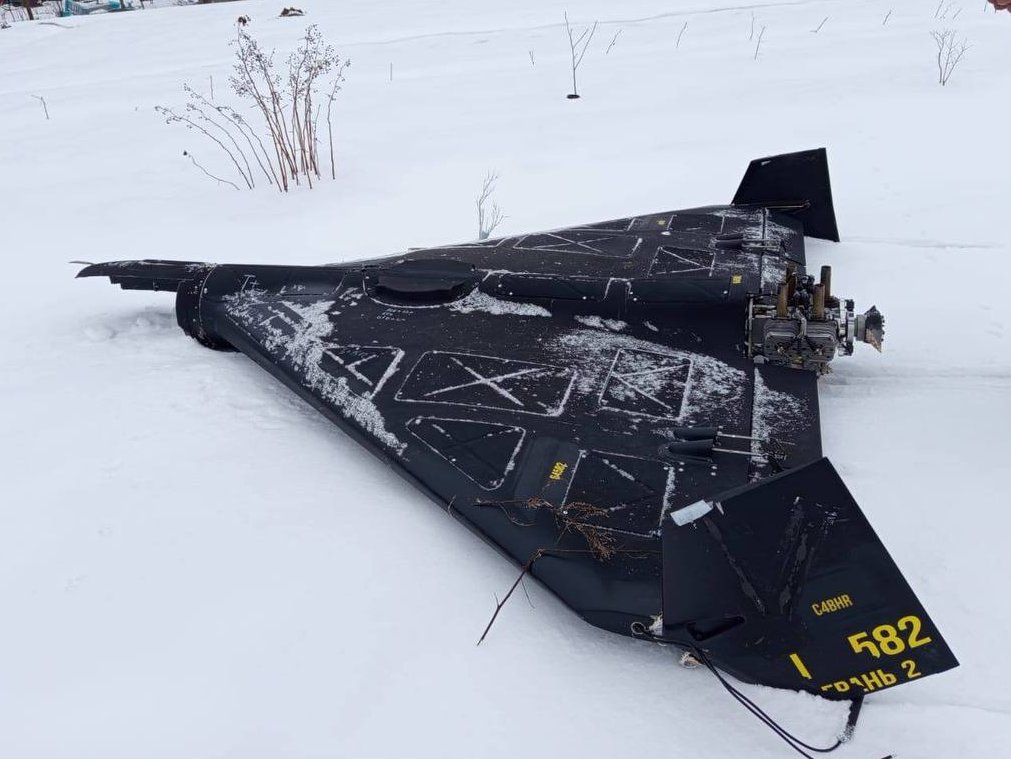
The russian Geran–2 suicide drone
Image: from Richard Woodruff X @frontlinekit
By Open Chronicle Staff
Tuesday, February 24, 2026
BRUSSELS — A chilling new report has issued a “red alert” for European security, warning that Russia’s rapidly advancing drone technology now possesses the range and sophistication to strike almost every major capital on the continent.
The report, highlighted by military analysts and security observers this week, underscores a dramatic shift in the “war of the skies.” According to data from the International Institute for Strategic Studies (IISS) and Ukrainian intelligence (HUR), Russia’s latest iterations of the Shahed-series drones, specifically the Geran-2, now boast an operational range of up to 2,500 kilometers.
A Continent Within Range
From launch sites in western Russia, occupied Crimea, and potentially Belarus, these low-cost “kamikaze” drones can reach deep into Western Europe. Experts warn that major hubs, including Berlin, Paris, Rome, and London, now sit within the potential strike zone.
“The strategic depth that Western Europe once relied upon is evaporating,” noted one security analyst. “These aren’t just weapons for the front lines in Ukraine anymore; they are tools of long-range asymmetric warfare that can bypass traditional defenses.”
Recent incidents have already signaled this growing reach. In the past months, unidentified drones have been spotted over critical infrastructure in Germany, Poland, and Romania, prompting NATO members to scramble jets and activate high-cost air defense systems to neutralize threats that cost a fraction of the intercepting missiles.
The “Portugal Exception”
While the report paints a grim picture for the continent, one European capital remains, for now, just beyond the reach of Russia’s current drone fleet. Due to its geographic position on the Atlantic coast, Lisbon, Portugal, is cited as the only EU capital currently outside the maximum 2,500km flight path of the Shahed/Geran-2 when launched from existing Russian-controlled territories.
However, experts caution that this “safety” is fragile. Should Russia deploy launch platforms from Kaliningrad or further increase the fuel capacity of its unmanned aerial vehicles (UAVs), even the Iberian Peninsula could soon be vulnerable.
Red Alert for NATO
The “red alert” serves as a wake-up call for NATO’s eastern and central flanks. The report emphasizes that Russia is currently producing an estimated 5,500 drones per month, overwhelming existing air defense stockpiles.
“We are seeing a ‘democratization’ of destruction,” the report states. “Russia is using $20,000 drones to force Europe to deplete its multimillion-dollar interceptor missiles. It is an economic and military war of attrition that Europe is not yet fully equipped to win.”
European leaders, including European Commission President Ursula von der Leyen, have characterized these developments as a “hybrid war” aimed at destabilizing the feeling of safety across the continent. In response, several nations are racing to develop “drone walls” and more cost-effective electronic warfare countermeasures to secure their airspace.
As the conflict in Ukraine enters its fifth year, the message from the latest findings is clear: the threat has moved from the trenches of the Donbas to the doorstep of the entire European project.