
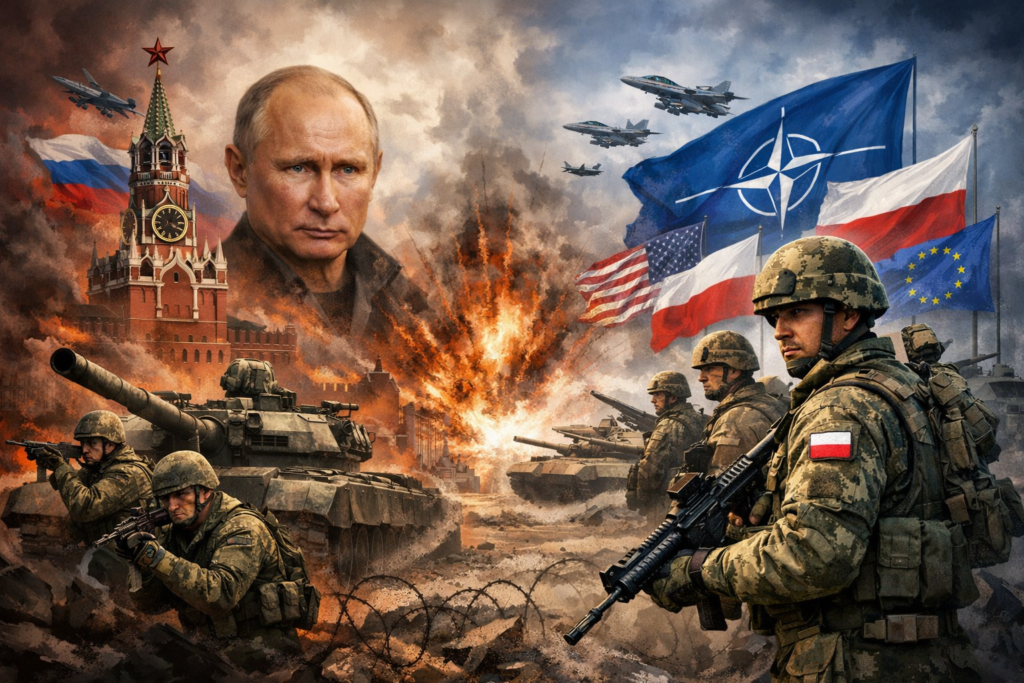
Image Credentials: Image Title: Nawrocki: Russia Sees NATO and Poland as ‘Main Enemy’ in ‘Civilizational War’ Against West Source: (sora.openai) Date: Feb 2026. Attribution: This image was created using AI-generated imagery (sora.openai) and does not depict a real-world scene.
By The Grand Strategy Institute
WARSAW — In a sobering assessment of the shifting European security landscape, Karol Nawrocki, the President of Poland’s Institute of National Remembrance, has warned that Moscow now views Poland and the NATO alliance as its primary adversaries in a “civilizational war” aimed at dismantling the Western international order.
The remarks, detailed in a recent report by the Kyiv Post, highlight the Kremlin’s intensifying hostility toward Warsaw as Poland continues to serve as the logistical and strategic backbone for Ukraine’s defense. According to Nawrocki, Russia’s ambitions have evolved beyond territorial conquest in Ukraine to a broader confrontation with the democratic values represented by NATO and the European Union.
A Global Bloc Against the West
Nawrocki cautioned that Russia is not acting in isolation. He pointed to an increasing level of cooperation between Moscow and Beijing, warning that the two powers are forming a “broader bloc of states” designed to challenge the West’s notion of international law and global stability.
“Russia sees NATO and Poland as the ‘main enemy’ in what it considers a civilizational struggle,” Nawrocki noted. “This is not just about borders; it is about the fundamental rules of how the world is governed.”
The “Polish Threat” in the Kremlin’s Eyes
Poland’s rapid military modernization and its steadfast support for Kyiv have made it a focal point of Russian state propaganda. Kremlin officials have frequently characterized Poland as a “hostile outpost” of American influence, using this narrative to justify the buildup of Russian forces in the Kaliningrad exclave and along the Belarusian border.
Security analysts suggest that Nawrocki’s warning reflects a consensus within the Polish intelligence community: that any “frozen” conflict in Ukraine would merely be a prelude to a more direct challenge against NATO’s eastern flank.
Strategic Implications
The report comes as NATO members struggle to maintain unity in the face of a grinding war of attrition in Ukraine. With Russia shifting to a permanent war economy, spending over 7% of its GDP on defense in 2025, Nawrocki argues that the West must recognize the long-term nature of the threat.
“The Kremlin is playing a long game,” the report concludes. “By framing the conflict as a civilizational war, Putin is preparing the Russian population for a decades-long standoff with the West, with Poland standing on the front line of that confrontation.”
As Poland prepares to host a significant German brigade by 2027 to bolster NATO’s regional deterrence, Nawrocki’s words serve as a stark reminder that for Moscow, the war in Ukraine is only one theater in a much larger global struggle.
The Grand Strategy Institute
Continue Exploring Strategic Analysis
Return to The Grand Strategy Institute for strategic assessments, long-form analysis and research examining geopolitics, military affairs, international security, emerging technologies and the changing international order.
← Back to The Grand Strategy Institute