
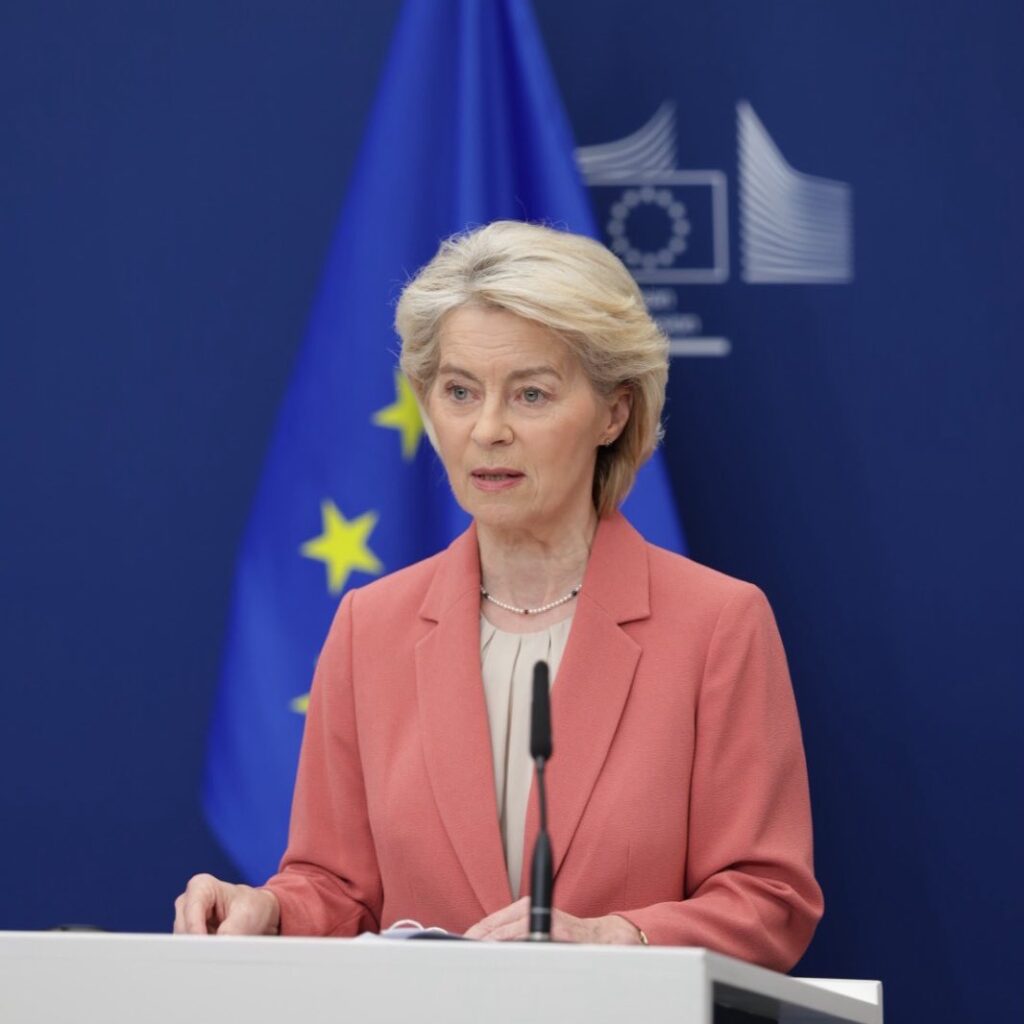
Image: from Ursula von der Leyen X @vonderleyen
BRUSSELS — In a decisive move to salvage one of the world’s most significant commercial alliances, the European Commission announced Friday that it will provisionally activate its long-delayed trade agreement with Mercosur. The decision follows successful national ratifications in Argentina and Uruguay, marking a critical turning point in a negotiation process spanning twenty-five years.
European Commission President Ursula von der Leyen confirmed the move during a press conference, signaling that the commercial portion of the pact with the South American bloc, comprising Argentina, Brazil, Paraguay, and Uruguay, will proceed despite mounting domestic opposition within Europe.
A Strategic Maneuver
The Commission’s decision to “provisionally apply” the deal is a calculated legal maneuver. It allows Brussels to bypass a significant legislative blockage orchestrated in January by a coalition of far-left and far-right factions, alongside a majority of French representatives. These groups had successfully referred the pact to the European Court of Justice (ECJ) to investigate its compliance with EU treaties.
While the judicial review and final European Parliament approval could take between 18 to 24 months, this provisional status allows for the immediate reduction of trade barriers.
“It is very good news because it shows the trust and enthusiasm of our partners to deepen our relationship and launch this historic agreement,” von der Leyen stated.
Economic Impact at a Glance
The agreement aims to create the world’s largest free trade area by population and economic output.
| Sector | Impact |
| Tariffs | Elimination of duties on over 90% of trade between the two blocs. |
| EU Exports | Improved market access for automobiles, textiles, and machinery. |
| Mercosur Exports | Significant gains for South American agricultural and mineral sectors. |
| SMEs | Billions in tariff savings for small and medium-sized enterprises. |
Geopolitical Necessity
The sudden urgency in Brussels is largely attributed to an increasingly volatile global trade environment. President von der Leyen explicitly framed the deal as a “strategic” necessity, referencing the instability caused by the tariff policies of U.S. President Donald Trump.
This instability was exacerbated by a recent U.S. Supreme Court ruling that struck down certain emergency-power tariffs, casting doubt on the legal foundation of the EU-U.S. trade accord signed last July. With the European Parliament delaying its review of the American deal, the EU has pivoted toward the Southern Hemisphere to secure its supply chains and market interests.
Regional Momentum
While Uruguay and Argentina have finalized their processes, with Uruguayan Foreign Minister Mario Lubetkin hailing the ratification as “extraordinary”, the rest of the bloc is moving quickly to follow suit:
-
Brazil: The lower house has approved the text; the Senate is expected to vote within days.
-
Paraguay: The text has been submitted to Congress for immediate review.
By activating the pact now, the European Commission is betting that the economic benefits will outweigh the political friction at home, positioning the EU as a leader in rules-based trade during an era of increasing protectionism.