
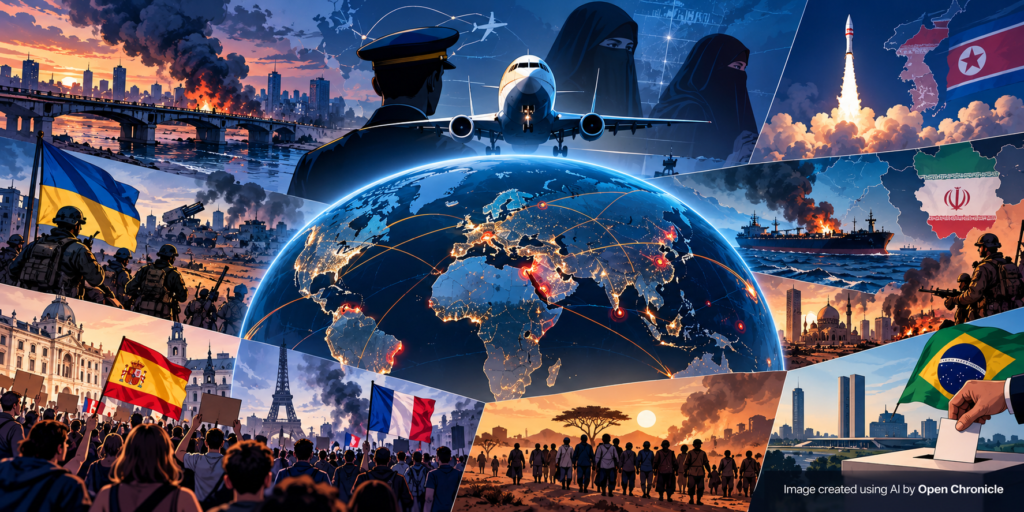
Russia intensifies attacks on Kyiv, North Korea launches another ballistic missile, fighting spreads across Yemen and Sudan, tensions rise between India and Pakistan, and renewed pressure on global energy supplies adds another layer of instability to an increasingly crowded international news cycle.
By Open Chronicle with agencies
The international agenda is being dominated by a convergence of military escalation, political instability, energy disruption and social unrest, with developments stretching from Ukraine and the Middle East to Africa, Asia, Europe and Latin America.
Russia has continued attacking critical infrastructure in Kyiv, while Moldova has reported further violations of its airspace. North Korea has conducted another missile launch. Fighting is intensifying in Yemen and parts of Sudan and Ethiopia. India and Pakistan are exchanging accusations following another deadly border incident.
At the same time, the continuing Iran conflict is affecting shipping and energy markets, Europe is confronting protests and security concerns, and several countries are entering politically sensitive electoral periods.
Here are some of the major developments shaping the global news cycle.
Russia Intensifies Pressure on Kyiv
Russia has continued targeting bridges and infrastructure around the Ukrainian capital, with multiple reports indicating that major crossings over the Dnipro have been struck during consecutive days of attacks.
The campaign appears increasingly focused on disrupting transport and logistics around Kyiv.
Ukrainian forces have meanwhile continued striking Russian military infrastructure, including a reported attack against a major drone launch facility.
The conflict is also spilling further beyond Ukraine’s borders.
Moldovan authorities reported that several Russian aerial weapons entered Moldovan airspace, with debris and explosions reported in multiple locations.
The incidents add to concerns among countries bordering Ukraine about the possibility of further cross border consequences from the war.
Russia and NATO Exchange New Warnings
Tensions between Moscow and NATO members also remain elevated.
Russian officials have issued warnings concerning Kaliningrad and the possibility of attacks against Russian territory, while European governments continue strengthening their military capabilities.
France has reportedly begun practical training for Ukrainian pilots connected with Rafale fighter aircraft, while Japan is considering discussions over potentially providing Patriot missiles to Ukraine.
Poland has also placed FA 50 aircraft into combat duty.
The developments underline how the Ukraine war continues to reshape military planning well beyond the immediate battlefield.
North Korea Conducts Another Missile Launch
North Korea has launched another ballistic missile towards waters east of the Korean Peninsula, according to South Korean and Japanese authorities.
The launch follows reports concerning a North Korean cruise missile test incorporating artificial intelligence technology.
Regional tensions have also been affected by disputes surrounding incidents along the Korean border, including mine related tensions.
North Korea’s continuing weapons development remains a significant security concern for South Korea, Japan and the United States.
Yemen Enters Another Dangerous Phase
Yemen is experiencing one of its most serious periods of escalation in recent weeks.
Loud explosions were reported in Sanaa amid claims by the Houthis that Saudi air strikes had targeted the Yemeni capital and telecommunications infrastructure.
Yemeni government forces separately said they had conducted dozens of operations against Houthi positions in the southwest of the country.
Reports also indicated increasing displacement as fighting expands.
The deterioration is occurring against the wider backdrop of the Iran conflict and instability affecting Red Sea shipping, creating the possibility that several previously distinct regional confrontations could become increasingly interconnected.
Shipping Under Pressure Near the Strait of Hormuz
Maritime security remains another major concern.
Five Indian nationals were rescued after a Kuwait flagged tanker was reportedly struck by a projectile near the Strait of Hormuz.
Other reports indicated that two oil tankers had been hit by unidentified projectiles in or near the strategic waterway.
The incidents come as Iran’s use of the Strait of Hormuz remains central to its confrontation with the United States and to negotiations over the wider war.
The strait remains one of the world’s most strategically important energy corridors, meaning disruption there has consequences extending far beyond the Middle East.
Emergency Oil Reserves Enter the Energy Crisis
Governments are increasingly turning to strategic reserves as energy disruption affects global markets.
The International Energy Agency said 325 million barrels of emergency oil had been released, according to reports included in the latest news cycle.
G7 governments have also been discussing or implementing releases of oil and diesel stocks as pressure grows over fuel availability and prices.
The measures demonstrate how the effects of conflict are increasingly moving from military theatres into the wider global economy.
Energy security is consequently becoming inseparable from the geopolitical crises affecting Iran, the Gulf and Russia.
Sudan Fighting Claims More Civilian Lives
Sudan’s conflict continues to produce heavy civilian casualties.
A medical group said an attack attributed to the Rapid Support Forces killed more than 25 civilians in North Kordofan.
Separate reports described drone attacks against civilian sites in Blue Nile state and continuing fighting elsewhere.
The humanitarian consequences remain severe as military operations spread across different regions of the country.
Sudan’s instability is also increasingly being viewed alongside developments in Ethiopia, the Red Sea and Yemen as part of a broader pattern of insecurity across northeastern Africa and the surrounding maritime region.
Ethiopian Forces Advance in Tigray
Government allied forces in Ethiopia have claimed the capture of a strategically important airport in Tigray.
Other reports indicated that Tigrayan forces were withdrawing as pro government troops advanced towards Mekelle.
The developments raise questions about the future control of the regional capital and the possibility of another major change in the balance of power inside Tigray.
Regional diplomacy is also intensifying.
Egypt is expected to host a summit involving Eritrea, Somalia and Sudan amid wider tensions involving Ethiopia.
Nile Dispute Remains a Regional Flashpoint
Relations between Egypt and Ethiopia remain strained over the Nile and the Grand Ethiopian Renaissance Dam.
Egyptian President Abdel Fattah el Sisi has rejected the use of Nile waters for political leverage and called for peaceful solutions to African conflicts.
Cairo has also denied involvement in Ethiopia’s internal conflict.
The competing statements illustrate how security tensions in the Horn of Africa are intersecting with the longstanding dispute over water, regional influence and the future management of the Nile.
India and Pakistan Face New Border Tensions
Pakistan has summoned an Indian diplomat following the reported killing of two Pakistani civilians near the border.
Islamabad has accused Indian border forces of responsibility.
India and Pakistan are also exchanging diplomatic arguments at the United Nations, with New Delhi reiterating that Jammu and Kashmir and Ladakh are integral parts of India.
The latest incidents come amid persistent tensions between the nuclear armed neighbours and renewed security pressures affecting Pakistan’s border regions.
Flydubai Cockpit Attack Raises Aviation Security Questions
A dramatic incident aboard a Flydubai aircraft has become another major international security story.
Authorities in the United Arab Emirates have described an alleged attack by a co pilot against the aircraft’s captain as an attempted terrorist act.
Reports said the captain was attacked with a cockpit crash axe during the flight.
The captain reportedly retained control of the aircraft despite the confrontation.
The incident has prompted wider questions about cockpit security and personnel screening, particularly after reports emerged concerning alleged extremist views attributed to the accused co pilot.
Those claims remain part of the developing investigation and should be distinguished from findings formally established by authorities.
Australia Investigates Car Attack on Rugby Crowd
Ten people were injured after a vehicle drove into a crowd of rugby supporters in Australia.
The incident occurred north of Sydney, according to reports in the supplied material.
Police arrested the driver.
Authorities are investigating the circumstances surrounding the crash.
Spain’s Housing Crisis Brings Protesters Into the Streets
Housing protests are spreading across Spain after parliament rejected measures intended to provide greater protection for tenants.
Demonstrations have taken place in Madrid and numerous other cities, with protesters demanding government action over housing availability and affordability.
Spain has simultaneously been dealing with severe weather, including heavy rainfall, flooding and significant damage in some areas.
The housing demonstrations represent another sign of how affordability pressures are becoming an increasingly important political issue across parts of Europe.
French Student Protests Expand
France is experiencing another major protest movement, this time involving students.
More than 1,700 people were reported arrested as demonstrations continued, while hundreds of schools were affected.
Students have raised concerns including deteriorating school buildings and teacher shortages.
Some demonstrations have involved clashes with riot police, fires and tear gas.
The scale of the unrest is turning what began as education related protests into a wider challenge for French authorities.
Latvia Votes Under the Shadow of Russia
Latvians have gone to the polls in a parliamentary election taking place against a backdrop of heightened concern about Russia and hybrid security threats.
The Ukraine war and questions surrounding Baltic security have featured prominently in the political environment surrounding the vote.
Latvia, like its Baltic neighbours, has strengthened its security posture as relations between Russia and NATO have deteriorated.
The election therefore carries both domestic and wider European significance.
China Opens Trade Investigation Before EU Talks
China has opened an anti dumping investigation into European imports of a chemical compound used in products including dyes and pesticides.
The move comes shortly before planned discussions between China and the European Union.
Trade tensions between Beijing and Brussels have increasingly expanded across industrial sectors as both sides examine subsidies, market access and competition.
The investigation adds another issue to an already complicated economic relationship.
US and China Continue to Navigate Strategic Differences
Despite recent high level engagement between Washington and Beijing, significant differences remain between the world’s two largest economies.
Security, technology, industrial policy and regional military competition continue to shape the relationship.
Reports that the United States plans to deploy the NMESIS anti ship system on a Japanese island close to Taiwan for the first time illustrate the growing military dimension of American strategy in the Indo Pacific.
Technology remains another major area of confrontation, particularly around artificial intelligence and advanced computing.
Brazil Approaches a Crucial Election
Brazil is approaching its 2026 presidential election amid heightened domestic and international attention.
Security concerns have led the United States and Australia to suspend some consular services ahead of the vote, according to reports in the supplied material.
The election is unfolding amid debates over Brazil’s political direction, relations with Washington and the country’s wider international role.
Political tensions surrounding the vote are likely to remain an important part of the international agenda.
Iran Conflict Continues to Reshape Global Security
Underlying many of the day’s developments is the continuing conflict involving Iran.
The United States is increasing military pressure while diplomatic efforts remain unresolved. Washington is also tightening sanctions and working with international partners to restrict weapons and financial flows connected to Tehran.
The conflict is simultaneously affecting Iraq, Yemen, Saudi Arabia, shipping through the Strait of Hormuz and global energy markets.
Reports that senior members of the Trump administration held discussions at Camp David concerning Iran and Yemen underline the importance Washington is placing on the rapidly evolving regional situation.
A Global News Cycle Defined by Connected Crises
The latest developments reveal an international environment in which crises increasingly overlap.
The Russia Ukraine war is affecting NATO strategy, Moldova and European defense planning.
The Iran conflict is influencing Yemen, Iraq, Gulf shipping and global energy prices.
Instability in Ethiopia and Sudan is interacting with Red Sea security and disputes over the Nile.
Competition between the United States and China continues across technology, trade and the Indo Pacific military balance.
At the same time, housing protests, student unrest, elections and domestic political disputes demonstrate that instability is not limited to traditional conflict zones.
The result is a global news cycle increasingly defined not simply by the number of crises, but by the connections developing between them.