
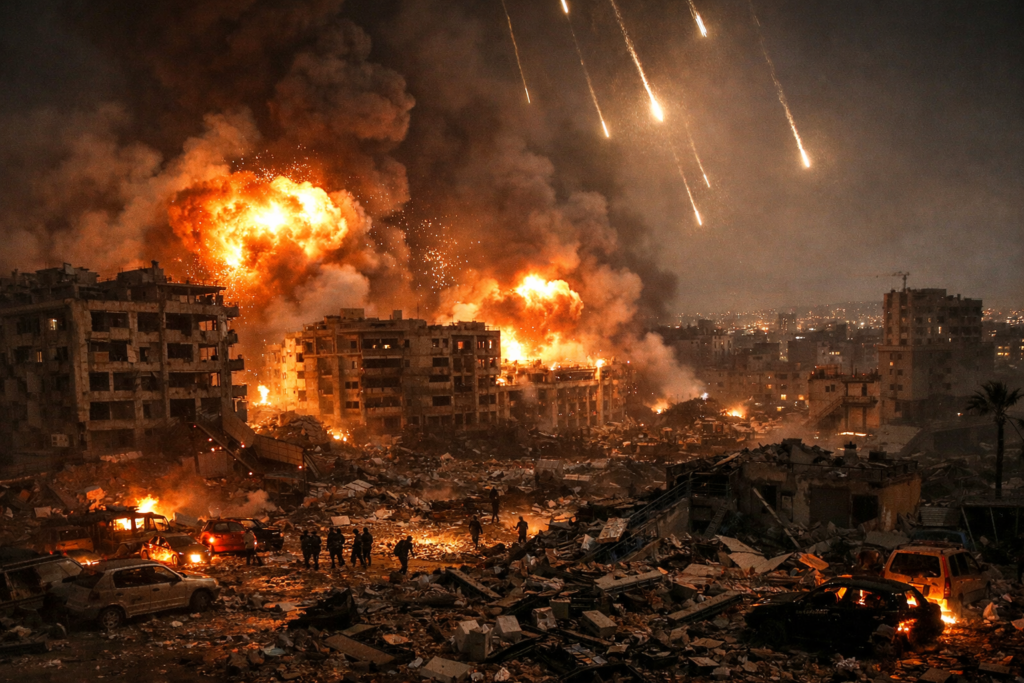
Image Credentials: Image Title: Conflict Escalates: Beirut Targeted, Civilian Toll Mounts, and Global Markets Shaken on Day 3 By Open Chronicle Staff Source: (sora.openai) Date: Mar 2026. Attribution: This image was created using AI-generated imagery (sora.openai) and does not depict a real-world scene.
By Open Chronicle Staff with Agencies
Monday, March 2, 2026
BEIRUT/TEHRAN — The Middle East has plunged into a deepening humanitarian and economic crisis on the third day of a widening conflict. Israeli airstrikes have intensified across Lebanon, while a mounting civilian death toll in Iran and the first confirmed American combat fatalities have sent shockwaves through global capitals and financial markets.
Lebanon Under Fire
Beirut’s southern suburbs, specifically the Hezbollah stronghold of Dahiyeh, were rocked by heavy explosions early Monday. The Israeli military confirmed it is targeting Hezbollah positions in retaliation for a barrage of missiles and drones launched toward Haifa.
The human cost is staggering. Hundreds of thousands of people are currently in flight as the Israeli army issued evacuation warnings for over 100 towns and villages across southern and eastern Lebanon. The mass displacement has turned major highways into gridlocked corridors of desperation, coinciding poignantly with the start of Ramadan as families abandoned pre-dawn meals to seek safety.
Horror in Minab and Tehran
In southern Iran, officials reported the deadliest single incident of “Operation Epic Fury” to date: a missile strike on a girls’ school in Minab that reportedly killed 180 children. Strikes also hit Gandhi Hospital in Tehran and destroyed the home of former president Mahmoud Ahmadinejad; his current status remains unconfirmed.
The White House confirmed the first American fatalities of the campaign, reporting three service members killed and five wounded. Despite the losses, President Donald Trump maintained a defiant posture, asserting that 48 Iranian leaders have been neutralized and that operations will continue until “U.S. objectives are met.”
Regional Contagion
The conflict’s reach now extends well beyond the primary combatants:
-
Cyprus: RAF Akrotiri was targeted by a drone strike following Prime Minister Keir Starmer’s decision to allow U.S. forces to use British bases.
-
Iraq & Bahrain: Explosions were reported near a U.S. base outside Baghdad, and at least one person was killed during retaliatory strikes in Bahrain.
-
Aviation: Airspace closures across the Middle East have paralyzed global transit hubs, leaving hundreds of thousands of travelers stranded between Europe, Africa, and Asia.
Market Shock and Domestic Unrest
The economic fallout was immediate. Brent crude surged 13% in early trading, briefly hitting a 14-month high amid fears that the Strait of Hormuz is effectively closed. Asian markets, including the Nikkei and Hang Seng, tumbled as investors braced for a protracted war.
In the United States, the strikes have polarized the public. While 27% of Americans support the operation that killed Iran’s Supreme Leader, a Reuters/Ipsos poll suggests roughly half the country believes the administration is too quick to use military force. Anti-war protests have broken out in Times Square and outside the White House, as the world waits to see if the conflict can be contained or if it will ignite a total regional conflagration.