
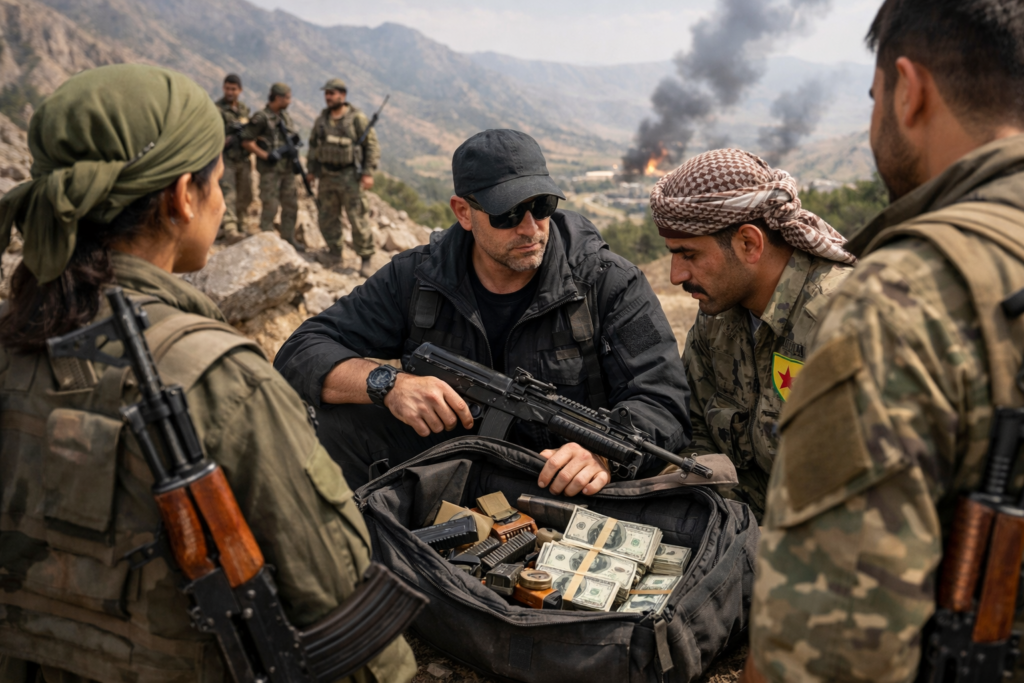
Image Credentials: Image Title: CIA Developing Plan to Arm Kurdish Forces for Iranian Uprising Source: (sora.openai) Date: March 2026. Attribution: This image was created using AI-generated imagery (sora.openai) and does not depict a real-world scene.
By Open Chronicle Staff |Wednesday, March 4, 2026
WASHINGTON and ERBIL, Iraq — The CIA is drafting a clandestine plan to provide military-grade weaponry to Kurdish forces with the explicit goal of triggering a popular uprising against the Iranian regime, sources familiar with the discussions told CNN.
The Trump administration has reportedly entered active negotiations with Iranian opposition groups and Kurdish leaders in Iraq to facilitate military support. The strategy aims to leverage thousands of armed Kurdish fighters currently positioned along the Iraq-Iran border to destabilize Tehran’s internal security as Operation Epic Fury enters its fifth day.
A ‘Grand Opportunity’ for Regime Change
President Donald Trump reportedly held a high-stakes telephone call on Tuesday with Mustafa Hijri, leader of the Democratic Party of Iranian Kurdistan (KDPI). Kurdish officials suggest that opposition forces are preparing for a ground incursion into western Iran within days.
“We believe we have a great opportunity now,” a senior Kurdish official stated, noting that the militias are expecting significant logistical and tactical support from both the United States and Israel.
The strategic goal, according to U.S. officials, is twofold:
-
Internal Displacement: Armed Kurdish units would engage Iranian security forces, pinning them down and creating “safe corridors” for unarmed civilians in major cities to protest without facing immediate massacre.
-
Buffer Zones: In the north, Kurdish forces could seize and hold territory, establishing a “buffer zone” to protect regional interests and further disperse the Iranian military’s resources.
Risks of ‘Mission Creep’ and Betrayal
The plan has met with sharp internal criticism from former diplomats and security analysts. Jen Gavito, a former State Department official under the Biden administration, warned that arming unaccountable militias could undermine Iraqi sovereignty and ignite a regional “powderkeg” with no clear exit strategy.
Furthermore, the history of U.S.-Kurdish relations is fraught with tension. Kurdish forces have frequently accused Washington of abandonment, most notably during the first Trump administration when U.S. troops withdrew from northern Syria, leaving Kurdish allies exposed.
“There is a fear that if an uprising fails and the U.S. withdraws, it reinforces the narrative of abandoning the Kurds,” said Alex Plitsas, a national security analyst.
Preparing the Ground
Evidence of the plan’s early stages is already visible on the battlefield. Sources indicate that the Israeli military has spent the last 48 hours striking Iranian police and military outposts along the Iraqi border. These strikes are reportedly intended to clear a path for the influx of armed Kurdish fighters into northwestern Iran.
While the CIA has declined to comment officially, the agency reportedly maintains an outpost in the Iraqi Kurdistan region, near the Iranian border, to coordinate intelligence. However, U.S. intelligence assessments remain cautious, suggesting that Kurdish groups are currently too divided by ideology and internal rivalries to sustain a successful national revolution without “substantial” and long-term Western intervention.