
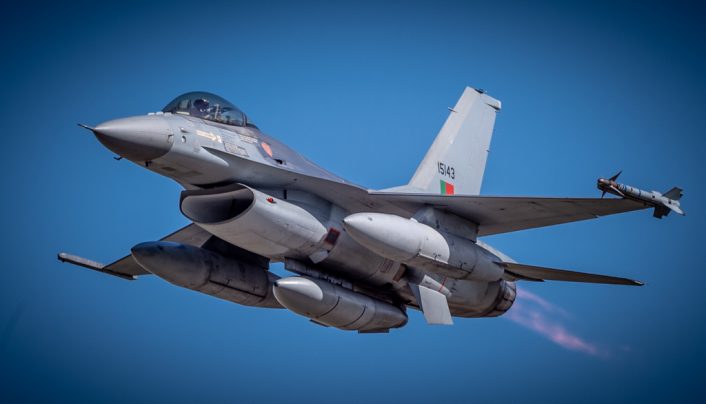
Image: from José Correia Guedes X @cpt340
By Open Chronicle Staff | Wednesday, March 4, 2026
LISBON — As the fourth day of Operation Epic Fury sees Iranian missiles testing allied defenses across the Persian Gulf, a sobering analysis by CNN Portugal has highlighted a critical vulnerability closer to home: Portugal’s nearly non-existent long-range air defense architecture.
Military experts warn that while the nation is geographically distant from the primary theater of war, its role as a strategic hub for U.S. forces, specifically through the Lajes Base in the Azorescould place it in the crosshairs of asymmetric or long-range threats for which it is currently unprepared.
“Short-Range Only”
Current assessments of the Portuguese Armed Forces reveal that the country relies almost exclusively on Very Short-Range Air Defense (VSHORAD) systems. These are designed to protect ground troops or specific high-value assets from low-altitude threats like helicopters and drones, but they offer zero protection against the types of ballistic missiles currently being fired by Tehran.
Portugal’s current inventory primarily consists of:
-
Stinger Missiles: Man-portable systems used by the Army for visual-range targets.
-
ForceShield System: A recently acquired Thales system including RapidRanger vehicles equipped with StarStreak missiles, designed to neutralize low-altitude fighter attacks and UAS.
-
F-16 Fighters: While capable of air-to-air interception, they lack the integrated missile-shield support found in other NATO nations.
“We have no defense possible against long-range or medium-range missiles. Zero,” stated Major-General Agostinho Costa. “Our capability is effectively null for this new paradigm of missile warfare.”
The Lajes Factor
The vulnerability has become a political flashpoint following reports of U.S. activity at the Lajes Base. Foreign Minister Paulo Rangel moved to reassure the public on Monday, stating that while the base is available for “necessary and proportional” defensive actions, no military assets involved in the initial strikes on Iran departed from Portuguese soil.
However, the Portuguese Communist Party (PCP) has already condemned the government’s “subservience,” arguing that the use of Lajes turns the Azores into a “permanent aircraft carrier” and a legitimate military target for retaliatory strikes.
A Multi-Billion Euro Pivot
In response to these gaps, the Portuguese government has signaled an “emergency” acceleration of its Military Programming Law. A secret €5.8 billion investment is reportedly underway to modernize the nation’s “missile shield.”
-
F-35 Transition: The Air Force has declared the purchase of Lockheed Martin F-35A Lightning II jets as the “only option” to replace aging F-16s.
-
Integrated Defense: New contracts are being fast-tracked for medium-range radar and missile batteries to protect “sensitive points” such as the undersea internet cables that land on the Iberian Peninsula.
As diesel prices in Portugal begin to climb and the threat of a “secondary price spiral” looms over the Spring budget, the lack of a robust air defense system has transitioned from a theoretical military concern to a central issue of national sovereignty.