
Image:
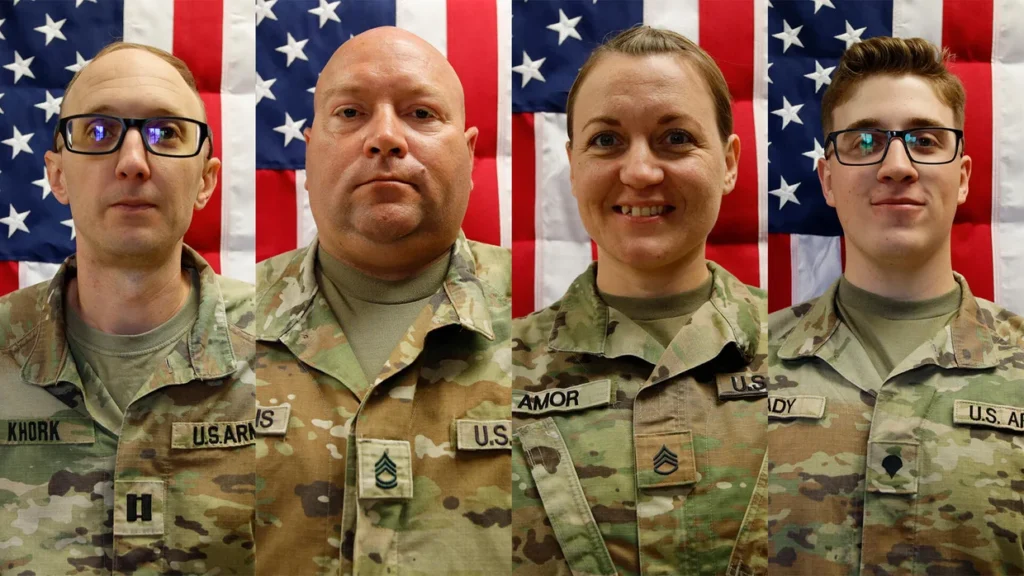
WASHINGTON D.C. — The Department of Defense has officially released the names of four U.S. Army Reserve soldiers killed during an Iranian unmanned aircraft system (UAS) attack in Kuwait. These deaths mark the first American combat fatalities in the rapidly escalating conflict with Iran, officially designated by the Pentagon as Operation Epic Fury.
The soldiers, all assigned to the 103rd Sustainment Command based in Des Moines, Iowa, were killed Sunday when a precision munition struck a tactical operations center at Port Shuaiba.
The Fallen Soldiers
The Pentagon identified the deceased as:
-
Capt. Cody A. Khork, 35, of Winter Haven, Florida
-
Sgt. 1st Class Noah L. Tietjens, 42, of Bellevue, Nebraska
-
Sgt. 1st Class Nicole M. Amor, 39, of White Bear Lake, Minnesota
-
Sgt. Declan J. Coady, 20, of West Des Moines, Iowa
Two additional service members were killed in the same strike; however, their identities are being withheld pending the notification of their next of kin.
A Growing Toll in Kuwait
The strike on the Port Shuaiba facility initially reported three deaths, but the toll rose as one service member succumbed to injuries on Monday and the remains of two previously unaccounted-for soldiers were recovered from the rubble.
Defense Secretary Pete Hegseth described the fallen as “the absolute best of America,” vowing that the mission would proceed in a manner that honors their sacrifice. Meanwhile, the number of seriously wounded service members has decreased from 18 to 10 as medical teams stabilize those injured in the initial retaliatory volleys.
“That’s the Way It Is”: Trump Warns of More Casualties
In a somber video message, President Trump offered condolences to the families of the “Cactus Nation” soldiers but maintained a blunt stance on the human cost of the war.
“We pray for the full recovery of the wounded… and sadly, there will likely be more before it ends,” the President said. “That’s the way it is. Combat operations will continue until all of our objectives are achieved.”
The President characterized the joint U.S.-Israeli operation—which began Saturday with a massive strike on Tehran that killed Supreme Leader Ayatollah Ali Khamenei—as the “last best chance” to eliminate Iran’s nuclear and ballistic missile capabilities. The administration currently estimates the campaign will last between four and five weeks.
Regional Retaliation
Following the decapitation strike on the Iranian leadership, the Iranian military launched a series of retaliatory strikes across the Middle East, targeting U.S. assets and allied nations. The strike in Kuwait represents the most lethal of these responses to date, highlighting the vulnerability of logistics hubs even outside the primary combat zone in Iran.
Maj. Gen. Todd Erskine, commanding general of the 79th Theater Sustainment Command, stated that the incident remains under investigation as the military assesses how the UAS bypassed local air defenses.