
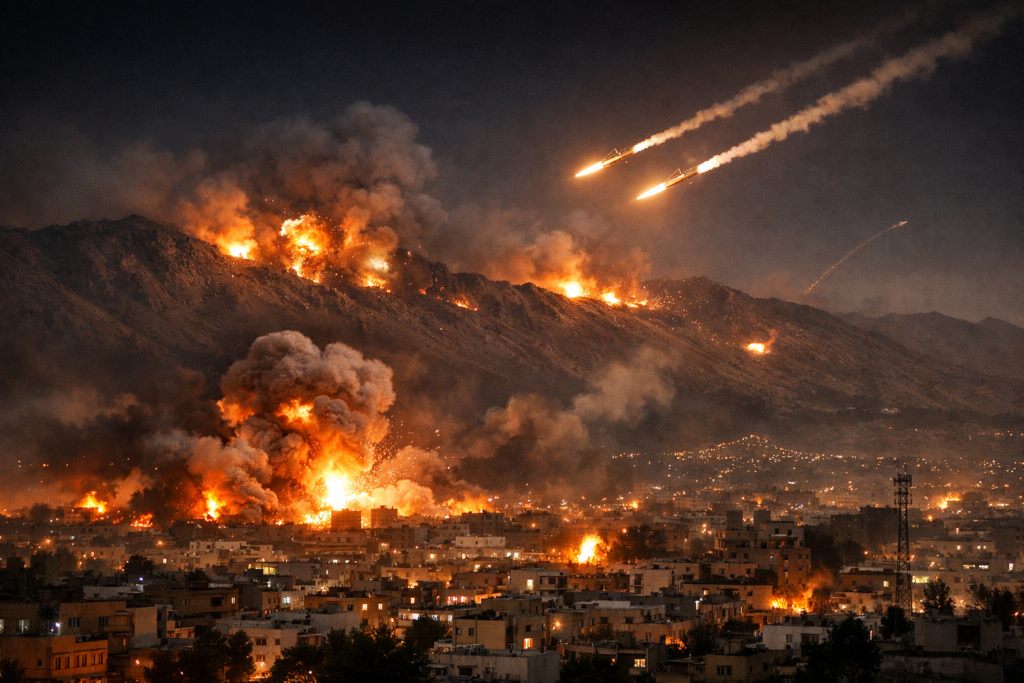
Image Credentials: Image Title: Tehran Strikes Kurdish Bases in Iraq as “Second Front” Looms Source: (sora.openai) Date: March 2026. Attribution: This image was created using AI-generated imagery (sora.openai) and does not depict a real-world scene.
By Open Chronicle Staff | March 5, 2026
ERBIL, Iraq — Iranian forces have intensified their military campaign against Kurdish strongholds in northern Iraq, launching ballistic missiles and drone strikes on headquarters belonging to exiled opposition groups. The escalation comes amid growing intelligence that the Trump administration is actively coordinating with these groups to open a ground offensive in northwest Iran.
Iranian state media confirmed the military targeted “groups opposed to the revolution” with a volley of three missiles. The strikes mark a significant expansion of Tehran’s efforts to neutralize domestic threats while simultaneously defending against the U.S.-Israeli air campaign.
Earlier, Clarissa Ward from CNN spoke with a senior official of the Kurdish Regional Government in Erbil, Iraq, who said they are "really scared" of possible retaliatory strikes from Tehran if their territory is used as a launchpad for a potential ground offensive into western… pic.twitter.com/8QZ8zTEpdZ
— Sprinter Press (@SprinterPress) March 4, 2026
On the Ground: Rubble and Resolve
The BBC has confirmed that at least one Peshmerga fighter was killed and three others injured during strikes on Wednesday. At one base, a ballistic missile impact gouged a massive crater into the earth, reducing a primary building to a skeleton of twisted metal and pulverized concrete.
Further south, at a base belonging to the Democratic Party of Iranian Kurdistan (KDPI), the aftermath of a “double-tap” drone strike on Tuesday left one civilian injured. Despite the barrage, the mood among the Kurdish fighters remains defiant.
“We are closer than ever,” said Hassan, a 25-year-old fighter armed with an AK-47. “I am eager to go to Iran to fight for our freedom.”
The “Trump Connection”
Speculation is reaching a fever pitch regarding Washington’s role in mobilizing the Kurdish resistance. While KDPI leaders refused to comment on reports that President Trump has held direct talks with their leadership in recent days, they signaled that a move across the border is imminent.
“The Kurds will be fighting in Iran soon,” a senior political leader told the BBC, though he declined to provide a specific tactical timeline.
U.S. officials have previously hinted that Kurdish-Iranian groups could serve as the “boots on the ground” necessary to destabilize the IRGC’s control in the northwest, a region where the Kurdish minority, roughly 10% of Iran’s population, has long complained of systemic repression and cultural erasure.
A People Without a State
The Kurds, the fourth-largest ethnic group in the Middle East, remain a nation without a permanent state, their population of 25 to 35 million split between five countries. In Iran, the predominantly Sunni Kurdish population has suffered what Amnesty International describes as “deep-rooted discrimination,” with their political and economic aspirations frequently met with state violence.
As Tehran continues to strike across its borders into Iraqi sovereign territory, the risk of a wider regional conflagration grows. For the Peshmerga in the mountains of Erbil, these strikes are not a deterrent, but a catalyst for a long-awaited homecoming.