
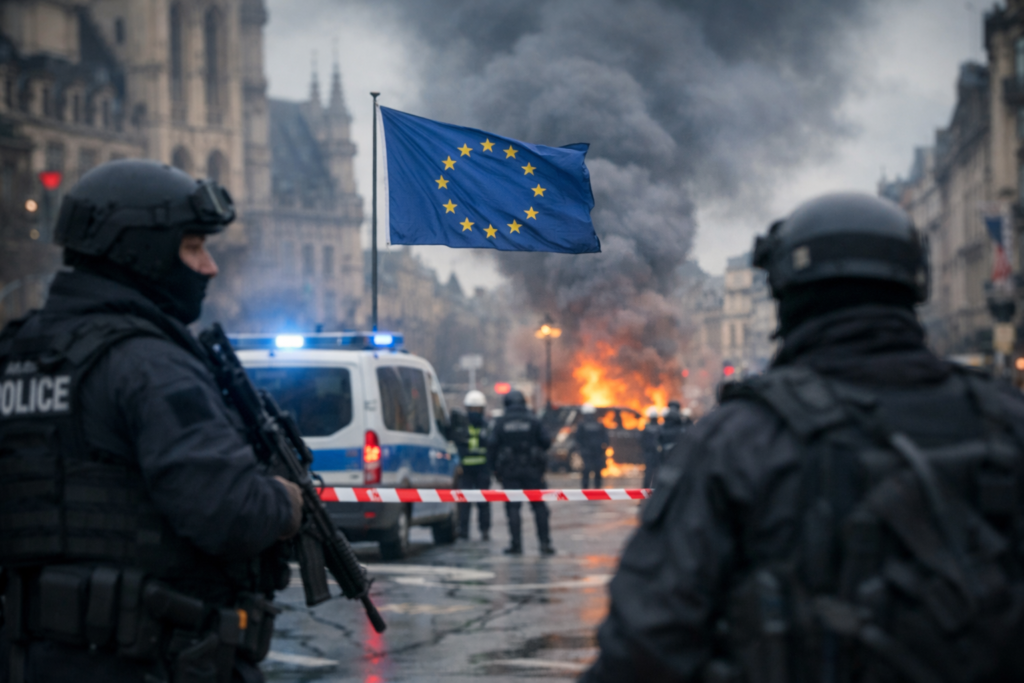
Image Credentials: Image Title: Europol Issues “High” Terror Alert for EU as Middle East Conflict Spills Over Source: (sora.openai) Date: March 2026. Attribution: This image was created using AI-generated imagery (sora.openai) and does not depict a real-world scene.
By Open Chronicle Staff with Agencies
THE HAGUE — The European Union’s police agency, Europol, has officially raised the terror threat level across the bloc to “high,” citing the immediate and volatile repercussions of the ongoing war in the Middle East. In a sobering assessment shared Friday, officials warned that the conflict is catalyzing homegrown radicalization and complex hybrid threats.
“Lone Actors” and Self-Organized Cells
According to a spokesperson for the agency, the primary concern for European law enforcement is no longer just large-scale coordinated strikes, but the rise of “lone-actor” attacks. These individuals, often radicalized rapidly through polarized online content, are difficult to track and can strike with little to no warning.
“The level of threat from terrorism and violent extremism on EU territory is considered high,” the spokesperson stated. “This may manifest through homegrown radicalization by isolated individuals or small, self-organized cells.”
The “Proxy” Threat: Iran’s Shadow in Europe
Perhaps most concerning is Europol’s explicit warning regarding the “Axis of Resistance”, the network of Iranian-aligned groups, including Hezbollah, Hamas, and the Houthis.
Authorities are monitoring two distinct fronts:
-
Direct Destabilization: The potential for these groups to engage in retaliatory activities on European soil.
-
Criminal Convergence: The use of existing criminal networks that operate under the direction or influence of Iranian security institutions to carry out intimidations, financing, or targeted attacks.
Cyber Warfare and Disinformation
Beyond physical violence, the EU is bracing for a surge in malicious cyber activity. Europol warns that critical infrastructure, government agencies, and businesses are at an elevated risk of state-sponsored hacks and “hacktivist” disruptions.
“The rapid online dissemination of polarizing content can accelerate radicalization processes in the short term,” the agency noted, highlighting how digital disinformation is being used to fuel civil unrest within diaspora communities.
Strengthening the Shield
In response to these burgeoning threats, the European Commission and Europol have announced plans to accelerate the implementation of new security protocols. This includes the 2026 activation of the Schengen Information System (SIS) “Information Alert,” designed to facilitate real-time sharing of biometric and biographic data on terror suspects across all member states.
As the conflict in the Middle East enters what U.S. and Israeli officials call a “new phase,” Europol is urging citizens to remain vigilant and for national governments to prioritize the protection of public spaces and critical digital networks.